Thoughts on Cultural Appropriation

I’ve been meaning to post on this subject for some time, but haven’t been able to find the right words.  I am not sure it’s something that I have any definite answer for so I hope it generates some discussion.  Some people say it’s just something made up by the left, like privilege.  I find such people who say things like that are the most guilty of cultural ignorance and what privilege actually means.  However one of the ways the topic seems to continue to come up is in terms of things like dreadlocks, or Halloween costumes.  Most of the times the topic comes up these don’t seem like really clear cases of cultural appropriation, but I try to listen and think about it more deeply because it is important.  Most recently I was listening to a podcast interview with Nicholas Christakis who is a physician and sociologist who, along with his wife, was at the center of a cultural appropriation issue at Yale.  I’ll get back to him in a second.

As someone who is half Indian (not native, but from India Indian) my life experience has been very different when it comes to cultural emulation.  Indians generally see it as a form of flattery.  Whether we have been visiting their country or whether in Canada.  There is a real sense in the community that we are valued when white Canadians want to eat our food, dance our dances, or dress in our clothing.  Growing up there was nothing more exciting than seeing a white person who could eat a spicy curry and then get up in Indian garb a kick ass on the dance floor doing the bhangra.  My dad was always someone who wanted to learn about other cultures.  We would often go out for dinner to different ethnic restaurants and he would order foods he’d never tried and he would always ask the waiter or waitress what the usual way the food was eating.  He wanted to use chopsticks or fingers where applicable.  For my dad experiencing the culture wasn’t just trying the food but eating it in a way they did.  For my dad, part of understanding culture was living it as much as you could, even if it was only in small ways.  The warmth he received by people of those other cultures for his honest interest and attempts to do as they did always inspired me to have the same attitude in my life.

A recent cultural appropriation incident in the NBA. Lin wears dreads.
A gracious response from Lin. Noting Martin has Mandarin characters as a tattoo.

I have noticed in my time in the U.S. the sentiment being different and it has become more heated in recent years.  Now of course it should make perfect sense.  Some readers might already be saying, well the history of Indians in Canada is different than African-Americans in the U.S.  There is no doubt about it.  Cultural appropriation is a real thing and I think Nicholas Christakis did a good job of defining it in the podcast.

“The notion of cultural appropriation, the kernel of the idea there, is that some communities of people are so denigrated that not only are they killed and wiped out, but all of their ideas and culture is stolen from them, they are effaced and that all that’s left is a kind of caricature of who they are and there is some truth to that …it’s like adding insult to injury…[like] not only do I engage in genocide,  but I take all your ideas and your culture as well and don’t even credit you and who am I to do that?”

There is no question that this has been done to native peoples in North America, and that this has been done to African-Americans here in the U.S.  Anybody who doubts the existence of cultural appropriation is blind to some real history.  However, if we are interested in making the world a better place, we still have to answer the question about the best way to move forward.  When I see someone genuinely interested in my culture to the point of wanting to emulate it, I don’t see a thief, I see an ally.  They might not be able to experience the lived experience of being someone of my race, but I see someone willing to defend my rightful place as an equal human in society.  Christakis that things have maybe gone too far:

“…now, the whole history of ideas, culture, art, and music is endless theft.  [because really] it’s endless modification, and transformation and exchange of ideas and of thought and musical and artistic forms and so forth”

I find myself agreeing here.  I mean we could get really ridiculous if we wanted to.  Someone could refer to African-Americans behaving badly as thugs, and this is offensive, because we know what the common usage of that word means, but then if I yelled out…”No that’s not offensive to black people, that’s offensive to me because the word is of Hindu origin and your appropriating my culture!”  As Christakis says to trace back practices and ideas back to one particular culture is tricky business indeed.  Culture has been stolen before, it’s been given, it’s been modified, it’s been incorporated, it’s been fused.  It’s complicated.  How do we right all of the wrongs and still move past it?  I guess we are struggling to answer that question as humans.

As I go back to my personal experience I think what matters most is that attitude you have towards another person’s culture.  If I’ve been discriminated against, which is a painful experience, I certainly don’t want others to experience it, but I want them to understand it.  At the same time I don’t want the best things about my culture to remain hidden, when I can share them.  If people are truly interested in my culture, think it’s beautiful, neat, cool, awesome, fascinating, that to me is when humans come together.  The fact that you might not be able to experience the worst of what I face, doesn’t mean, if you’re interested, that you can’t experience the best of my culture.  At least that’s my attitude.

But it’s true that there are some extremely marginalized groups in this country, and I can’t claim to know what that feels like.  I can understand the source of that frustration given the history, and the fact that we live in a country where many don’t admit there are racial problems, where history is white-washed and there is a lot of glossing over the atrocities in which this country was founded.  There are reasons to be angry, but I still hope there is a path forward.  I still hope there is way to make sure people understand the history and the wrongs that have been done, while still having the wisdom to include those who truly enjoy what your culture has to offer.  I agree that people’s cultures aren’t costumes for Halloween, these are things people of those cultures wear everyday, and so appreciating cultures is also something you do everyday.  I think there are lots of people out there like that and I think it’s something to embrace.

Please share your thoughts, I don’t profess any scholarly knowledge here, and would enjoy hearing other voices on this matter.

*Note:  If you’re interested in learning more about the incident at Yale beyond the article I linked, I encourage to read the e-mail that started it all by Erika Christakis which I thought was a thoughtful one.  You can then watch the YouTube video where Nicholas Christakis is surrounded on campus.  I challenge you to watch the whole video.  I couldn’t stomach the whole thing. He handled the situation as heroically as possible.  Also here is the podcast interview with Nicholas Christakis.  The first hour relates to the incident.

My Two Pence Worth

This is probably the most opinionated thing I’ve ever said in public.  Not sure I should say it, but I guess everybody bubbles over a little.  I don’t know why the Trump/Pence football PR stunt seems like the last straw for me.  Maybe it’s just because they go from the still more respectable “clueless and not very nice” people, to two people who are legitimately and with forethought kicking their voters in their head.   It’s just despicable.  Forget about the wasting of taxpayer money for this stunt, but the very fact that they are intentionally trying to divide people as a form of theater…bad theater, is truly embarrassing.  It’s like they know the harder they kick their voters in the head the more their base holds on.  Because if they give up on him now they would have to admit that they’ve been kicked in the head all this time.  And the thing is it, I get it.  We’ve all had it happen before.  We’ve all got sucked in more than we should and the embarrassment is too much to bear.  But the embarrassment always gets you in the end anyway, and you always suffer more than you should by sticking with something that you thought understood well, but isn’t really what you thought it was. I know it sounds like I’m blaming those who voted for Trump, but I’m not.  Also, I might be just as stubborn had I been duped so badly.

It takes a corrupt system to begin with to get this Trump/Pence winning combination as leaders.  It’s been built over years from politicians from both sides of the aisle.  We all get that many of you who voted for Trump were reaching for somebody who you thought was an outsider, who could challenge the status quo.  What ended up winning was much different.  What ended up winning was the very set of values that corrupts those with power.  Trump didn’t come to end dysfunction, he IS dysfunction.  The only sense I can make out of any of it is that the rich white in America were bored and just wanted to see people fight.

But maybe my cynicism is wrong and in some grand design these soulless people will have us all joining the protesting NFL players and getting down on one knee, and a new golden age for this country will dawn.  My fear, however, is that if we keep accepting unintelligent and compassionless leadership, eventually somebody whose more competently ruthless will come along and the only knee we’ll get down on is one of servitude and the great American experiment will be over.  They want you to believe that freedom is bullying people into obedience.  This paradox has to become clear to everybody.  You can just as easily be a slave to the state as you can be a slave of it.  There are no real winners here.  I promise there will be no “I told you so’s”.  There is no joy in it knowing every minute this level of dysfunction remains in office we are one step closer to a lot more suffering and that’s just not a place worth going to if we can avoid it.

I hope we can avoid it.

The Wrong Standards – Arguments against the relevancy of biological differences between men and women as having meaning in society

In my last post I talked about a hoax perpetuated by Peter Boghossian and James Lindsay, which I argued was not only a bad hoax that didn’t prove what it set out to prove, but seems to be indicative of misogyny in higher academic circles as well.  I’d like to use this as a launching point into two future posts.  This one I am going to address James Lindsay’s claim that gender studies ignores biological differences completely and whether or not this is even important, and then I thought it would be interesting to look in more detail at the gender imbalance that does exist at the higher echelons of intelligence,  and academics.

So let’s begin our investigation into biological differences between men and women with the assumption that such differences exist.  There are clearly some genetic differences and if it’s a collection of genes that go into our various behavioral qualities it’s plausible that there are differences.  But let’s go a step further and say some of the stereotypical ones are true.  An employee at Google reminded us of several of them.  So let’s say men or more aggressive/assertive, more competitive, they are about things, and have a high drive for status, and let’s say, and I hate to even pretend this is the case, that men handle stress better and are less neurotic.  Anybody who’s seen the typical working mother knows that it’s probably more likely that men just don’t have as much stress, but for now let’s assume this is the case.  So conversely this assumes that women are more agreeable, cooperative, don’t have a high drive for status and prefer to have a more balanced lifestyle, are more about people over things (this sort of translates also to the stereotype of women being better nurturers than men), and don’t handle stress as well.

The first thing that matters of course is how different are these things.  In a previous post I talked about some basics about statistics and that any trait is distributed about some mean value.  If the difference between men and women in some trait like aggression is small, there is a lot of overlap.  Meaning there are many women who are as aggressive as men and increased probability that some women will be more aggressive than some men. The main difference is that you will only find men in the hyper-aggressive end of the distribution, and only find women at the far opposite end of the aggression distribution (super timid?).  Whatever metric you might use to measure aggression the closer the averages between men and women the less presumptive you could be about any particular gender having that trait.  It’s arguable though that even if there is more separation if you were interviewing applicants for a job this would not be something you could simply assume and use as a basis for making your decision.  That is still discrimination.  Even if the odds are in your favor there is still a chance you could be unfairly punishing somebody solely based on their gender instead of their individual qualities.

But let’s say the differences were significant enough to have some meaning.  Are any of the traits that women are supposed to have bad for any reason?  Our friend at Google actually doesn’t consider them bad, but simply wants to say that maybe there is just some natural reason for why there aren’t more women in tech and hey who are we to fight nature?

Imagine a society that was built valuing the traits that are so “obviously” female.  What would that world look like?  Could we say it was worse?  Let’s say you were a man going in for a job interview at a corporation.  In this world where the feminine traits were valued, where they are the ones that society was built around you might hear things like this at your interview:

EMPLOYER:  Now you list here on your application that one of your strengths is competitiveness.  How do you think you would fit into the cooperative philosophy we have here at our company?

EMPLOYER:  I’m a bit worried that your aggressiveness might be a problem in a leadership role.  We’re looking for someone who is more thoughtful before making decisions and listens more carefully to ideas that come from their team over making decisions unilaterally.

EMPLOYER:  As a man we know you are more about things, but things are used by people, and so really what we are looking for is a more people focused person.

EMPLOYER:  We think it’s great that as a man you can handle stress really well, but our company has gone to great lengths to creating a stress free environment so that’s not a quality we are looking for.

EMPLOYER:  As you know children are the future and the key to a child’s development is having a parent home in those early times especially.  Given that men aren’t interested in a more balanced lifestyle you’ll simply be expected to take on more responsibilities as your female colleagues go on leave without compensation for those extra duties.  And given that we are playing an important role in our children’s welfare, those extra duties you take aren’t considered as additional experience when being considered for promotion.

A female friend of mine were talking and she just said to me, “I am not exactly sure what life should look like, but if I were to build it all back up from scratch, it wouldn’t look like this.”  I think another thing we have to consider when we are analyzing studies that purport differences between males and females is how much of our society is structured with maleness as the standard.  If women and men have different traits as a result of their biology then much of what we see in society will naturally show women as being disadvantaged as compared to men in a society that is built on traits they on average excel at.  There is nothing inherently better about favoring competitiveness over cooperativeness, there is nothing inherently better about favoring things over people.   Why should assertiveness be more rewarded over being agreeable?  These are all examples of a male standard that women are being forced to meet for no reason other than this is a man’s world.  Even the way we do education could be argued as being structured with male education in mind, given for a long time educating women wasn’t a priority as they weren’t expected to utilize that knowledge in a career.  So if men and women learn differently, maybe we are forcing them to conform to a different style of learning.  Now, I’m not saying that biologic differences don’t exist, but it seriously casts some doubt on any study that is trying to disentangle biological differences between men and women in a world that still uses maleness as the gold standard that everyone must meet.

Finally the onus is on those who purport biological differences in traits between male and female to demonstrate that they are significant and useful in any way.  There a lot of reasons to doubt that this is the case.  In a series of meta-studies and research findings by psychologists by Janet Shibley Hyde, Elizabeth Spelke, and Diane Helpern indicate little to no difference between cognitive abilities in language and mathematics among men and women.  Their results are summarized here.  From this same summary, Spencer (1999) found:

“… that merely telling women that a math test had previously shown gender differences hurt their performance. The researchers gave a math test to men and women after telling half the women that the test had shown gender differences, and telling the rest that it found none. Women who expected gender differences did significantly worse than men. Those who were told there was no gender disparity performed equal to men.”

In another study by Gneezy et. al (2009) differences in competitiveness between women and men is challenged.  Participants from villages that are matriachal (Khasi) and patriarchal (Maasi) in India were asked to take part in a game of throwing tennis balls into a basket:

“They were given a choice of a simple payment for the task—about 40 US cents—or they could earn three times as much if they beat they the other player. Among the Maasai, half the men chose to compete, while only a quarter of the women chose to. Among the Khasi, not only were the results reversed, but Khasi women were even more competitive than the Maasai men: 54% of the women opted to compete, as did 39% of the Khasi men.”

The clear role that socialized gender roles plays in differences between men and women is highlighted in a paper by Guiso et. al (2008) where employers were asked to make quick decisions about who to hire for a job based on performance on a 4 minute math sprint exam:

“Men and women employers alike revealed their prejudice against women for a perceived lack of mathematical ability. When the only information that the employers had was a photograph of the candidate, men were twice as likely to be hired for the simple math job, no matter whether it was a man or woman doing the hiring, the team reports online today in the Proceedings of the National Academy of Sciences. The hiring bias did not disappear when candidates self-reported their ability on the task, in part because women tended to underestimate their ability while men tended to boast. And even when the employers received accurate information about the actual performance of the candidates, the bias did not fully disappear. The more prejudiced a person was, as measured by the Implicit Association Test, the less likely they were to correct their bias.”

Confirming the findings from this study as well as outlining the difficulty with pointing to biological differences as any sort of major cause for the  presence of women with high levels of cognitive abilities and leadership roles, I strongly recommending reading this article by Halpern et al (2012) published in Scientific American.

The article will make a nice launching point into my next post where I talk about the intersection of feminism and atheism or lack thereof.  What seems clear is that there continue to be strong biases against women in both academia and in the work place.  While such bias still exists in our society it seems more apt for the Boghossians, Lindsays, and Shermers of the world to spend more of their time worrying about that imbalance instead of mocking a field which may not be as bereft of scholarship as they claim, and which may have some valid arguments to make.  And if they are the scientists they claim to be and going to rail against a field which denies biological differences between men and women, they should also make sure that all the findings out there fit that assertion.  It seems far from clear that those differences are significant enough to be meaningful in any gender make up of any corporation, tech company, or university.

It may be that at some point biological differences do give us important information that can help men and women achieve better states of well-being in reaching their full potential, but it seems clear we are far from that stage in our society.  Only once we truly see that there is no career or field that women are less qualified for, and that we live in a world that puts emphasis on good human values, not male values, should biological differences really be part of the discussion.

Bad Hoaxes – The Conceptual Misogynist

Several months ago, an “exposé” came out in Skeptic Magazine about a hoax paper that was accepted in a gender studies journal.  The paper was titled The Conceptual Penis as a Social Construct, written by James Lindsay and Peter Boghossian.  It’s publication was supposed to expose the gender studies for the postmodern scam it is, that relies on political and emotional truths over scientific ones.   Michael Shermer who runs Skeptic Magazine published this, and people like Richard Dawkins, Sam Harris and many of our other favorite thinkers delighted in this hoax except there was one problem.  It wasn’t a very good hoax.  It was rejected by a mid-tier gender studies journal called Norma, and only accepted in a pay-to-publish journal.  Harris has since rejected it as a good hoax after more information came out as to how it was originally presented and published.  Sadly Shermer has tried to use some hand-waving to say that well it’s still satire and for him it doesn’t matter where it was published, it’s a fair satirical critique for what passes as scholarship.  The style of the hoax is patterned after a hoax in biology committed by Sokal and he seems to still think it was a decent hoax, but even he has admitted that I didn’t actually really prove that gender studies was bereft of scholarship.  You can find Shermer’s apologetics and Sokal’s analysis of the hoax here.  However, the authors of this hoax claim in their original article in Skeptic Magazine that they have successfully done this.  They claim:

There are at least two deeply troublesome diseases damaging the credibility of the peer-review system in fields such as gender studies:

  1. the echo-chamber of morally driven fashionable nonsense coming out of the postmodernist social “sciences” in general, and gender studies departments in particular and
  2. the complex problem of pay-to-publish journals with lax standards that cash in on the ultra-competitive publish-or-perish academic environment. At least one of these sicknesses led to “The Conceptual Penis as a Social Construct” being published as a legitimate piece of academic scholarship, and we can expect proponents of each to lay primary blame upon the other.

They also claim that since Norma recommended the pay-to-publish journal that they must have taken it somewhat seriously. However, it’s also possible that Norma played a hoax on them.  Maybe they recognize it as low grade garbage and just said, well if you want it published take it over to this other journal. Although I will concede that it still might be a problem if an academic journal is still recommending garbage for publication even in low tier journals.  You can read Lindsay and Boghossian’s response to criticisms here.

This issue for me had been put in the past, until I listened recently to a podcast (which I now adore) called Very Bad Wizards, where they interview James Lindsay, one of the co-authors.  I recommend listening to the interview (especially if you like watch mathematicians dance) which starts half way through the podcast, but Lindsay comes off as completely unwilling to concede that the paper wasn’t very successful, and in fact comes off someone who was more interested in mockery than making an honest statement.  He admitted to have no personal expertise in gender studies and thus couldn’t engage in honest criticism.  Despite not having any knowledge of the field still felt that his satire was good satire.  He also claims since the journal it did end up in had at least one reviewer with the requisite expertise to judge the paper that point #1 was in fact proven.  The hosts of the show made several excellent points:

  1. The fact that even a mid-tier journal didn’t publish the paper lends some weight to the fact that Gender Studies does have standards of scholarship.  And even if gender studies was publishing morally fashionable nonsense, this hoax did not prove that.
  2. Low tier pay-to-publish journals exist in numerous fields, so this point could have been proven in numerous areas of study.
  3. The velocity in which many male scholars jumped on the bandwagon of this hoax without giving it the serious critical thought it should have had before getting behind it, makes the reaction to the hoax guilty of the same charge of “morally fashionable”. How are we to take a criticism of gender studies seriously when it I also acts in the same way as they claim the field of gender studies acts?

Given that every field probably has some junk science and some crap journals I asked myself the question, why did these two men pick gender studies?  Why was the hilarity all coming from men.  I’ll admit, I myself fell into this without the requisite critical thinking that I should have had.  I hold Skeptic Magazine in higher regards (that’s dropped a couple notches now) and I’d like to believe that it’s just because I enjoy a good hoax, and that I do think it’s important to point out junk science, but the more I reflected, I thought it’s quite interesting how quick men were to jump on this.  There seems to be something else going on, even if somewhat unconscious.  I am quite aware of the scholarly work that is done in feminism, but on reflection, even if this hoax had proved what it attempted to prove, I was wrong to post the hoax originally on Facebook, because I don’t believe it represents anything normative about gender or feminist research, and while there may be some bad research out there, given the tilt against women in our society both nationally and internationally if there are criticisms to be had it should be done honestly and in good faith and not in the manner that this was done.  At seems at the very least there is still an undercurrent of misogyny in this hoax and it’s unnecessary.

Lindsay also claims that the field of gender studies largely ignores robust scientific evidence of differences between genders.  As a follow up to this post I’d like to challenge this evidence in a post later to come.  There I will make the case that even if we did find such evidence I’d like to address how minimal and possibly pointless such gender differences are, and that compared to socialized gender constructs, biological differences between the sexes are largely irrelevant.

For now, let’s have less hoaxes that genders that are disadvantaged by society, where many serious problems still exist.  I am quite certain that there is a lot of bad scholarship going on out there in academia, and I’d like to believe that this is the main reason I initially delighted in the hoax.  On reflection it was in poor taste and upon learning more about it, it didn’t prove what it set out to prove.  Let’s be united against bad scholarship wherever it might be and instead of being clueless about the field as James Lindsay claimed he was, let’s have educated criticism.

Some Quick Thoughts About The NRA

The NRA is at it again with another one of their dark dystopian commercials that seem to advocate for civil war.  I am not going to do their work for them by posting it here (you can find it yourself if interested).  Several people claim that the NRAs real goal is to actually not try to scare the left and anybody on the right who doesn’t feel like they have enough guns to increase gun sales.  So I did a little digging into this possibility.  We all know that gun sales rose under Obama, with false claims about how he was going to take our guns, but I had know idea how much.  Below is FBI data on the number of background checks performed.  While this doesn’t translate directly into gun sales themselves, the number of checks certainly is correlated.


You might have to click on the image to get a better view.  What I thought was interesting was that despite violent crime per capita peaking in the early 90s and declining steadily since, the number of background checks (for as far as the data goes back) seems reasonably steady, in fact falling slightly until 2005.  What changed then?  This was during the Bush presidency, certainly nobody was suggesting G.W. Bush was going to take away guns, so I did a little more digging and found this article in Forbes.  From the article:

“Over 50 firearms-related companies have given at least $14.8 million to NRA according to its list for a donor program that began in 2005. That was the year NRA lobbyists helped get a federal law passed that limits liability claims against gun makers. Former NRA President Sandy Froman wrote that it “saved the American gun industry from bankruptcy,” according to Bloomberg.”

The NRA appears to have been riding a wave to more and more gun sales since.  By the end of the Obama Presidency, background checks had increased by 300% from pre-2005 values.  It was just kind of a “holy shit” moment for me, so I thought I’d share.  Since Trump has been elected, the number of background checks seems on pace for about 10%-20% reduction by the end of the year.  It seems all the rich gun manufacturers want to keep getting richer, and the best way to do that is for them to market fear.  And that is what they have done steadily in the US for well over a decade.  Whatever your stance on the second amendment this should frighten you more.  Unfortunately for many the fear they feel is an imagined one.

The Recipe for a Shooter

On June 14th, 2017, James T. Hodgkinson walked into a baseball field where the Republican congressional baseball team was practicing and opened fire.  In the end 6 people had been injured and the shooter was killed by law enforcement on the scene in a shootout.  It should be no surprise that this is a situation that can easily be made political.  This was not a random act of terrorism.  The intent was to attack members of the GOP, and the shooter knew who would be at the baseball diamond that day, and the political views of this shooter were that of a “liberal”.

Given the growing unreasonableness on the left, such as the suppression of free speech on university campuses and even outbreaks of violence, it might be easy to say that conservatives are under attack by liberals and that we must increasingly become concerned about liberals.  If we look at the trends of mass shootings over the past 10 years I think we can easily see that this is not a partisan problem.  This is just another of many mass shootings in this country.  Another act of terror of the many that go through our news cycle, where nothing gets done.  But if we want to look at direct response to shootings that were politically based, when Gabby Giffords was shot, nothing was done legislatively because of that incident so it doesn’t seem likely anything will change now.  However, this administration hasn’t been terribly predictable so who knows?

When the name of the shooter was identified, knowing that he shot at Republican politicians, I was immediately interested in who the man was, because I was worried that his political views would be on the democratic side and that in the face of our current administration this might spell trouble for other liberals.  I imagine it is similar to the feeling a good law abiding Muslim must feel when a shooting happens.  Hoping the shooter isn’t a follower of Islam.  My Google search brought me to his Facebook profile.  This was literally a minute after his name had been released by the news.  I immediately saw that he was a Bernie supporter and was anti-Trump and naturally I groaned.  Several posts were public as is typical on any profile that shares stories.  What happened next was something I did not expect.  People began commenting on those posts.  Within a minute, hundreds of comments had been made with the larger proportion of those comments being insults hurled at the shooter.  The ugliness of humanity laid bare before me, and it was painful to see watch some meaningless rage.  One might argue that had this rage been directed to the actual shooter, maybe we could somehow have sympathy for such actions, but the shooter was dead.  The only people that could possible see this was family.  The anger could only hurt people who were only guilty of knowing the shooter.  No information about his family supporting him had been reported.  He could have been divorced, estranged, hated by them.  Perhaps they knew the man he once was and were simply saddened by the whole situation.  They were perhaps as appalled as anyone else at what Mr. Hodgkinson had done, and were simply grieving at the death of a man they thought they knew, or once knew.  I don’t understand people.  Unless a shooter actually killed somebody that I loved, I can’t imagine myself feeling enough rage to do the equivalent of “spitting on his grave”.

But I then reflected on my initial reactions to the shooting.  They were none too virtuous either.  Worried about how my “group” might be perceived in the future.  And yes even the thought of the irony of Republicans against gun laws, paying some penance for their views floated through my brain.  I am not proud of it, but perhaps this is what we’ve become in a society full of these incidents.  Of course, it’s also natural to have such thoughts, but what actions you take are, in the end, more important.  Despite my thoughts I did not get angry and lash out at anybody.  No shame or mocking.  This is a serious and sad incident and that is the most important position we should take on this matter. And as I saw comment after comment pour out I knew there was something important to be learned here, and wanted to take a few days to collect some thoughts and see what that might be.  I am not sure I’ve completely figured it out, but unfortunately I can’t help but worry that things aren’t going to get better here in the U.S. anytime soon.

CNN laid out quite distinctly all his liberal viewpoints, and that he was anti-GOP, and frustrated by the corruption and income inequality in this country.  The entire laundry list describes most people I know in my life who would never do something like this.  And yes, of course you never know, but I can at least say that probabilistically 99% of the people I know will not do something like this.  When we say that shooters like Dylann Roof are racist and that’s why he did what he did, or that Mr. Hodgkinson was a liberal or Bernie supporter and that’s why he did what he did, is this a fair thing to say?  I don’t believe so.  It ignores the many people who share similar views but don’t do these types of things.  We know John Lennon’s shooter was inspired by Holden Caulfield in Catcher in the Rye, but we know that millions of schoolchildren have read the book and certainly had no murderous thoughts because of the book.  The first thing that we have to be honest about, if we truly hope to lessen violent crimes like this in our culture, is that people who do these kinds of things are the confluence of more than one factor.  For any one behavior or trait, or any one environmental influence that you find in the shooter, you will find no solution to what makes somebody do this.  In the population of people that represent any one behavior or influence you will find far more non-killers than killers.

I should point out that there is one trait that all these acts of terrorism have in common.  The killer is male.  Yet of course we will still find far more males who aren’t killers, but it should at least make us ponder, what is it about being male through nature or nurture that increases the odds that they will become a perpetrator of these types of mass shootings?

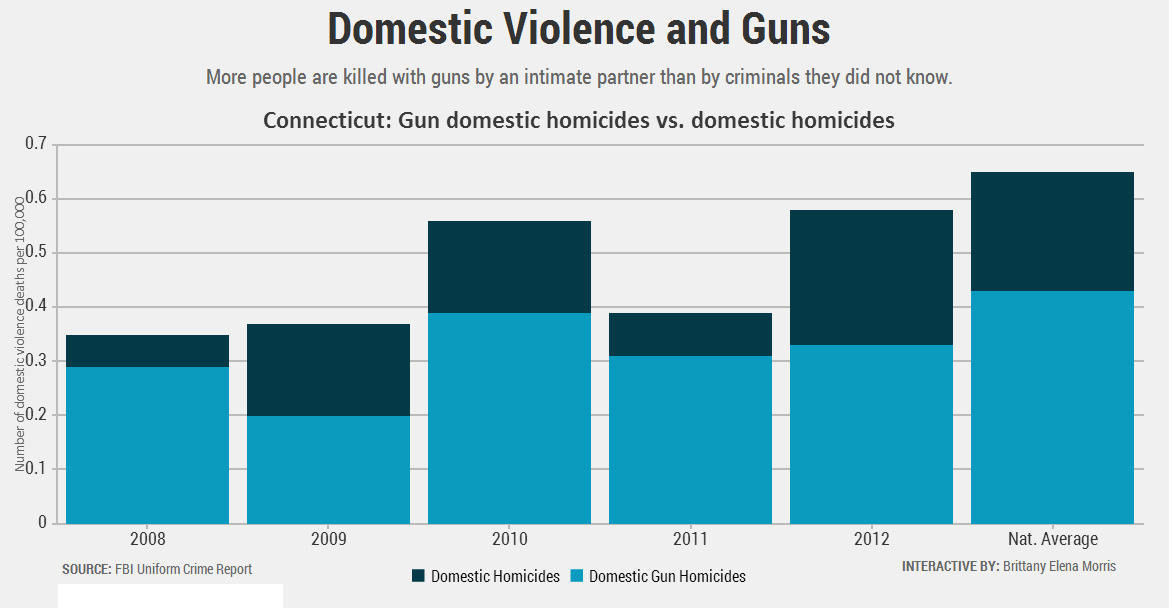
One of the main points to come out about the shooter is his domestic abuse charge.  Why would someone like this be able to legally own firearms?  I’d like to look at this from two perspectives.  On one hand, it’s easy for everyone to get up in arms about a domestic abuser having a gun, given how often women are the target of incidents with firearms, this should be a no-brainer.  And maybe it is, although there are apparently some loopholes as discussed in the Slate article I just linked, but here is the problem:  he was never convicted.  This matters.  It must.  If we simply start denying people rights based on charges, then the rule of law has no value.

On the other hand, women know all too well about this kind of abuse.  It is very difficult to get a conviction for domestic violence.  What happens if your abuser threatens worse if you report them?  What happens if you do report them thinking, well they will be behind bars so I’ll be okay.  But what happens if you report it, but the cop doesn’t take you seriously?  Or the justice system fails you?  In reading about Mr. Hodgkinson’s domestic abuse case (it was against a daughter and a friend of the daughter), the case seemed a bit strange.  Though charged, he was never convicted because the victims never appeared in court?  Why would this be?  Perhaps they knew his temper.  Perhaps he threatened them. These are all likely scenarios and so the question then becomes, how do we deal with this type of person.  If we believe that evidence is still necessary for conviction, how do we get more people to come forward about their abusers?  How do we protect those victims adequately during and after their case, win or lose?  This is a problem we’ve been trying to tackle for years and there has been some progress, but not enough.  The progress that has been made has been a result of the rise of feminism.  Yes you may actually have to become a feminist if you want to make the situation better for those who experience domestic abuse.  And just because I am sure somebody reading this might say men are the victims of domestic abuse too, I shall freely admit that, yes, this is true.  But that doesn’t mean believing in gender equality is going to make you forget about male victims.  In fact, fighting gender stereotypes that oppress women actually makes things better for men.  Narrow definitions of masculinity and femininity also play into why a lot of men don’t get believed when they say they are victims of abuse.

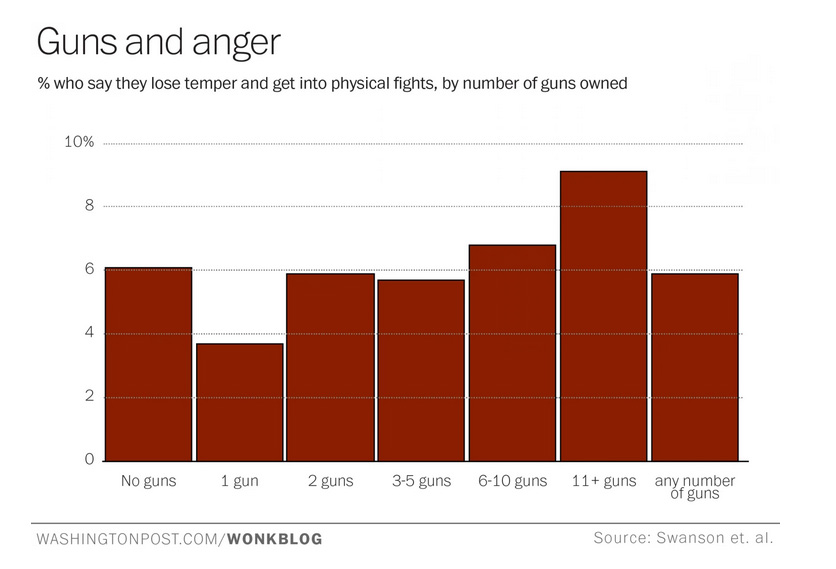
Finally, we can’t ignore the role mental health plays when it comes to these types of incidences.  In reading about the shooter, beyond the domestic violence incidences, it is clear that he has a history of anger problems.  Anger has been linked recently to gun violence (link is an article that links to the peer-reviewed study but is only the abstract).  From the article:

“Swanson believes that it could be more effective to, instead of looking at mental health history, look at a prospective gun buyer’s record of misdemeanor convictions that could indicate impulsive, explosive and violent behavior.”

The paper also has a somewhat alarming graphic about men who experience excessive anger and gun ownership.
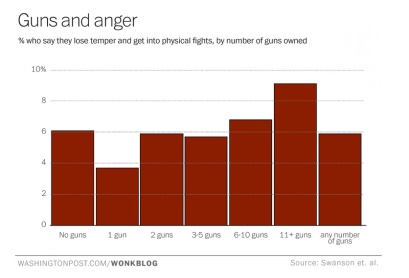
This is only one study and hopefully more research will be done in this area.  It seems also relevant then to ask, where does the shooter’s anger stem from?  Something in his childhood?  Is it some chemical imbalance in his body?  Is too much anger a mental health issue?  I would say yes, but there are a lot of people out there who get angry.  Like many things, any emotional reaction you find exists on a spectrum among people.  We could easily find someone out there who has anger problems but not quite as much as Mr. Hodgkinson, and some people with a little more.  Where do we draw the line and say, “this amount of anger is unhealthy, this amount of anger is healthy?”  And isn’t it more on how we act on that anger?  The study points again to convictions, but if there are none what then? How else might we learn about anger issues?  There are still stigmas for receiving treatment for any type of emotional struggle we are going through are still strong, especially for men.  In our society being aggressive and angry is valued for a man.  Such stereotypes imply that if you were to get help you would be seen as weak and less masculine.  Also, many people think of mental illness as only some condition you are born with or as something serious like schizophrenia, bipolar disorder, or dementia.  Things like anxiety, depression, anger are things people think we should always be able to control.  Unfortunately, this is not the case and excessive bouts of these things, even if it is temporary within your lifetime can lead to some pretty unhealthy outcomes.

So far, I don’t think I’ve said much new, but I guess one of the other facets of this incidents that inspired me to write this post was to look at the political activism of Mr. Hodgkinson.  Here is a person who has been active politically for some time.  He was a local business owner, was constantly engaged in various political causes.  Signing petitions, getting others to sign.  He was wrote opinion pieces to his local paper.  He volunteered for political campaigns.  Despite his anger problems, here is a man who, at least for a solid portion of his life, tried to solve the problems in society through engagement with people and the system on a non-violent platform.  I’ll quote once again from Sam Harris, because I think these words are very poignant here “…all we have is conversation…you have conversation and violence.  That’s how we can influence one another.  When things really matter and words are insufficient, people show up with guns. That’s the way things are.”  The end of Mr. Hodgkinson’s life are indicative of a man who was suffering mentally.  He was living out of a van, he looked like he was homeless.  Had sold most of his things just to move to D.C.  These aren’t the normal decisions someone makes and at the age of 66, it seems likely that there was at least some brain deterioration going on.  But here was a man who believed strongly about the world not being right, and he wanted to make it right.  And for many years he engaged in that activity non-violently.  Maybe he wasn’t the best representative for his cause, but he also wasn’t wrong.  There has been growing income inequality, the government is corrupt and colluding with the top 1%, and poverty increases in this country.  These are good things to get angry about.  Here is a man who tried for much of his life to use words, and I couldn’t help but thinking of the Sam Harris quote.  The causes the shooter was fighting for really matter, for many of us it feels like words ARE insufficient, and here we have someone showing up with a gun.

I am not trying to make this man seem like some sort of hero, but it made me wonder, given that this was clearly an attack on a political party, what is the difference between a terrorist and a revolutionary?  Numbers and organization?  I think the collective population, regardless of their beliefs, can feel helpless as words seem ineffectual in influencing change.  There are so many people in this world and the weight of it is enormous given the rate we can receive information about all the terrible things happening in it.  It’s more weight than our evolution prepared us for, and as one person it can easily feel like the only way to make an impact in it is to really get noticed.  And violence gets you noticed.  Mr. Hodgkinson has far more people thinking about him then he ever did being involved in politics throughout his life.  So when you have anger issues, problems with gun laws, problems with domestic abuse, a patriarchal society, a corrupt government that doesn’t respond to the people, increasing poverty, how many more people like Mr. Hodgkinson will pop out of the woodwork?  Can we stop them all?  Perhaps this is a commonality among all of these types of shooters.  A desire to be impactful in a world that feels unchangeable or a world that is changing with the feeling that it’s leaving you behind.  Either way, the amount of women doing these things is so negligible that it seems worth asking the question why men seem more susceptible to this type of behavior.

There are no easy answers here, and it’s time we stopped pretending there were.  One’s politics and religion certainly play a role, but so many other things do as well.  Let’s not aim for simple correlations and blame that solve nothing.  We know there are societies where this isn’t as big of a problem.  We are NOT helpless when we work together to build something better.  Change, however, does not happen overnight.  It takes patience and perseverance.  I still hold hope that we can find that change through conversation instead of violence, but I won’t lie and say that a worry that violence will continue to rise grows in the back of my mind.  As I think about all those people hurling out rage on Mr. Hodgkinson’s Facebook page, I wonder which angry person is the next to become violent.  Which one of those angry people has a gun, and with the right confluence of factors is the next one to use it.  For all my talk about conversation, I worry that not enough people are listening anymore.

It’s the Thought That Counts

It has been discussed by many that our brains are wired on an evolutionary scale, and that the rapid change of society through technological advances has outpaced us, leaving us with many disconnects between what we see every day and what we can actually handle.  In many ways, we might be happier if we lived in small tribes and were closely surrounded by wilderness, instead of surrounded by brick and cement, drive vehicles and get visual stimuli from computer or television screens.   One aspect of this disconnect, that I find quite intriguing, and I think is central to our ability to understand the world we find ourselves in, is what I call and order of magnitude problem.

Think about early man in those hunter gatherer days.  Counting is a base cognitive skill, important for our survival.  But what is that we might count?  You might count the amount of fruit gathered on any particular day, the number of children, or people.  Such numbers might get you into the 100s.  You might count seasonal cycles.  If you were lucky maybe you had 80 of those to count.  You might count lunar cycles.  Getting you to about 1040.  Even this would require some note making, because this is counting over time, and surely you would not sit there and count something that high.  Such cycles of time were the only things worth keeping track of.  We had no need to measure time beyond that.  No need for small units of time such as a second.  It might make sense to come up with some unit of measurement for distance. Something comparable to arm lengths or hand widths…something we might use to size an animal, measure height of people or spears.  When it came to traveling, you might then simply use something like phases of the moon, or number of diurnal cycles.  Once again such counting would leave numbers small.  Occasionally you might find yourself thinking about numbers in terms of fractions.  Maybe something like half a day, or a quarter of an armlength.  For things very small, you probably would no longer use armlength as your standard, but perhaps finger width.  Such techniques are ones that we still use today.

The reality is that if you think about numbers, you probably won’t get very far.  Now do a little exercise for me.  If you think of the number 1000.  How do you think about it, to picture a 1000 of something?  You might think what a $1000 can buy, but money is a fiction that represents a quantity of stuff you can buy which varies depending on what stuff your buying.  If you wanted to actually count, what would you think about.  Maybe 1000 people in a room.  You might have a sense for how big a group that is.  Chances are you won’t get it exactly.  Go down to a 100 and your chances of picturing 100 things gets better.  Now do 10 of something.  Pretty easy.  Now do 1.  Even easier.  Let’s go down another order of magnitude.  Try to think of something that is 0.1.  Here as we move down an order of magnitude we can no longer count whole things.  So think of 1/10th of a person probably gets a bit graphic, so what are you thinking of to imagine 0.1?  For that you now have to think of some standard.  Maybe a mile, an inch, a meter?  Depending on what you choose, you can do okay.  Now try 1/100th.  Again with the right starting point you might do okay, but even dividing by 100 can be hard for someone without a formal education and once we get to 1/1000th our ability to guess at the meaning of that fraction is severely reduced regardless of our starting point.  So if you are keeping track this puts the human mind, on a good day our brains are capable of somewhat accurately sorting out 5 orders of magnitude (10-2 – 103).  However, if we look at the scale of the universe in size we span 52 orders of magnitude from the plank length to the size of the observable universe (please see this very cool interactive graphic that allows you to explore the different spatial scales of the universe).  In terms of time, our quantum clocks can measure up to 1  ten billionth of a second (10-10) .  Meanwhile we know the universe has been around for about 14 billion years (1015 seconds).  If you don’t have trouble digesting such numbers you are a super genius, because everybody should.  Those are just the extremes, but unless you are within that 5 orders of magnitude range I discussed earlier, it makes little difference.  And this is also important because it means that a million miles, might as well be a billion miles in our head.  However, the difference between those two numbers is meaningful.  In science, to consider two numbers like that the same would be to make a grievous error on the order of 100,000%.

Scientists, through years of working with the numbers that shape our world are often better at dealing with these things, but even scientists tend to use conventions to make numbers easier to manage.  There is a reason why you don’t measure the distance from New York City to Boston in inches.  We have developed different units of measurement for distance.  In the old English system we have inches, feet, yards and miles.  In metric, we have prefixes that span numerous orders of magnitude so that we don’t have to always report distance in meters.  For objects in space in our solar system we might use astronomical units to keep those distances in more manageable numbers.  For things outside our solar system, light years.

                  Image of radar reflectivity.

Whatever we measure in science can change over large ranges and change at massively different rates.  Change is rarely linear, but very often exponential.  As a result, we might find ourselves dealing with quantities which very over several orders of magnitude.  In my field a good example for this is radar reflectivity.  You may not be familiar with it, but you’ve certainly seen radar images if you’ve paid attention to the weather.  Higher reflectivities indicate bigger drops and faster rain rates.  Lower reflectivities represent light rain or drizzle.  The difference in size between a drizzle drop and a basic rain drops is no more than a factor of 10, but the reflectivities span over 10- 1,000,000.  Thus, meteorologists convert those reflectivity values using decibels.  The decibel system was initially used for sound given the large range of frequency for sound waves, but now is a common tool for expressing values that vary over several orders of magnitude by taking the logarithm (base 10) of the value. This reduces the number to its order of magnitude.  For example, instead of 106 if I take the logarithm with base 10 of that number I get 6.  And 6 is much easier to wrap our heads around than 1,000,000.  I know I’ve gotten kind of technical here with this example, but the point is that nature, as we’re discovering, does not conform to the numbers our brains had to deal with when we evolved.  And most scientists, while they might have some understanding of the microscopic or macroscopic numbers and the wide ranges of values science employs, to objectively analyze and come to some meaningful conclusions we very often have to be able to visually see those numbers between about 0.01 and 1000.

You might say that such numbers make little difference to most of us unless we are in science, but let’s talk about where our everyday lives might be impacted.  First let’s start with the population of the world.  There are 7 billion people.  Try to wrap your head around that number.   Is your soul mate really just one in a billion?  Could such a large group of people create an environmental disaster? How many bodies could certain countries throw at you in a war? About 700 million, globally, live in abject poverty.  Do the numbers seem so voluminous that it’s easier to ignore human suffering, or make you feel defeated before you try?

What about some of the more important educational and scientific controversies that still exist today? Evolution has been happening for several billion years, but many would like to believe that we’ve been around for only 6000 years.  Religious dogma aside, isn’t it possible that part of the reason that some people resist what science clearly demonstrates is because we are talking about a length of time that few can relate to?  The vastness of time threatens to humble us all as blips in a universe far older than we can fathom. And its size and origin similarly attacks our human conceit at being the grandest and cleverest design in a creator’s eye.

                                         The Geologic Time Scale

Vast amounts of people also create vast sums of money.  Billionaires have almost unimaginable wealth that people still commonly believe that can obtain too.  Politicians and media constantly throw large dollar values in our faces to intimidate us.  When one wants to high light wasteful spending we can put point to something costing 100’s of millions of dollars and we shudder at such an amount being wasted.  Forgetting that with 100 million taxpayers, something in the 100’s of millions is costing us a handful of dollars a year.  I have seen the tactic used frequently.  Once again we might on some level realizes that a 100 million, 10 billion, and a trillion dollars are different, but they are all unimaginably large sums of money that in the battle for what’s important and what’s not, they can all be seen as being on equal footing. The idea that public television and radio need to be cut for austerity is quite simply a joke when compared to a 10% increase in defense spending if anybody thinks that’s going to balance the budget.

One might argue that the microscopic matters very little (no pun intended), but I do think an appreciation for that scale is valuable, if for no other reason helping us appreciation the vast variation of scales that make up our known universe.  Scientists often take very small numbers that might exist for pollutants or toxicity in foods or water, and change the unites of those numbers so that they are bigger.  I understand why, because of course we don’t want to underwhelm in those situations, but maybe it’s also a problem that we continue to cater to this limited range of numbers that our minds most easily manage.   It’s probably best to start incrementally, and perhaps a good example of how we can begin is with time.  John Zande over at his blog, The Superstitious Naked Ape, offers up a good first step towards our lack of comfortability with numbers outside of our “sweet spot”.  The start of our counting of years begins with the birth of Christ, but this is a religious and faith based reason to start the counting of the years.  Why not use Thai’s bone which is our earliest evidence of careful astronomical observations of the sun and moon over a 3 ½ year period.   Instead of the year 2017, it would instead be 15,017.

                                                                          Thai’s bone

It might seem like an arbitrary difference, but I think it would give us a better feel for the vastness of time, and a better appreciation for the numbers that shape the universe we’ve come to know.  Since there seems to be little stopping the advance of science in technology, perhaps we better find more ways to help these brains, made for a different time, catch up.

Can Multiculturalism Work?

What is multiculturalism?  Here is something that I am for, and think is a positive thing, but a recent interview I listened to made me wonder if I was perhaps defining it differently than other people.  Not that I am necessarily wrong, but it is perhaps a term that easily lends itself to some interpretation.  Perhaps part of the reason is a definition of what we consider culture likely also varies from person to person.

The argument has come up many times in Europe and North America in response to the Syrian Refugee crisis that multiculturalism doesn’t work.   My father-in-law in Poland has even joined the parade of fear over refugees and said he’s against “multy-culty”.  Many Americans describe the U.S. as a melting pot and promote that as an important part of a successful nation.  But are we really a melting pot?  It’s clear when you look around there are plenty of cultures celebrating events that are important to them.  Whether it’s religious holidays, whether it’s going to the church or temple of their religion.  There are also plenty of restaurants catering to different ethnic cuisines.  We can see the evidence of different cultural norms among African-Americans and among Hispanic groups.

So, what is it that we are actually afraid of changing?  It seems that when most people say multiculturalism won’t work it’s targeting specific values that another culture holds, or is perceived to hold that is different than values held already in the country.  But since there are clearly many diverse cultural practices that go on already that don’t bother anybody is it reasonable to say something so broad like multiculturalism doesn’t work?  I don’t believe so.  That doesn’t mean that bringing in other cultures into your own society won’t have problems.  Part of the reason why the story of immigration keeps repeating itself with one generation of immigrants being criticized by the generations before is that we generally don’t trust what we really don’t know.  But we live in the age of information so there should be a bunch of stuff we do know.   So let’s take a look, and for a little bit, ignore the fact that often in these situations the experiential knowledge goes a lot further than book knowledge.

When it comes to refugees from Syria, Iraq, and Afghanistan let’s face it, a large majority of these immigrants are going to be Muslims and fear of Islam is at a high today.  While extremism exists in every religion right now, a good portion of it is coming from Islam, so perhaps there is a good reason to have more fear, even if that fear compared to other things we have to fear in this world, are exaggerated.  Once again I don’t want to get into any No True Scotsman arguments, because we can say extremists are not truly followers of Islam, but they claim they are so let’s go with the idea that whatever religion people claim they are affiliated with that’s their religion.  It’s true to say that whatever small percentage of Muslims we bring into this country that are jihadists, the more immigrants we take, the numbers go up.  So I think this is always worth paying attention to since a society should always be aiming to reduce violent crime.  But for now let’s just throw away the extremist views and look at these societies in general.  We have very traditional values.  Women do not have equal rights in Islam.  They are expected to dress modestly because they are a temptation to men.  They try to protect their followers from information that would cast doubt or refute tenets of their religion.  Their governments do not have separation of church and state.  Islam has strong rewards for commitment to the religion and strong punishment for those who are apostates (both on this plane of existence and the other ones).  They have no tolerance for homosexuality.  Do any of these qualities sound familiar?  They should, they are the very similar attitudes held by a large portion of the religion right here in the U.S.  What’s very odd about it, is that the same people who have so much in common with all these potential new immigrants are the most against them coming in, and it’s the left that is happy to important such illiberal values into the U.S.

Now before you fight me on this, let it sink in a bit.  If this is the case, what’s going on.  Are we all very confused?  No, but perhaps we are a little confused.  First of all we shouldn’t expect two very similar religions to coexist happily.  It’s easy to see why to very conservative groups with slight variations on “The Truth” don’t want to share space.   It’s also not hard to see that Islam doesn’t have a high degree of tolerance towards free speech, something that many, if not most on the right, consider to be one of our most important values as an American. It is also isn’t difficult to understand why people on the left would be side with Muslim immigrants.  Certainly, when it comes to the refugees there is going to be a great deal of desire to reduce human suffering.  But let’s say, to a large degree many people, whether they support immigration or not, are moved my human suffering.  From an ideological point of view, we’d expect many people to be sensitive to the oppression they’ve endured at the hands of religious intolerance, racism, and misogyny. It’s not completely irrational, therefore, to be against allowing large groups of people that are experiencing oppression and suffering to be painted with a broad-brush stroke simply for being different.  We’re all too familiar with what happens when such attitudes persist in a society.  We know the harm that stereotyping can play and how it closes doors to meaningful conversations which can lead to an exchange of ideas and mutual understanding.  There is value in diversity and adding some might not be a bad idea.  This at least for me is at the heart of a multicultural society.

My concern is that we seemed to have reached a level of political correctness where it is not okay to criticize Islam, out of fear we will be supporting attitudes on the right.  And I would like to believe that there are many people on the right who might be similarly scared of expressing empathy to humanitarian crisis in the Middle East in case they are seen as supporting the left.  Identity politics is not helping.  We have to have some honest conversations about what we can tolerate in terms of diversity and multiculturalism.  As a liberal there are certain harmful views that I will not tolerate in any culture, and do not want to see them increasingly practiced in my country or any country.  Many of the Syrian refugees are very educated, which is helpful, but harmful cultural practices, particularly attitudes towards gender or sexual orientation are not dependent on the level of education.  It’s not unreasonable to be against importing illiberal values into our society, just as it is not unreasonable to be intolerant to illiberal values here.  It seems clear to me that multiculturalism is not impossible, but it does have limits and if you claim to be a liberal it’s of value for you to recognize that.  And on the right, the level of xenophobia and fear of terrorism is also highly disproportionate, dishonest and is not helpful to meaningful conversation.

I come from Canada and am proud to say that is one the few if not the last country that largely embraces multiculturalism, but this does not mean that we tolerate every cultural practice.  Canada can boast some of the most progressive imams in Islamic society who actively speak out against Islamic extremism.  I wonder if Canada’s inclusive attitude towards different cultures has anything to do with that?  And I am not under any illusions that racism or bigotry is absent in Canada.  It’s still a problem.  It takes time to solve such problems and I think Canada has made some impressive progress.  Growing up in Canada my view of multiculturalism was that you retain the best of your culture and adopt the best of Canada, and the nation simply gets better.  As someone who is biracial I never struggled about whether to consider myself Indian or white, I always just thought of myself as Canadian, because Canada recognized the value that other countries have brought with them to Canada.  To me, this is one of the principal differences between Canada and the U.S.  Canada definitely thinks we have some lessons for other cultures, but we are humble enough to recognize that maybe other cultures have something to teach us as while.  It seems to me that the U.S. has an attitude that it only needs to teach others, but has nothing to learn from them.  Such an attitude seems to be held by many Americans on the left and right because it seems to play out in identity politics as well.   Maybe, in the end, whether or not multiculturalism can work all depends how willing each culture is willing to listen and learn.  This is a value that we all need wherever we may live.

I, Science

Around the nation tomorrow, there will be marches for science.  Why should that be so?  We might understand marches for women, or marches for a minority group, but why should scientists march?  We make only 5% of the population, it’s clearly a small proportion of the workforce.  I am sure I could build a compelling scholarly argument for the importance of science, but rather than go about it mechanically, I’ve decided to talk more about my relationship with science and why it’s so important to me.

Like many children I enjoyed books with different animals and learning about their characteristics.  I remember watching many an episode of Mutual of Omaha’s Wild Kingdom.  I had a book on whales that I love to read a lot, and one on dinosaurs.  I remember learning about the different planets.  I found the colors of the planets, the sun, so stunning.  Different atmospheric compositions led to vastly different looks.  I marveled at the thought of looking up at the red sky of Mars.  I used to capture a variety of insects in jars.  And while I would certainly not encourage such behavior from my child without proper care and the hopes of setting it free, I marveled at the structure and behavior of such creatures.  When I look back on these memories, I have hard time imagining every child not being like this.  Maybe it was a precursor to what I would eventually become, but there seems nothing so natural as wanting to observe the world around us and learn about it and wonder how it works.  How can one not marvel at the array of colors that nature provides?  How can we not wonder at the flight of some creature and the scurrying of others?  How can we not be fascinated by the massive size of the blue whale, to the little aphid that seems but a speck in your hand?  I am certainly not an expert in child behavior, but I have watched enough children to know what observers they are.  And while they may not understand all they see, they are constantly looking.  It seems to me the essence of science lies in the very heart of who we are as humans.

From at least my early elementary age, I remember being fascinated by thunderstorms.  Seeing the lightning streak across the sky was nature’s fireworks and I loved every minute of it.  Often peeking out the window at night, and occasionally sneak out at night so it under the ledge of our house to watch the thunderstorms.  My very first introduction to meteorology was in grade 6 when we learned about different cloud types and how different cloud types could often be predictors to the type of weather that was coming your way.  For some reason I found that fascinating, but I know there was also an aesthetic quality to clouds that I found beautiful.  Their variety of shapes and colors depending on the position of the sun.  To this day I still look up at them and they seem almost beautifully magical floating there.  My first real act as an atmospheric scientist at around adolescent to early teens.  I say this because my observations were recorded mentally over probably a couple of years.  Thunderstorms in the prairie of Alberta are seen a long way off and I noticed that when a line of bubbling cumulonimbus clouds was on the horizon the wind was always blowing towards the clouds, yet the clouds kept getting closer.  After enough observation I saw this as simply a fact, and knew when to tell my family to prepare for thunderstorms.  Often adults would question me, saying “you’re wrong kid, the wind is blowing the other way”.  Of course I wouldn’t learn why this was the case until university, but it gave me some pride to recognize patterns in such a way.

My mother was always good at supporting me asking questions, and even better at showing me how to find those answers.  In those days it was the library.  How easily today I could have looked up the answer as to why wind blows towards the thunderstorms before they come to you. Kids today really have it so much easier, but they also have to deal with a lot more misinformation than I had to deal with in a library.   She taught me a lot about research and to look for answers in multiple places to make sure there was some consensus.  Though she didn’t have an advanced degree, she was always one to have questions herself and research the answers before forming an opinion.  Although she never said so explicitly, I think it was important more to see that our own senses are not enough to really understand how things work, and having information from other sources can help us answer our questions and make better sense about what we see.

When I look back, the ingredients it took for me to become a scientist seem rather organic.  Parents who encouraged questions and were curious themselves, made science feel like it was no extra effort.  School was effort at times, and I didn’t understand everything easily, but it never stopped me from finding it all quite interesting.  My favorite subject in high school was actually biology.  I loved learning especially about organ systems.  The way the body works and maintains itself still amazes me to this day.  So while there may be some combination of genetics that works in my favor, I find it hard to understand how we aren’t all scientists.  Not by profession, but just by nature.  I think, that regardless of my job, science would be a part of my life.  It has already helped me immensely in understanding so much and answering so many questions, and knowing that there is always more to learn is rejuvenating because it means that maybe I will learn something and it will change my whole outlook.  It means that what I do today, because of what I have learned, might be something that I never saw myself doing before.  I used to think that it was sad that I could not learn everything there was to know.  Beyond the impossibility of that task, I think life would go stale quickly if there wasn’t newness.  Science may not bring certainty, but it does bring to the fore previously unknown possibilities and who can say that does not make life more fulfilling?

Some people think that science removes mystery from the world and thus makes it less exciting.  It was in the 8th grade that I decided to become a meteorologist.  I can tell you that a thunderstorm today excites me to less than it did when I was a child.  In fact now, when I look at a thunderstorms I see equations and physical laws floating around like code from the Matrix.  I see into the cloud and in my head see interactions between droplets and crystals that I never saw when I was a child.  I understand the magnitude of the forces that meet to produce this wonder of nature, and I feel the weight and power of it, in a way I never could have as a child.  It is like the difference between falling in love with someone, and the deep intimacy and friendship that you develop after you’ve known that someone for many years.  It is love with depth, it brings a lasting feeling of happiness and well being.

Somewhere a child has nowhere to turn for answers to the questions they have.  Somewhere a child is told not to ask questions, or is simply told what their parents say is the truth of things, and that questions are dangerous.  Somewhere parents have decided that their girl shouldn’t be educated, or that science is not for girls.  Somewhere a teacher doesn’t understand science themselves and thus kills the joy of curiosity and learning in their students.  Somewhere a group of politicians have decided that memorization-based exams are the important metrics to determine funding.  Somewhere a television show is making scientists seem irrelevant and worthy of ridicule for finding excitement in discovery. Somewhere a journalist is completely misrepresenting a scientist’s findings.  Somewhere a government is denying the findings of scientists to help rich people make more money.

These things make me sad.  I see no reasons why we can’t be a society that is constantly asking questions.  We have a tool for answering those questions that we know is reliable.  It is so pervasive now that we don’t even recognize all the ways it shapes our lives. If we supported that scientist in all of us, the one who first makes their appearance at the earliest of ages, the power and value of this tool would be immense.  It helps us ethically and morally.  It helps us fight oppression and inequality.  Science is the only thing that has no politics, no religion, no race or culture.  It truly is for everyone, and in everyone.

I see the March for Science as not just a political statement.  It is about showing the value for curiosity, for education, for discovery, and for wonder that we seem to be losing.  Our government has become one which seems to think it has nothing to learn.  One where opinion is as valid as fact.  One where there is no consequence for lying.  I don’t blame Trump for this alone, he may be the penultimate in this dangerous attitude, but it has been bleeding into our society for some time.  The March for Science is a march for progress.  A march that shows we care about our fellow human, and that we value science as a means to reduce suffering in the world.

I say all this, not because I am a scientist and I worry about my job.  I say this because it is my lived experience.  I say this because we all intrinsically know that change is the only truth in this universe, and that time makes a fool of the arrogant who think they have nothing more to learn.  I say this because history is full of the darkness that follows when we rest our futures on superstition and falsehoods.  Finally, I say this because I do think there is significant evidence that human-induced climate change is the scientific issue of our time, and threatens our very existence.  It challenges us like no other issue, because it cannot be solved by one nation.  It cannot be “felt” on a day to day basis.  It is the essence of science because it takes us beyond the narrow field of view that we each individually possess and asks to widen the lens and reach out into space and time, and think big.  If we cannot do that, the story of humanity becomes a tragedy.  I, for one, refuse to let it be, because I know we can do better.


Progress and the Monsters that Hinder Us

There is an idea, or perhaps several that I’ve been struggling with for the past few years.  The election of Trump has certainly elevated my thoughts on this matter.  It started as the issue of political correctness became controversial.  There were starting to be more and more rumblings that things had gone too far.  Not just from conservative pundits who complain about every ounce of liberal criticism, but from liberals as well.  Often from satirists and comedians whose life’s work comes from criticizing conservatism and extreme right wing values.

It seems, in my own experience, I start to see more and more people on the left become abusive of the people on the right.  It doesn’t even seem like it’s because they’ve been offended first, but are being offended for other people, and thus feel justified in shaming others.  Now perhaps we have always had a group of people who have been quick to take offense, and that this age of social media has simply brought such people to the fore.  Just as social media has been quick to enhance a culture of shaming which probably already existed.  Perhaps the allure of being able to shame people anonymously and with greater volume is too great for many of us to resist.  Keep in mind,I am not just making a criticism of people on the left here. Because for all their talk about “liberal snowflakes”, if the right was just this “let it slide” group of people who just kept their nose to the grindstone, I think social media would look much different.

The idea that has been bouncing, increasingly more violently in my head, is to what degree we create the monsters we despise, and to what degree to we become them ourselves.  Many of us have listened to or read analyses by various pundits and scholars about how right wing movements are on the rise and there are some who would blame this on the left.  Part of this could be in support of neo-liberalism, but some have suggested that this is due to a more aggressive liberalism that is trying to force a certain viewpoint on others.  An example of that is written in a critique of a New York Magazine piece in Salon.   Look I don’t want to make this another self-examination piece where I am going to blame the left for the ills of today.  I am not going to let off the hook harmful ideologies on the right which have no place in civil societies either. It’s well documented that the right has used fear and misinformation to exploit people and for the most part I feel like the left is simply trying to react to increased levels of irrationality, but not necessarily in a rational way.  Politicians are of course not the only ones to use fear to persuade people.  Corporations and the media all do it as well, and so to a certain degree all of us live at a certain level of fear most who are my age or older didn’t grow up with.

I worry about universities becoming places that disinvite speakers due to social media pressure and protests from students.  Such things are certainly a function of the corporate model that universities are being run as also, but it is a concern that students would be so upset to hear what someone they disagree with has to say to actually prevent that person from speaking.  This article is from 2016 and only in the U.S. but it is happening in the UK as well.  This year we had protests turn violent at Berkeley because of professional provocateur Milo Yiannopoulos, and a twice this year a pro-police speaker, Heather MacDonald had talks canceled or dangerously disrupted and was unable to give her talk.  I believe bad ideas fester in the dark.  I would rather have bad ideas challenged in an open forum.  Allowing people to speak at universities doesn’t legitimize their claims, it tells young people that in the real world you are going to face a diversity of views and people that hold them and that you must be able to absorb them and answer them with rational and evidentiary arguments.  

Today, I listened to a podcast, and heard yet another critique of Merkel (from a liberal) for letting in so many refugees and that this is the fuel the right-wing parties need to take over many European nations and possibly lead to the collapse of the EU.  Even if Islamic terrorists acts are small in comparison to the amount of good that helps the refugees opening borders so freely is dangerous.  The overarching argument being that so much compassion leads to a blind spot, where political moderation would be more prudent for long term stability.  From a political standpoint, I find it hard to disagree perhaps, but as an individual who also recognizes the cost of not helping people who are suffering it leaves me feeling helpless.  If compassion leads to the rise of nationalism and racism, and I believe in the value of compassion as one of our most valuable human traits, then I must at least ask the question, “Is it enough if our heart is in the right place?”

Since I believe we can live in a more compassionate society, and that human society has trended towards greater compassion, I want to be able to see that movement continually.  Maybe in the long arch of history it is our fate to take two steps forward and one step back.  And these back steps may be half a human lifetime.  Furthermore, perhaps in some places things go back for longer, while other countries that were back start to move forward.  So globally we may still be moving forward, but all moving at different rates.  The fact remains, that as an individual, while I can be pleased that the average moves forward, I still am not content to let the society that I most directly live in fall back.  What can I do?  How must I behave?  And how can I promote positive behavior in others?

An important part of my journey in life was to understand the brain.  My inspiration for doing so occurred when I met with people who had diametrically different world views, and where no amount of evidence would sway them.  That journey was a great one and it gave me a greater understanding of how people come to believe the things they do.  But I still find that in the everyday things we generally want the same things, and that we are all quite similar, so I find myself wondering how common ground is to be found.  I guess, it is just who I am that I can’t give up on the idea that we are all human and that we have more reasons to work together than to work apart.  And so it is this lens that I find myself wondering, “Even if some minds can’t be changed, how do we make sure that the problem doesn’t get worse?”  It seems to me that 20 years ago, someone like Trump would have been laughed at to the point of just being a lopped off as to one of those crazy eccentrics who runs for president but nobody takes seriously.  Many of us were of that very mindset in the primaries, myself included.  But it also seems to me that the left has changed as well.  I don’t remember a group of people on the left that behaved the way we have seen either.  I don’t remember universities preventing speakers they disagreed with from speaking.  I certainly don’t remember riots over it.  I don’t remember the name calling and the shaming, and the dehumanization of people we disagree with.

It’s perhaps a chicken and the egg, but it seems like as the divide has grown such that the fringes grow too.  In my mind I see this being plausible as a normal statistical distribution morphs into a bimodal one.  Have the terrorists been winning?  Sending the west into a spiral of fear, where the existence of one extreme, requires that we oppose it with another?  Is the “alt-right” a response to an “alt-left”?  Or vice-versa? Are most of us just living in such a state of fear that we, on average, feel a greater need to be part of a certain camp, where it’s “us” against “them”?

There was an excellent little article by George Orwell I read a few months ago, that he wrote in a London newspaper on fascism.  A word we’ve seen a lot lately and reading this article made me realize how easily the word was thrown around then too.  In trying to define the word, the most common definition that he thinks people could agree with is bullying. I think if we’re honest with ourselves we can think people who fit the description of a bully, and they aren’t all on the right.  I’ve heard the political spectrum described as a horseshoe and that there is a place that the left and right meet, and that’s at fascism.  Communist Russia and Nazi Germany might have come from different political philosophies, but I think we can agree that the style of governance was very similar in its oppressiveness and cruelty.  The fact remains that no matter how right someone might be the way in which we deliver that truth matters.  If I say it is better for you to be kind.  That statement is true.  But if I, in convincing you, try to shame you, push you around, call you names, surround you with a bunch of my friends and make threats, I think the importance of kindness would be lost.  Yet this is the kind of behavior we see every day: people on both sides being jeered at and dehumanized for being wrong about something.  There are too few attempts to educated and reason.  Plenty of getting angry and ridiculing others.  I maintain the belief that rightness divorced from empathy is ultimately unhealthy, even poisonous at times.  We’ve all been wrong about things, and at times we’ve been ignorant or misinformed about some pretty basic information.  We’ve also been guilty of letting our emotion override our rationality.  This is part of being human.  So even when you believe that someone is wrong about something, even dangerously wrong, it doesn’t make them any less human.   We have easily duped and plastic brains that are subject to the influences in our lives.

As I quoted recently in a post about Sam Harris’ thoughts on Trump, we have two choices in influencing others: conversation or violence.   Is shaming and ridicule conversation?  Or is it more of a violence of the mind?  Even if we can say it is still not violence, it feels like unproductive discourse that will make violence more a necessity.  I am not a pacifists to the point of saying violence is never the answer, but I am constantly going to be looking at how we can avoid it.  Free speech, provided it is not inciting violence, is one of our most important values.  It is the one value that allows us to self-correct peacefully, and challenge ideas that cause harm.

I am not sure how this post will be perceived.  Whether it appears balanced in its criticism.  I guess, it seems to me, that fascism is growing in both political directions and that somehow they are a reaction to each other.   A reaction to fear perhaps, and as fascism grows the fear gets worse.  Can we find a way out of the positive feedback loop?  Maybe the other guy started it, but as the divide grows that origin seems to matter less than trying to figure out how to end it.  As a liberal rooted in all people enjoying basic human rights, I wonder how we defend those values while loving those who attack such values at the same time so that they know those values can improve the quality of life for all.  But one thing is sure to me, if we can’t live by the values we claim to embrace, then a progressive liberal society doesn’t seem achievable.