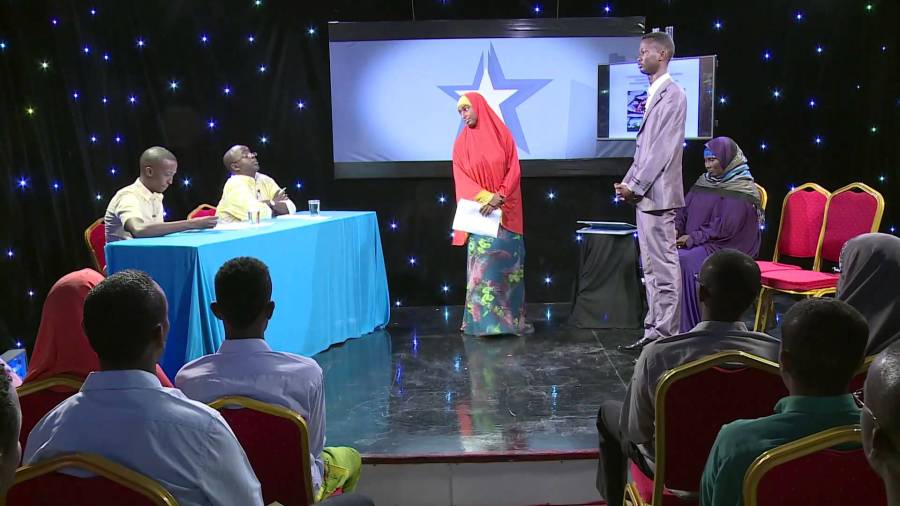
I was listening to one of my favorite podcasts yesterday, called Invisibilia, and the show focused on a unique attempt to counter Islamic Extremism, which was to run an American Idol type reality show in Somalia. If you don’t have time to read the 40 minute podcast, you can read about it here. If you don’t have time for either, the gist of this was that there was a plan supported by the U.N fight extremism by impacting the emotional landscape of the country. The government at the time was unstable but had recently replaced the far more extreme Al-Shabab government that had previously held Mogadishu. So things were better, but delicate. Previously Al Shabab had forbit music, even at weddings, and went so far as to kill many important Somalian musicians and poets.
Hearing this story brought a number of thoughts to my head. One was how pop culture might be used to transform a culture in a positive way. In my last post I talked about the harms of excessive moral outrage exacerbated by social media, which polarizes and brings more instability to a culture. Here was an attempt to do the opposite. It might seem surprising but some of the advantages that American Idol has are:
democratic voting process
a panel of judges that are both men and women
one mean/tough judge, that increases the joy of the contestant when the mean judge soften to approve the contestant
It may not seem like much, but when you think about the just act of getting into the habit of voting, and getting a say in an outcome, seeing authority that is both mean and women, and a nation of people watching and sharing in the joy of a contestant who has overcome a number of hurdles. Well maybe it’s the upper the country needs to continue to stem the tide against extremism.
Of course this also made me think how easy it is to erode culture with western culture, and that’s an entire other conversation, but the good thing here is that they not only made it about music, but also included a poetry, as part of the competition, which is big in Somali culture. At the very least they were trying to adapt their idea to fit Somali values and traditions.
These are of course only seeds, and real change will happen slowly. As the article says:
Which brings us to this question: Did this reality show actually change reality in any way?
It would be impossible to make the case that Somalia is a completely different country now. It isn’t.
But there is at least one undeniable change since 2013. Music is back in the streets. Brought back, slowly and painfully, through a complicated combination of political strategy and personal courage.
Anyway, I thought this was an interesting story and wanted to share it.
One of the common words that we hippie-type people like to use is the word tolerance. We need to be more tolerant. I said it myself in my last post, but based on a discussion on that post I decided that it was worth investigating this concept of tolerance. While I think many people derived a theme of being more tolerant towards Muslims, what I really meant to look at is what are better and worse ways of dealing with a difficult situation. I’ve come to realize that often when I use the word tolerance, the meaning I hold to it is different than others. And so maybe what I am suggesting is not tolerance at all, but something else.
Ahirhsa refers to non-violence
What I think we can agree on, is that tolerance is definitely not something we should always be doing. We live in a very PC culture where we are being told constantly to be tolerant, but tolerance can lead to passiveness, and there are some things we should not tolerate or be passive about. One could say that being intolerant has led to many important social changes. When laws are unjust being tolerant of them isn’t getting you very far. Gandhi and Martin Luther King, Jr are good examples of historical figures who were not very tolerant and accomplished great things for their people in the march towards equality and self-determination. But then I also thought about the importance of context. If laws are unjust, if there is oppression, then it is these practices that are intolerant. And shouldn’t we be intolerant to practices that are intolerant. For instance, if black people are not allowed to sit in certain restaurants this would be an example of a system which is not tolerant towards different races. White people would not tolerate a black person sitting next to them while eating. Did black people owe it to white people to be tolerant of their practices so as to not make them feel uncomfortable? Of course not. On the other side we could point to Kim Davis. She doesn’t agree with a law that allows gay people marry. The law is just because it gives equal rights to people of different sexual orientation, and doesn’t infringe on anybody’s ability to practice their own religion. Thus we would ask Kim Davis to be tolerant. Of course, whether it is people not wanting blacks in their restaurant, or gay people to marry, what we are really saying to those people is “you’re wrong, get used to it”. We’re saying, your “intolerance, will no longer be tolerated”. And I believe this is fair and this is right, but there is a little bit of a subtext there that says “You really should change your mind and agree with us, because other ways life is going to be pretty annoying for you”. And again, I’m not saying this isn’t fair, but to the other person they would easily say that we are the intolerant ones of their views and why do they have to show tolerance and we don’t? The word “tolerance”, at least to me, is sort of a confusing word when you think about it.
So going back to the issue of “banning the burka”, if I say tolerance is prudent, what does that mean? First I think it’s important to note that tolerance of an action and condoning that action are different. But if you are really against something, being tolerant and thus passive can be seen as equal as condoning it. I think there is some truth to that, but it’s important to remember that not all people would fight a battle in the same way. Some methods of fighting are more effective and/or cause less overall harm. Kim Davis’ beliefs may make her decide that she should not tolerate what she’s sees as an unjust law and she is welcome to fight it. However there are better and worse ways to do such a thing, and the choice she has made is ultimately ineffective, and denies legal rights to fellow citizens. The burka or niqab is a troubling practice. Women have become so oppressed in some countries that many of them are even complicit with that oppression and would feel real spiritual pain by not following what they believe to be true regarding their value compared to men. Should we tolerate such gender equality? The answer once again is, of course not. However should we be tolerant towards women wearing the burka? Then I would say yes, but I would say that doesn’t mean we can’t do anything about it. So maybe when we ask for tolerance, what we really mean is patience and careful thought. Let’s not have knee-jerk reactions that are governed by our fears, but let’s take actions that are based on our love and compassion. The fight for gender equality is really one about love and compassion. Telling women that they have equal freedom and value as men in society is just that. Freedom of religion is also one of love and compassion because it says to people that you are allowed to keep your beliefs and that the law will not dictate what you must believe. No one else wants their beliefs infringed on so why should we pass laws that infringe on others? Of course that doesn’t mean that you can come into a country and expect that a belief structure that by design causes harm to another group will be easily tolerated, especially when that country has fought long and hard to try and erode the traditions you still hold on to. At the same time, you may also expect that new laws shouldn’t be passed that specifically target you for doing what you were raised culturally to accept as normal. I think it’s also important that when we oppose certain cultural practices that we consider immoral, that we don’t reject an entire a culture. Cultural practices are not homogeneous and thus are not all bad or all good. At the very least some practices may cause no harm at all and thus we should be tolerant of those.
What we are really after, therefore, is a way in which we can present a group of people who have morally unsound practices with a better way of living. In the case of the severe oppression of women in some Islamic countries, a proactive way of doing this is to empower women. Self-determination goes a much longer way in affecting change than oppressive laws. And while it would be nice to have men on the same side, many will resist due to the fact that they will be losing a position of privilege in their society, but ultimately just as the fight for equality here in the U.S. has required the support of men, so will it need to be the case in Islam. One possible way in which we can appeal to the rational in both men and women would be to offer education into the development of children. This article was shared with me by Victoria over at VictoriaNeuronotes and discusses the important of babies being able to see facial expression in their mother. From the article:
Teacher Maryam Khan, says: “Working with young children, so much is read just from facial expressions, you don’t have to speak to a child.
“If they can’t see your face, they don’t know what you’re thinking – a glare, a smile.”
Psychologists agree. “It’s particularly true for children under five because their communication is non-verbal, they’re much better at reading it than adults,” says Dr. Lewis. “If they’re denied these signals they become quite confused.”
If, when in public, the mother’s face is always covered, this has an adverse impact on a baby’s mood and reactions to situations. The YouTube video below demonstrates this impact clearly. And there may be other things that we can discuss with them such as the importance of sunlight to pregnant mothers and babies for Vitamin D. Given that a love of children is cross-cultural and people generally want the best for children, this seems like a proactive way to change minds by connecting with men and women emotionally through the love they have their children, while presenting also a rational argument for the value of not covering your face. What’s best is that is also reveals the best about us. We aren’t trying to persecute anyone, we are showing another culture, our value of education, our shared love of children and wanting the best for them, and that what we want is a conversation and an exchange of ideas, not forcing a behavior through a punitive law. It also shows another culture that we have humility. That we too had practices that were not always beneficial and through the act of investigation and learning we have grown to become more loving and compassionate.
As I ponder more about the word tolerance, the more it seems like a word that isn’t overly descriptive. Because within the idea of tolerance is an implication that one isn’t happy or supportive of a particular behavior and that in some cases, when a particular behavior is harmful we would rather do something about that behavior. What it does not imply is a hasty reaction. We can be patient and thoughtful, and act in away that is inclusive and not exclusive. We can act in a way that is proactive and not adversarial. In the end, I believe, such tactics are more successful.



 Cloak Unfurled