

The current election has shifted a lot of attention away from the issue of police violence, but in searching through some of Sam Harris’ podcasts I found an episode that I found to be very very engaging. If you want to get the perspective from a well-educated, well-trained police officer (Scott Reitz). I highly recommend listening to this podcast (Episode 25 of Waking up with Sam Harris). I felt it was important to hear this side of things. I am a big supporter of the black lives matter movement as well, and my goal here isn’t to delegitimatize what is a very legitimate movement, but if we are also in the business of solving problems we need to hear from police officers, and we need to understand what problems they see.
Most people I know are even-minded about the issue. They know most cops are good people. They recognize that police are an important part of our society, and they don’t want to see police die. They also know that there are bad cops, and there are systematic problems with the justice system that need to be addressed.
He raised a number of I think important issues about cops that I found very information. For instance he said that the difference between the minimum proficiency requirement that cops need to have, and what a good cop needs to have are far apart. But there is no training you can take for better shooting skills, or better hand to hand combat skills, unless you do it on your own time and own money. He talked about why cops often fire so many shots at a target. It’s simply because the hit rate is only at like 13%. They are trained to take many shots at a subject. There have been also many changes on how police do their job that have made it harder. The choke hold for instance which killed Eric Garner, was outlawed, and perhaps for good reason given how it might have impacted somebody with certain health issues. Garner being no exception. However, what Mr. Reitz said was that the removal of a cops ability to use this method, took away a main method of incapacitation often used previously. He also talked about how often tasers and other incapacitation method’s fail. It was mentioned how recruitment standards have fallen greatly in who they accept. When he first became an officer in the 70’s he said it was typical for police officers to have university degrees. This is no longer the case, so standards are being lowered in terms of who they accept. He was also agreeable to the idea that there are just a lot of cops who shouldn’t be cops.
There were a couple of places I disagreed with Mr. Reitz in the podcast and I wanted to discuss in a little more detail. At around the 50 minute mark they discuss the topic of “back talk to officers, disrespect, how you should deal with illegal actions by a police officer”. Mr. Reitz’s advice is that you don’t know the kind of day or week an officer has had. They see the darker side of society, they often work long hours, and starting off your conversation with a police officer in a combative way, even verbally is a recipe for escalating the situation. I am not sure that I necessarily disagree with this advice. But what I started thinking was the following:
- Nobody likes being treated like a criminal if they’ve done nothing wrong. Nobody likes having their rights violated even if they have. Nobody deserves to be shot just for a traffic violation. I guess in the end, it’s not a reasonable excuse to me that the cop is overworked, or that he’s had a bad week or day that I am somehow asking for abuse by not being as passive and compliant as possible. That’s victim blaming, and I can agree that to some degree cops are also victims of a system that isn’t giving them the training or the workload to reduce their stress levels.
- Following from that, why is it not on the cop to think that maybe this person is also having a bad day or week? We are usually not going to be in the best of moods when we are pulled over, but if this is just a small bad incident in a line of bigger ones our attitude may not be great either. Isn’t possible that a black person might just have felt racially profiled one too many times in his or her life, that they are in a bad mood? When two people who are having a bad day meet. Right and wrong still matter. The cop has as much responsibility to act right as the person does. I think that, and Mr. Reitz seems to argue this at times, is that we are probably better off recognizing the reality that cops face, and that most of them aren’t particularly well-trained, and don’t necessarily have a lot of experience. Sometimes you do have to be smart over being right.
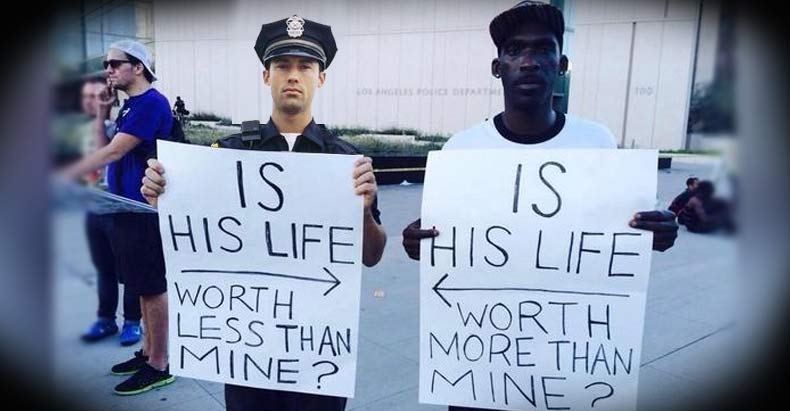
- Finally and most importantly, the idea that an officers wrong actions can be rectified after the fact, is not necessarily a guarantee. This is a big part of the frustration expressed by the Black Lives Matters movement. The wrong actions of the cop, are supported by other cops, and are supported by judges. In many criminal cases people can’t afford lawyers and they are often bullied into accepting a plea bargain by an overworked public defender and prosecution. So there is frustration here by many. They’ve seen what has happened to people they know, especially those with less financial means, and for many, even though they may be putting their very lives in danger by standing up to a cop, don’t have faith in the rest of the system to protect them. I think we have to recognize this reality as well.
 Another area they talked about was gun control. Sam Harris I think tried to get him out of the practical side of things and just look more at ethics, but I suspect Mr. Reitz is extremely pragmatic, because I think you have to be in his line of work. As I’ve argued before I think that the love of guns here is something that you have to accept to be in the U.S., but that we can try to fight for a society where we don’t them as much. Anyway, Mr. Reitz supports the ownership of guns for home protection, but is less than enthusiastic about open carry or conceal carry. I would expect most cops feel the same way. In regards to personal protection, I can’t argue in some ways with the idea that a gun is an equalizer. There are very bad people out there, and they are far meaner and stronger, and having that gun, just in case, is a practical solution to the problem. Mr. Reitz seemed to take it as a given, however, that those of us in positions where we might be worried about the worst, would still see owning a gun as the only solution. I know many people who have been victims of crimes, but not all of them seek guns after. When you come from a place with very few guns, or where it’s more difficult to get one, even when bad situations do happen, guns aren’t the first thing we think of to be safe. I think that it’s a very American attitude to think that a gun is the only solution. And the type of violent crime of a complete stranger coming into your home to do unspeakable things to you and your family, while possible, is rare compared to people being victims of homicide or rape by people they know. I guess it raises the ethical question of: How far do we go to let people feel safe, knowing that a very small percentage of those people would actually be victims in a situation they could have stopped with gun and knowing that the large amount of guns it keeps in society makes more gun violence possible?
I found Mr. Reitz to be quite reasonable and well-informed overall. He believes that guns should be in lockers and only for hunting or home protection. Because he also accepts the reality that few people are likely to get the training they need to be able to use a firearm well, and to have practiced shooting targets, and to store and care for it properly.
In the end it was nice to listen to a conversation that was substantive in which the right things were being discussed. So often on this very important issue we don’t get to have this conversation, because it immediately turns into things like “Cops are heroes!” or “Banning all guns is against the second amendment!” Imagine if we could always have such thoughtful conversations, we might be able to solve problems that might meet the concerns of both Black Lives Matter and Blue Lives Matter.
In the end I really appreciated Mr. Reitz’ perspective. I imagine it is generally impossible not to be impacted when your entire career has been dealing with hard cases and the worst of people, even if it’s just a small percentage of the population. It’s great that he has remained even-minded and thoughtful about his own job. I really can’t imagine how stressful it is. In a way we have perhaps made strides in more sensible policing from a policy point of view, but I think when you want to put more public safety and compassion into policing (which is the right thing) that does impact its structure, and what type of resources we have to put in. To make it work we have to support better training, better mental health support, higher qualifications. An acquaintance of mine here, when I talked about the attack on public education, said it’s not much better for the police either. Nobody wants to pay taxes, nobody wants to support the institutions that make for a better society. Mr. Reitz summed up his thoughts on policing today by the following quote:
“Most police officers out there feel overwhelmed with the demands on them…[we’re saying to them] ‘I want you to hazard your life, but I want you to be really careful in defending yourself’….it’s hard”.
If you have time give the whole thing a listen. If not, keep trying to have good conversations about this, because it is important.


 Cloak Unfurled