

So why have we invested so much time and money into this movie series over the years? We can understand why kids love it and our nostalgia for it when we’re older. But let’s get down to the bare bones of it. There are really only three reasons why we watch these movies.
 The first reason is light sabers. Light sabers are the coolest things ever. The light saber toys they have now are so far superior to what they used to be that it’s hard to not be a little jealous, but even those toys aren’t where I’d like them to be. Look, I don’t know how light which radiates away from a source forever and ever could be contained like that to only extend several feet, but this technology has to be figured out. I also don’t think it’s slicing through things that people like about light sabers. It is the humming sound they make whether in motion or not. The way they sound when they clash together. The fight choreography also improved vastly in the later movies. I am not certain if doing a big spin move is what you should be doing when someone else has a weapon aimed at you, but it all looked pretty awesome. I could watch light saber fights all day. I mean I think most people agree that Rogue One is the best Star Wars movie of the franchise. I think it was. But I haven’t watched it again. Why? Not enough light sabers.
 This brings us to our next reason which is chase scenes. Lots of chase scenes in these movies. Whether by ship, by pods, by speeder, or by foot there a lot of chase scenes often at speeds that defy human reflexes but are a lot of fun. We all like chase scenes.

The main reason why Star Wars appeals to people, I believe, is because it is full of underdog situations. Almost every scene that isn’t a light saber battle is full of scenes in which the enemy vastly outnumbers the good guys. There is no scrape they are trying to get out in which the odds aren’t against them by and often by fairly substantial margins. Humans love to see good guys beating the odds. Hell, that’s even one of the more famous Han Solo lines when C3P0 is telling Han the odds and he says “Never tell me the odds!” This is sound advice throughout the 9 movies, where the odds would end up depressing people fairly substantially. Whether it’s 1000s of droids, legions of star destroyers, inexhaustible armies of storm troopers, or apparently untold amounts of Sith disciples spending a lot of time in the dark on Exegon, the odds are never in the favor of the good guys. But time and time again, the “let’s not hurt people” crowd comes out on top. Almost to the point of being kind of unrealistic. Nevertheless we love these situations.

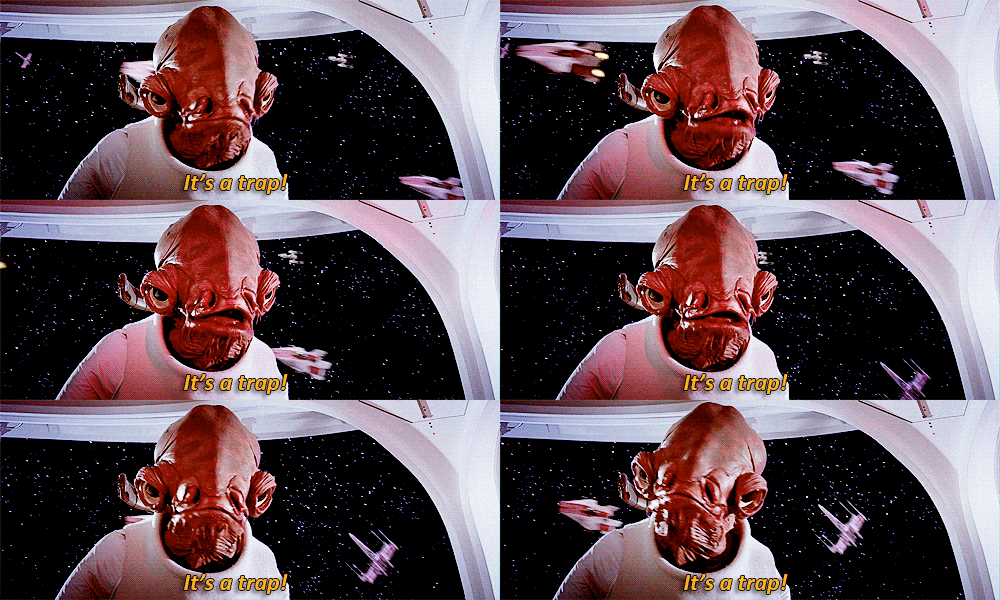
But there are reasons that we should appreciate Star Wars even more for. While I liked that they brought in more human races into the last movies, I’m not sure it was entirely necessary. They had aliens and droids aplenty in the movies on both the good guys and bad guys side and race or language didn’t seem to play any sort of role. Whether a band in a bar, as co-pilot, as admiral (we love you Akbar and I can’t believe they killed you so unceremoniously!!), a helpful group of muppets, or an annoying sidekick, the fact that people look differently seems to be of no matter. All that matters is if they are good or bad. And I think that was pretty awesome.
The most important reason why we should love the movies is for what I think is some pretty positive feminism. First you got Queen Amidala. She’s smart, strong, and has genuine compassion and care for her people. Though she lived a short life, her last task was to make sure that her children were hidden and protected from their father. There are many strong women in the franchise, Jyn Erso, Rose Tico, Vice Admiral Hodo, and even Anakin’s mother seems like a very strong woman. And we can’t forget Rey, who I really enjoyed taking the lead in final 3 movies. What’s great is that they aren’t just there for love interests for male characters. They just kick ass.

But there is one woman, who I’ve saved until last. She deserves her own paragraph. As great as Amidala was, she is nothing compared to her daughter. Princess ”fucking” Leia. This woman is out there leading the rebels while in her early 20s while Obi Wan and Yoda are still in hiding. She is already infamous enough at that point to have got the Empire’s attention…and they have a whole galaxy to pay attention to. She gets captured by Vader herself and put in jail. She doesn’t take any shit from womanizer Han Solo, and basically forces him to become a better man if he wants any piece of her. She’s good with a blaster and becomes even stronger in the force than Luke. Now one could argue that compared to Luke she grew up with much more privilege and education. That may be a factor, but they take that away pretty quickly by blowing up the entire fucking planet she grew up on, included her parents. She just shakes it off and keeps fighting. And where is she at the beginning of Return of the Jedi? She’s a sex slave mole in the service of Jabba the Hut. Getting out of her conservative attire to suddenly wear a bikini and have a chain around her neck. She suffers grave humiliation for the cause. At this point you might be thinking, “oh this is just another movie degrading women”, but she ain’t no floosy. A whole bunch of fans might have found it sexy as hell, but she didn’t do it for cat calls, she did it to save someone she cares about and someone who is a leader to the rebel cause. It doesn’t take long before she’s got that chain around Jabba’s neck and is choking the life out of that fat, disgusting, keeping women in chains motherfucker. This is no delicate flower. She’s a leader, a fighter, a mother, and an inspiration to the entire rebel movement. Carrie Fisher really is the marvel of the Star Wars franchise in my opinion, and arguably the star of it over Mark Hamill.
If you can’t find any good reasons from all this to watch the movies, but want to feel knowledgeable about the movies, I’ll give you a quick rundown so you can still be part of Star Wars conversations:
Episode I: The Phantom Menace – Two overconfident Jedi pick up an annoying CGI physical comedy expert and then get stranded on Tatooine where they believe too strongly in destiny and end up bringing back a child who will eventually cause great death and destruction to many by insisting he be trained to use his off the charts skills. Dance party and award ceremony complete the movie.
Episode II: Attack of the Clones – Here we see why Yoda is a Jedi Master and get an explanation for why there is an endless supply of Storm Troopers. (Hint: unethical cloning). Amidala starts falling for Anakin now that his voice has deepened. Dialogue and acting are extra terrible in this movie.

Episode III: Revenge of the Sith – We are never told what the revenge is for here. To my knowledge the Jedi never tried to hunt down every last Sith and kill children in Sith kindergartens. Anyway Amidala misses her period and Anakin falls to the dark side. Gets his ass kicked by Obi Wan, but is saved by the Emperor sans arms and legs, and is made it to a mechanical juggernaut and transforming his voice into James Earl Jones.
Episode IV: A New Hope – The new hope is a whiny brat who complains about never having anything to do, and ends up going on a space adventure. In the end he rejects the technology that got him there to use the force to blow up a rather poorly designed planet destroying station. Award ceremony at the end.
Episode V: The Empire Strikes Back – Definitely the best of the 9 movies. The rebels are forced to abandon Antarctica. The first black guy is introduced to the films. Luke experiences the tutelage of a grammar impaired Jedi master on a swamp planet. At the end of the movie he gets a robot hand and develops daddy issues.
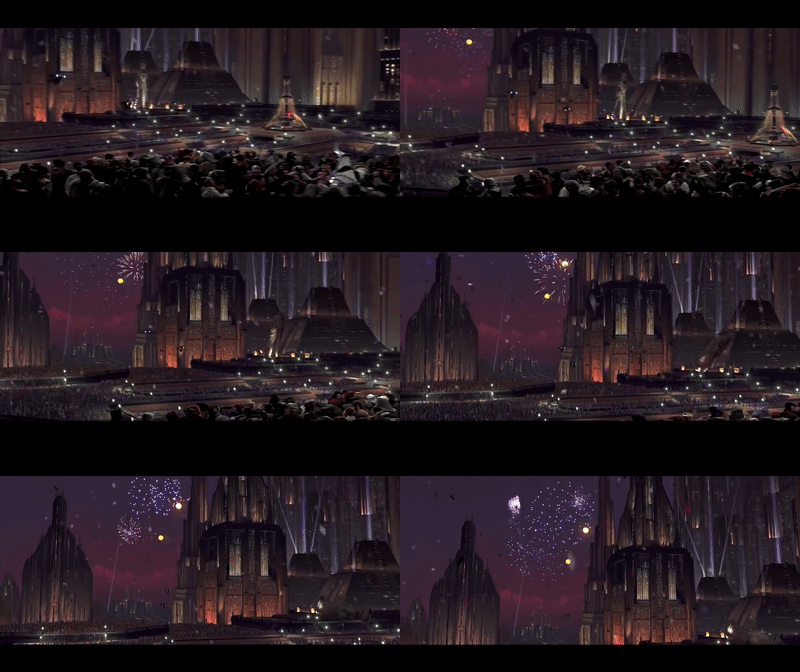
Episode VI: Return of the Jedi – It should be noted that Jedi is very singular here, despite the fact that Jedi can also mean multiple Jedi. It should have been called Return of A Jedi. Despite all the Imperial technology, they still get outwitted by a band of fuzzy muppets with rocks and sticks, and the better designed death star is still compromised by ineptitude. Luke believes in the good of his father and as he’s writing in electric shock therapy, dad throws the emperor down a long long way which leads to his demise. Dance party and celebratory ceremonies ensue.
Episode VII: The Force Awakens – Mysterious girl is mysteriously connected to brooding son of Han and Leia. Some Sith dude called Snokes comes from nowhere. Rebels are still in the same position they were at the end of Return of the Jedi. Everything from Episode IV pretty much happens again. Kylo Ren kills his dad just for believing in him and wanting him to be a better person. Award ceremony of course.
Episode VIII: The Last Jedi – Kylo Ren defeats Snokes to become the new head bad guy. Connection between Kylo and Rey grows. The out of nowhere Jedi power of astral projection saves the Rebels from being completely destroyed as there numbers unnecessarily dwindle from 200 to about 50.
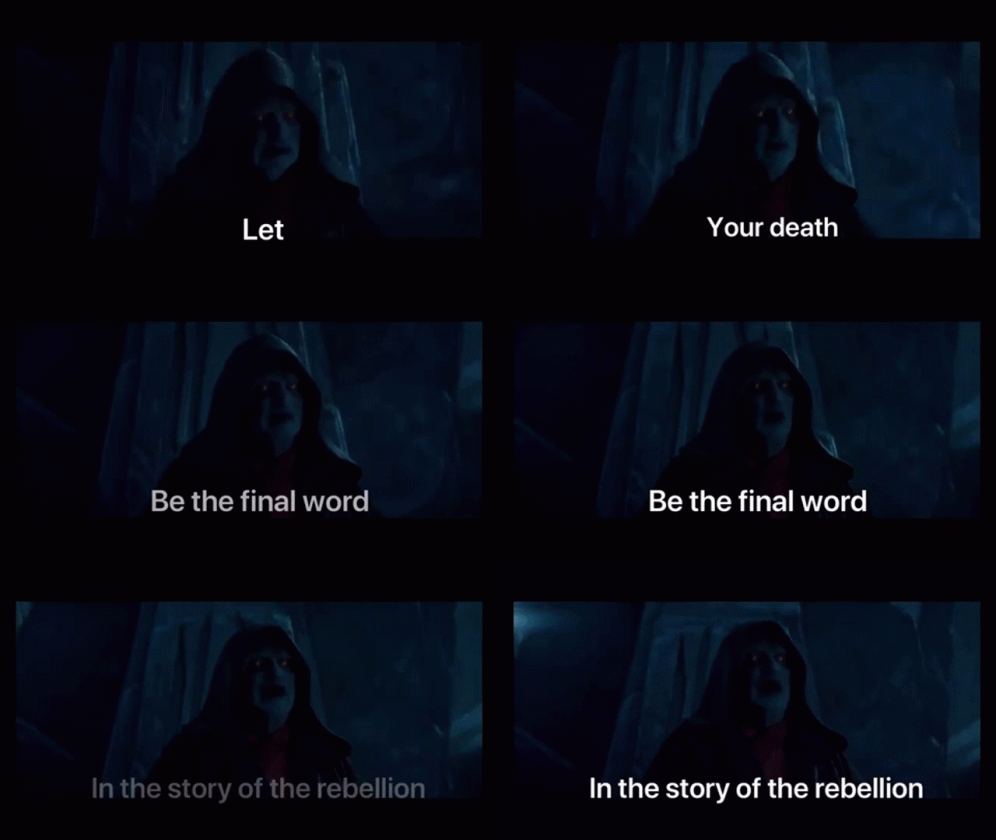
Episode IX: Rise of Skywalker – Skywalker doesn’t really rise up here. Perhaps spiritually since they all die. We all had every reason to believe the Emperor was dead, but apparently they couldn’t think of a real new bad guy and the Emperor is still alive and has to be defeated once and for all. This also makes the celebrations in Return of the Jedi less meaningful. 😦 He has become even more decrepit and evil. Of course his penchant for trying to corrupt Skywalkers ends up being his downfall. The movie does have a dance party, but award ceremonies were not included in this one. I imagine they would have been impressive.
Look, these aren’t great movies. But they have their moments and there are very real reasons to get attached to them. You can still have fondness and feel a nostalgia for it while watching and enjoy them even while knowing they also kind of suck. May the midichlorians be with you!
 Star Wars is the classic good vs. evil tale, but there is no complexity to it at all. Either you like freedom or you don’t. Either you want to hurt people and are evil, or you don’t want to hurt people and you’re good. If a planet isn’t a criminal run planet in chaos, your only other choice seems to be monarchical rule. A system of governance that opens itself up to despots and authoritarianism and thus we shouldn’t be surprised that good can turn to evil. Or you have totalitarian, theocratic, dictatorship. We are first led to believe that there is a senate that is representative of different worlds. This governing body seems to be totally without any governing powers. Nobody seems to have any political position. There is an argument over a trade blockade. Allowing commerce to proceed is fine, but it’s hardly a political ideology. I mean even as one planet we have far more competing ideologies than this entire galaxy seems to have. Once Palpatine takes over, he has no real manifesto. He’s just a bad dude who wants to hurt people. He wants to make people live in fear of the might and power he controls. This is cartoonish villainy which is why these movies are largely for children from about 8-14. The mildly comical antics definitely solidify the movies into that age range as well.
 And what are the good guys really about? What do they really believe in? In their off time, most of the good guys seem to enjoy either informal dance parties, or award ceremonies. I would agree that societies should be free to have such things, but it’s hardly a meaningful ideological position. I imagine if the Empire wanted to have dance parties and award ceremonies that could do so as well, just about different things. What are they doing to ensure any kind of lasting peace? If there is one thing we’ve learned is that the dark side of the force is easier to fall into that a blindfolded man at the edge of the Grand Canyon.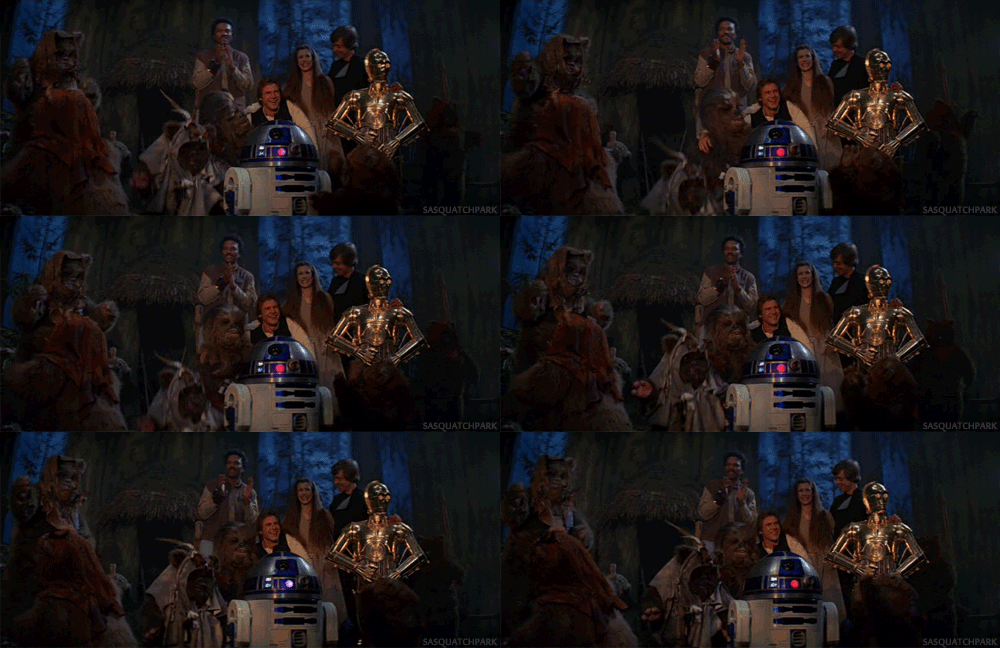
 One of biggest problems with the movies is how easily Anakin Skywalker falls to the dark side. Let’s review. We have this little kid, who initially Yoda doesn’t want to train. Why? Because he misses his mother. I mean he loves his mom and was taken away from her forever by these adults who can appear to do magic but still need to rely on this mechanical genius kid who helps them from being stranded on one of the myriad of desert planets that people for some reason live on. It seems pretty standard for a child to miss his mother. So Yoda’s powers of deduction here is hardly impressive. Then Yoda says he’s too old, we can’t indoctrinate him properly. Eventually he reluctantly agrees, the boy gets trained. Next we meet him as a 16 year old who is impatient and headstrong. Just like every other fucking teenager. Maybe it’s because we know what’s going to happen to Anakin that we feel dread, but he’s really just an obnoxious teenager played by a terrible actor. You almost can’t wait for the mask and James Earl Jones’ voice so you can be rid of Hayden Christiansen. But you get through episode II, still hoping that an epic struggle to remain good and loyal to the Jedi Order will happen.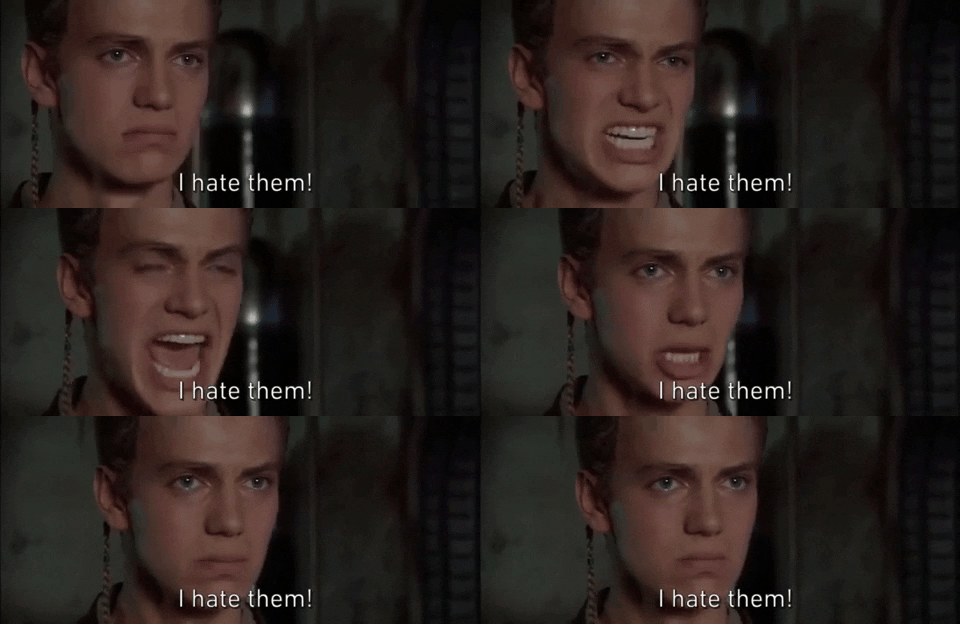
 Now he’s apparently evil, turns on the Jedi after this, and what’s his first target? A whole bunch of fucking kindergartners at the Jedi Academy. The poor kids don’t expect a thing. And why should they? He became evil faster than a bored worker at The Gap outlet store asking if you need help. All because in this universe despite the fact that they got lasers, can travel faster than light speed, sophisticated AI and massive language translation programs, but apparently forgot to research medicine to help pregnant women (fucking patriarchy!) and needs Palpatine’s tutelage to learn how to heal. Who knows why the good Jedi Order isn’t trying to learn this healing technique? I mean it seems like a pretty basic good guy Jedi power to have. And despite seemingly knowing nothing about obstetrics (did I say ‘fucking patriarchy!’ yet) they do have cloning technology. What Anakin, a cloned version of Queen Amydala isn’t good enough for you? You just had to kill a bunch of kids, because you thought this good person (who’s pro not hurting people) would be glad you killed a bunch of kids so you could learn the power to save her life. That’s a serious misunderstanding of what appears to be a fairly simple concept of goodness. So when Darth Vader chooses to turn on the emperor and save his son he remembers back to the good man he once was, he’s apparently about 7 years old. Because after that he’s pretty much a whiny dick.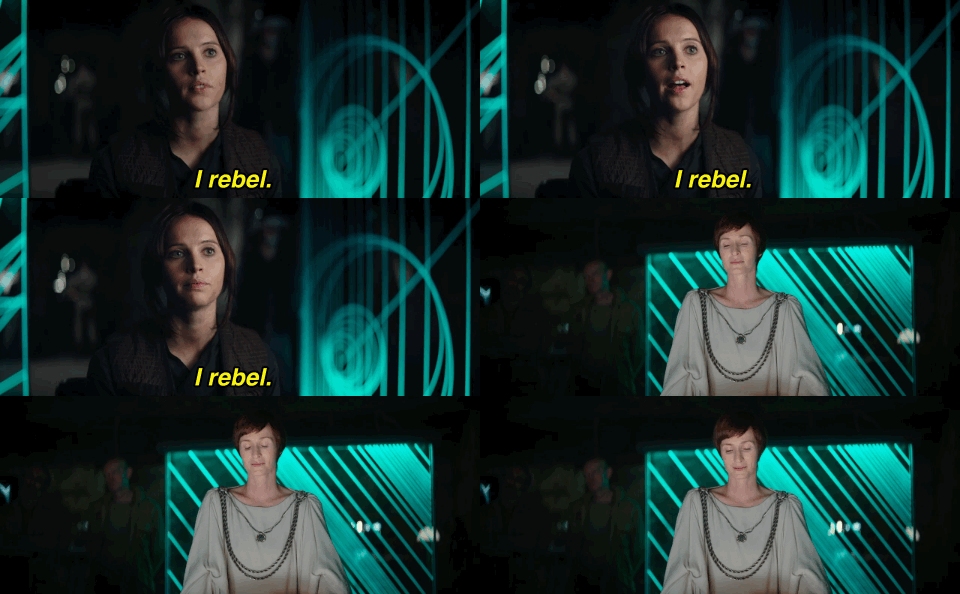
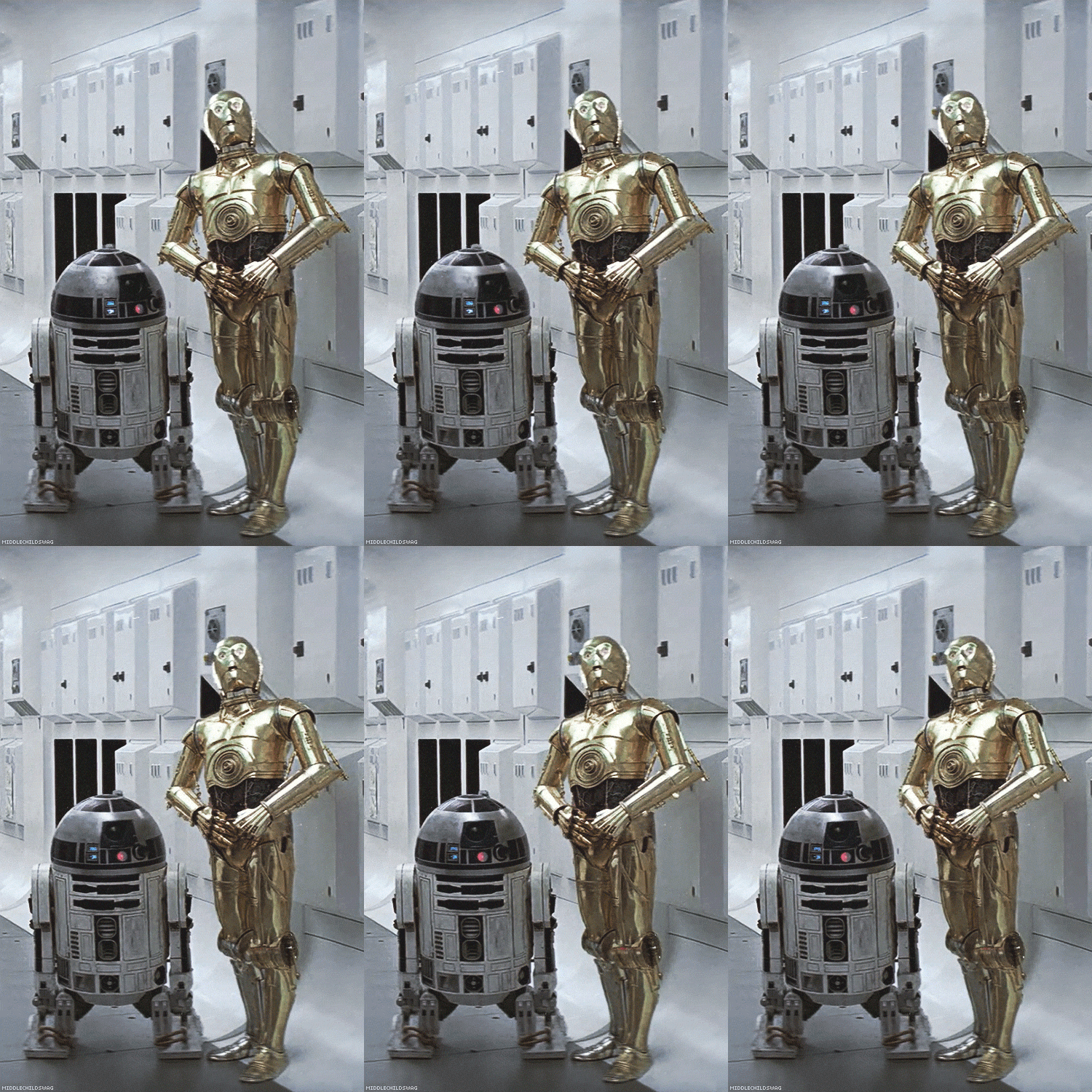
 Finally, why is it that despite having droid technology the Empire has all the droids that would actually be useful against a military force, and the rebels seem to only have droids that access computer systems and can speak a lot of languages while moving very slowly from place to place. Literally there were so many jams that they could have gotten out of way faster had they had droids who weren’t slowly ambling over to them. Meanwhile when it comes to fighting droids the empire has legions of them. Does the state control the means of production? Are we talking about some Soviet Union-like Empire? Perhaps so. My point is some angry fighting droids could have been a real help for a cause that can only scrounge up a couple hundred people from an entire galaxy.
 There are many common complaints I haven’t dealt with here. For instance many people say the writing is terrible in later movies. This is wrong. It’s all pretty bad. If you don’t think the writing in the original movies was bad it’s because you’re looking through it with a nostalgic lens. This isn’t rich writing with complex characters with a complex history, or complex relationships with each other.
 Now if you’re a big Star Wars fan you are probably full of counterarguments, and I’m here to tell you they are all wrong, and if you want to tell me that if I really want to appreciate it all, I need to read some nerdy set of books, that is also wrong. Star Wars is a movie experience. Also you should really just read my next part about why Star Wars is good.
 One thing that is fairly obvious among humans is that we don’t like uncertainty. To say that we don’t know something is to highlight ignorance. It’s the highest level of uncertainty we can reveal. Even us ego driven academics are often chided for weighing in on every issue, and it’s a stereotype that is not unfounded. But as every good teacher will tell you there is a lot of value of telling your students that you don’t know. Now maybe some students idolize your intellect and saying you don’t know might shatter the pedestal they put you on, but if they truly care about the pursuit of knowledge they should be lauding you for having the humility and honesty for saying “I don’t know”. No one can know everything, even in their own field. And it’s a moment to teach your students about how one goes about finding the answer to a particular question, and that you never really stop learning or being a student.
 The one thing that I think religion and science have in common is that they are both representative of our desire to know things and our uncomfortability with uncertainty. There are always things we don’t know. Sometimes big things like why is there a universe at all? Or, how did life begin? Many of the questions we’ve had over the years have been explained by the supernatural, only to have that debunked through scientific investigation. Refusing to leave things unexplained we have, in human history, always had those who claimed magic is real and that supernatural forces act with intent. But can we call supernatural explanations an explanations? It answers what, and sometimes who and when, but rarely how and why. It also seems to me that such explanations never really factor into things we are closer to understanding. For instance, we still have questions about lightning, but this is something that we also understand a lot about. We don’t say, “Alright we don’t know exactly how charge separation happens in a cloud, so therefore God.” We have enough of a physical understanding of the situation to know there are some details we haven’t worked out, but that it’s an explainable, natural phenomena. In ancient China, well before we understood anything about lightning, people believed that lightning was caused by supernatural forces and it would strike down people who were disrespectful to their parents. It’s as good an “explanation” as anything when you know nothing perhaps, but that’s a big problem. Such explanations are a dime a dozen, you could say “No! Lightning strikes people who are dishonest with their spouses”, “It’s pixies in the clouds, angry at humans for taking their home to make their village”, “It’s punishment for an entire civilization for their sinful nature”, “It’s an electric elk called Simon”. Things that promote magic as real render the investigation of scientific laws and principles useless. What value would understanding these things if such rules are ignored by the supernatural and the whim of a believer? People often want answers so badly they don’t care about the process.
 This is where science differs from religion. Science seeks to explain and is much more about the process of investigation than the answer. Obviously that is the endpoint of a particular question, but how you arrive at that destination is at least as important, if not more important than the destination itself. Science seeks to explain through premises that are verifiable and analyzing available data before arriving at a conclusion. This conclusion then must be reliable as a starting point for new questions to be answered successfully, and this conclusion must be reachable by others independently. And because we don’t always have or know what relevant data is to answer a particular question, we can’t guarantee that any conclusion is 100% right. We can only determine the most correct answer given a certain set of information.
 People say that history is also a way to know what’s true, but such people who say that don’t truly understand what good historical scholarship involves, or the reliability of such conclusions. Historians know that any one source of historical knowledge can be biased, so the more data (sources) about a historical event the more sure the conclusion. But even then there still may be cultural bias, or differences in the way historical events were recorded at different times in our history. The lexicon of a particular language was less complex than now and thus we can sometimes only guess at the true meaning of a particular text. We can also support historical claims with archaeological evidence. Apologists that I’ve debated with love to cite the truth of a historical event in the Bible, but saying a historical event happened doesn’t mean the rest of a particular text is reliable. We can’t say that because City A existed as described in the Bible, thus the resurrection happened. This would be like saying well Mel Gibson’s movie Apocalypto must be all factual history because there was a tribe called the Incas. The Bible is a mixture of ordinary and extraordinary claims, and given that it was written by people who were aware of history and the norms of their time it would foolish to expect all of it to be fiction. Unless we have some unaltered video footage we still can’t know anything for sure. Video footage of Kennedy’s assassination tells us that he was assassinated and where the assassination took place. It doesn’t tell us who did it, or why? That had to be investigated and evidence collected. And despite the many conspiracy theories out there, the one thing that nobody says is that God sent down a bullet to kill Kennedy. The laws of physics were obeyed. Somebody fired a gun and that bullet traveled as it should towards its target.
 The most important value perhaps of admitting “I don’t know” is that this means that it elicits curiosity and investigation. Having an answer, even if it cannot be tested, can often close off an avenue of investigation that might have otherwise been taken. If you ask me a question about the atmosphere and I give you an answer, you may simply believe me, based on my authority as an atmospheric science professor. If I’m right the fact that you don’t investigate for yourself costs you nothing. Yet if I think I know, or am afraid to look dumb and pretend to know my answer can prevent you from finding the actual answer, and now you may act on false information in the future. The reality is that there is too little time in our lives to investigate everything. Some things we do have to just believe. Having an answer is comforting. Believing in the supernatural can be comforting. That which is comforting doesn’t necessarily equate to truth, it is aesthetics. Aesthetics are important, but we shouldn’t expect everyone to share our aesthetic preferences.
 Finally it is often the case that apologists will also use uncertainty as a means of positing that all answers are thus equally valid in the absence of evidence. Sometimes this is true, but certainly there are some explanations that have a higher probability of being true than others. If a tornado doesn’t hit your house one answer to why, could be that God spared your house. But this is highly improbable given how much the dynamics and the thermodynamics of the atmosphere influence storm motion. Provided we could get sufficient measurements of the atmosphere, we would have a better explanation as to why the storm took one path and not the other.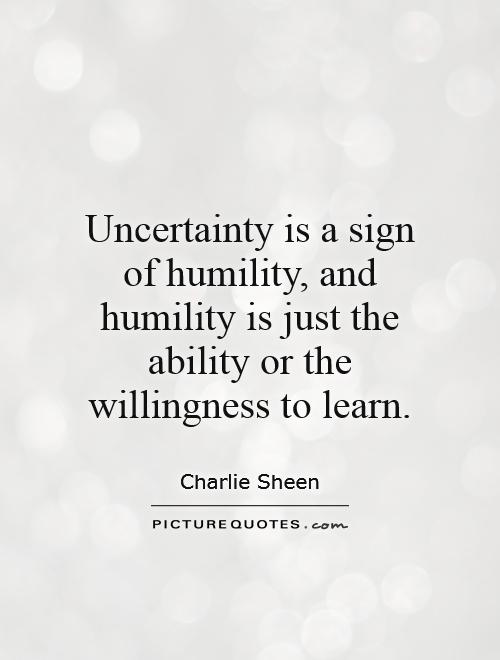
 Cloak Unfurled