Profit over Education – Academic Fraud at UNC-Chapel Hill Gives Another Black Eye to Public Education

As a college professor in the United States it is difficult to know where to begin as I process the massive scandal that I have read about today regarding UNC-Chapel Hill in which 3,100 students, nearly half athletes, were shown to have taken fraudulent classes in the university’s athletic program.  I am not usually one to make extremely bold statements, but education is something I feel strongly

about, and this scandal could not make a clearer statement that this country has lost its way.  The love of money has replaced love for each other.  We have let ourselves become distracted by games so that we don’t pay attention to what’s most important.  We have become a culture of fear instead of striving to be a culture of understanding.

Before I begin I want to make it clear that I am sure that the majority of professors and students at UNC-Chapel Hill have the highest standards of work ethic and integrity and as I speak now I speak also in your name.  Those who were part of this conspiracy have brought the most shame to you and I am truly sorry for what you have to go through. Bringing legitimacy to your university is a battle you did not ask to fight, but you will have to.  This fight can be made easier or harder depending on who joins that fight.  In this essay I write I call upon those who can do the most to help you.

This year Penn State University had their ban lifted by the NCAA on post-season play 2 years early and still much controversy remains about whether this was the right thing to do given that Jerry Sandusky has been confirmed to have molested 26 boys and school officials looked the other way to avoid a scandal for their football team. As if this wasn’t enough of a blight on higher education and how sports plays too high a role in what is supposed to be an institute of higher learning, perhaps it could simply be argued away as the result of one highly disturbed individual, while several higher officials chose to brush off what seemed to them only rumors without clear evidence.  Personally the Penn State incident should have been enough for us to take a harder look at our priorities, but as the NCAA softened their initial judgment by lifting the ban it seems that it’s business as usual once again.

What has happened at UNC-Chapel Hill has been happening for nearly 20 years. It, as a result, must involve a far greater number of people ranging from personnel in the athletic program, recruiters, registrars, administrators, and faculty  This was a large conspiracy that was covered up for many years and even when the investigation was first opened 5 years ago, it took a long time for the full truth to come to light.  Even now this article is buried on the CNN website under many other less dire stories.  At a time when public education struggles to maintain adequate funding, when there is a great disparity in public education across the country, and public institutions of higher learning continue to raise tuition as their state funding decreases, the scandal at UNC-Chapel Hill will only act to lessen the trust in public education.  What we must work hard to do right now is to show that it is not public education that is the problem, that this is the symptom of a for-profit culture.  That when the money made off of TV deals, advertising, and merchandise of college sports takes precedent, that those without integrity can take a larger stake in our society and run it into the ground.  Let’s start our call to action with the NCAA.

The NCAA proudly lists on their website their core values which include:

  • The collegiate model of athletics in which students participate as an avocation, balancing their academic, social and athletics experiences.
  • The highest levels of integrity and sportsmanship.
  • The pursuit of excellence in both academics and athletics.

For those you not aware of the word “avocation”, it means “hobby or minor occupation”. Note also the words “integrity” and the emphasis of “balance” and “excellence” in not only their athletics but also academics.  These core values are great.  As a society we should value athletic achievement, exercise, and health.  There is a connection between mind and body and it can come together in sport and competition.  It is also important to remember, however, that only about 1% of NCAA athletes will be able to turn professional that means there are many more students for whom their education will be their primary means of having a stable and successful future.  Thus if the NCAA believes in these core values it must also be an advocate for integrity in the classroom and at least be partially responsible for the health of the players who suffer injuries while playing NCAA sports which they profit from (NCAA is a non-profit by the way).  The NCAA has been recently accused of making large profit off the players who are often fed insufficiently and do not take care of the players who suffer injuries and who many times suffer lifelong problems related to those injuries both physically and financially.  The NCAA has a chance here to do the right thing and make its core values be more than just words.

While the NCAA should punish UNC-Chapel Hill for not displaying academic integrity in accordance with their core values, what is the responsibility of UNC-Chapel Hill? The university is ultimately the one that perpetrated this conspiracy and they need to make sure everyone involved faces punishment; no scapegoats, no more lies, no more cover-ups.  I understand why, from a legal standpoint, they cannot lift the degrees of those students.   They are the ones who advised students to take those classes when they saw they were struggling academically.  Rather than providing them with legitimate academic support to help them improve they gave up on trying to expand their minds and said “Your only value to us is in the money you make us in the athletic program, we are not concerned about your future”.  They were supposed to show a student how the same work ethic they apply to their sport, can be applied to learning.  They were supposed to show those athletes the same way they stretch and bend their body they can do also with their mind.  Given the low chances of those athletes becoming professionals they were supposed to give them alternate avenues of success.  And even if they did get drafted into a professional league, injury can happen at any time, and they were supposed to give athletes something else to fall back on.  Instead they have left these students bereft of legitimate degrees, and employers will have a hard time trusting the value of any degree achieved by a UNC-Chapel Hill alum who was involved with their athletics program.

I would also like to point out that the fraudulent program in which these students were enrolled in was an African-Studies program. While I am sure many other scholars can talk about this with more vigor than I can, I find the choice in the academic field of this fraudulent program more than a little insulting given the race issues we still face in the United States.  I know and have known many scholars in this area and this is an extremely important field for young African-Americans to learn about their history in this country and to understand issues of race both in the past and today.   I am not sure whose idea it was to use African-American studies to house the fraudulent courses but those people have done a great disservice to African-Americans by doing so and have treated a very important area of scholarship cheaply.

Of course we cannot be naïve enough to believe that this is the only school where this is happening. This scandal will open investigations into all athletic programs, especially in NCAA division I programs, that have had rumblings of grade inflation for athletes in the past.  It will make employers everywhere wonder if perhaps the academic success of a student athlete is deserved.  At my university, it is only a NCAA Division II school. Athletics is a money drain on our university and does not make us profit.  Yet many student athletes report that coaches will not let them miss a practice even if a legitimate academic opportunity that will benefit their future, such as going to an academic conference,  comes along.  I have seen resources that could be used for academic programs go towards athletics.   We all must join the fight to maintain legitimacy of public higher education institutions and remember that the NCAA core values emphasize balance and that the sport is, for almost all athletes, a hobby and nothing more in the context of their entire lives.

What responsibility do the students themselves share in this scandal? While they were advised to take these fake courses, they knew they were fraudulent.  One student who has come forward even made the Dean’s list having a semester full of fraudulent courses and admitted to not attending one class and receiving all A’s.  These are young adults who were not completely unaware that what they were doing was wrong.  It is difficult, however, for me to judge a young mind bolstered by the fame that we as a society gives them,  and bolstered by the pride of their friends and family at making a renowned college sports team with a full scholarship.  This is coupled with the fear of losing the scholarship that saves their family or themselves financial burden should they falter midway through their degree and cannot continue in the athletic program.  I am not going to judge you for decision you made as a young adult, but I would ask you to consider the steps you take now with care.  Because now that the scandal has been brought to light, the next steps you take are yours, and yours alone.  You know what you did was wrong, and you do a disservice to every student athlete who has worked hard to balance their athletics and academics to legitimately achieve their degree.  You do a disservice to the meaning of the baccalaureate degree which is supposed to be based on a minimum of 120 credit hours of academic rigor.  More importantly you do a disservice to yourself by knowing that you walk around with something that many are in great financial debt for and that many have worked hard for, but for which you did not earn.  Though you were misled, you were old enough to know that the easy path was not the right path.  Retake those credits and demand that UNC-Chapel Hill allow you to do so for free and provide for you the support they should have during your time there.

From http://www.fiscaltimes.com

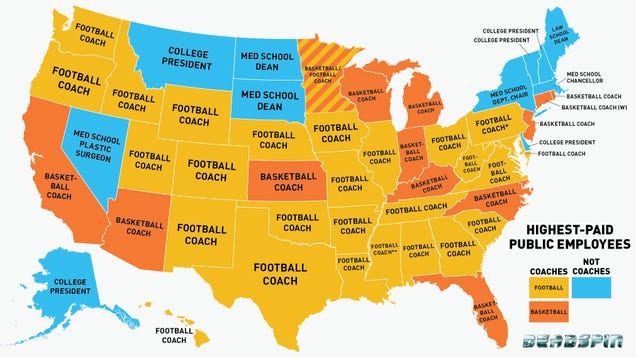
The final call to action is for the rest of us.  We must take a look at ourselves and ask ourselves some tough questions, because in the end it us who generate this profit from collegiate sports by watching and attending the games.  It us who read the articles and watch television programs of analysis.  It is us who buy the merchandise and wear the colors of our favorite collegiate teams.  So what can we do?  To start we, as parents, can make sure that the academic integrity is high at the institutions our children attend.  We can be realistic about what our child’s athletic ability really means and remember that even if they are one of the lucky ones to go professional that smart player is always better than just a player and that when the body breaks the mind still needs to be in good shape so that life goes on.  We need to ask questions, we need to talk to our children and make sure they are learning and let them always know that doing what is right is more important than a moment in the spotlight. We as the public need to make sure that we continue to fight for educational equality across this nation, to make sure that we maintain high standards in curriculum, academic rigor, and pedagogy, and vote for politicians who recognize the importance of education in making this nation great.  We must ask ourselves if it’s right that the highest paid public employee in 40 out of 51 states is a college football or basketball coach? Finally we must remember that a good life is built on a solid foundation made from love, integrity, compassion, humility, self-reflection, and learning.  Sports are fun to watch, but it’s still just a game, and the future of our children and our nation cannot rest on a game.

He Blinded Me With Science

As a meteorologist and scientist I am very familiar with many pseudoscience arguments and websites like creation science, new age science, anti-climate change arguments, and all the conspiracy theories that go along with it.  My colleague recently turned me on to a little gem of a website.  Somebody has ‘solved’ tornadoes.  I hope you click on the site.  Not only will the guy who owns this WordPress website be excited that he has so many hits, but you will immediately be able to tell that this person isn’t playing with a full deck.  At first I laughed a lot as I read it, but the more I read it, the more I actually started to be impressed.  Now don’t get me wrong, it’s not that I’m impressed with the actual ideas here, they are completely wrong, but I was impressed with how much time and thought this person has gone into thinking about the problem.  I don’t want to post any individual blog posts linked here, because I really don’t care to have this person start harassing me, but if you go through a number of them you’ll see that he has talked to some real experts in the field (although it’s unclear about whether he has e-mailed them or actually talked to them personally), he has posts where he has retracted some of his statements and then explained why he retracted them.  He has designed experiments to test his hypothesis as well.  In fact I’m a bit jealous that this guy actually has more blog followers than me.  Did I say jealous?  I meant frightened.  Anyway, what I thought what was really interesting is that here is a very unique belief system which has blossomed into something rather complex.  One that to my knowledge nobody else really believes (at least not yet, or at least I hope not yet) and yet bears much similarity to existing belief systems.  So I thought it might be interesting to deconstruct it a little and see what we get.

At the heart of every belief system is at least one premise that is accepted as true, without being supported by any empirical observations.  Once this is accepted as

From http://www.nc-climate.ncsu.edu

true, much can be built from it.  For instance many religious belief systems accept as fact that there is a God and goes on from there.  Many times of course there are several faulty premises.  It could be that they stem from an original, but it’s hard to say.  Let’s take a look at the one’s that seem to this gentleman’s starting point

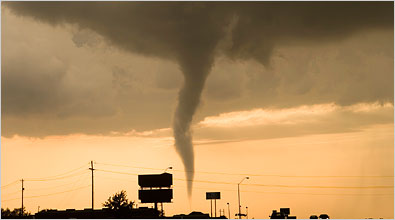
Premise 1:  The jet stream is a conscious entity that is thirsty for water and thus tornadoes are a result of the jet stream needing to suck up water.  I guess that makes a tornado a giant straw.

Premise 2:  Moisture is the most important factor in determining density differences in buoyant air. (Actually it’s temperature).

Premise 3:  Meteorology is a cult, and meteorologist simply believe in old and outdated arguments that have never been proved experimentally.

From this all sorts of things are possible.   If you were to accept the first two things as truth you would come up with a very different scenario for how and why thunderstorms and tornadoes form.  The 3rd premise is what then allows him to never have to rethink the first two.  People who could argue intelligently with him and are more knowledgeable are meteorologists and since they are part of a belief based cult they can’t possibly be correct or unbiased.

Another important part of a belief system is the inequality in standards the proponents of the belief system must live up to in comparison to non-believers.  For

From http://static01.nyt.com

instance, those against gay marriage will expect everyone to respect their right to be legally bound in holy matrimony, but do not have to respect the rights of homosexuals.  As is often the case pseudoscience literature like this, the expectation of other is to provide rigorous proof, yet no such proof is given by this gentleman as he espouses his hypothesis about how and why tornadoes form.   At its root I feel this comes from a lack of humility.  To be so sure you are right about something that you are beyond the need for evidence, and that you are beyond the ability of anybody (regarding their experience and expertise) to change your mind is to be so prideful that even Donald Trump would be impressed.  It is also a sad state to be in.  As I’ve argued before since reinforcing beliefs releases dopamine in the brain, over time as the neural pathways become so entrenched into a belief, this person literally will become ill to consider anything else.  The stronger the argument you make, the less likely you will get anywhere.

So what’s the harm in all of this?  Perhaps very little since there is a certain amount of crazy that even the most clueless about the subject won’t buy into.  Nevertheless there is at least enough science jargon on his website that people who are not educated about the issue may think there is controversy and conspiracy.  Just like many who are not educated about climate change think the same way.  There was at least one commenter who reblogged one of his articles saying it was an interesting “new theory”.  I wanted to also introduce this website and blog post as a lead in to a discussion of the age of information (or misinformation) that we live in.  This person has self-published a book for sale on amazon and has done a lot of writing on this subject.  If he had a little bit of money and/or web savvy he could make his site one of the top hits on google when people search for information about tornadoes.  Critical thinking skills are even more important today than they were before the internet to be able to navigate the flood of information that we are faced with on any one subject area.  Anyway, keep well everyone and stay away from thirsty jet streams!

Fleetwood Mac and why they are so great

From http://upload.wikimedia.org

On October 14th, 2014 I was fortunate enough to see Fleetwood Mac in concert.  They were amazing and I would like to talk about how amazing they are.  Or rather why I think they are amazing.  I know some purists will say that Fleetwood Mac was a band before Lindsey and Stevie.  I like that older stuff, some of it is pretty good.  However, it is clear their popularity and musical ability greatly increased with the joining of Lindsey Buckingham and Stevie Nicks. On stage Christie McVie called them her musical family and as I listened I started to get a vision of that family.  They are a family who stays together despite the fact that they are all very different people.  Their strength lies in both the tensions in personality but also that musical family combination.  It is perfection for a band and few bands can claim to have such a perfect combination of personalities and talent.  I would like to speak to this perfection by talking about their musical personalities and why they fit so well together.  I’ve even given these musical personalities a name they are as follows:  The Aura, The Violet, The Craftsman, The Silence, and The House.  Perhaps you can already guess which is which.

The Aura

Both leading ladies in the bands might be described as romantics, but in very different ways.  For Stevie Nicks love and

From http://www.fanpop.com

magic go hand-in-hand.  She is as mysterious as the moon and she is the feelings of romance that you can’t quite put into words.  You will love her and not exactly know why.  She dances, she moves, she floats, and she spins.  She is the girl you want to get close to, but not necessarily the one you should bring home to mother.  She lives in dreams and want you to live there with her. Who doesn’t love to dream? She is the theater, and who doesn’t love a good show?  You recognize that loving her might also bring peril and yet you are still drawn in.  This is why she is the aura of the band.  She envelops you and you can get lost in her.  She makes you dance to her tune, helpless, enraptured.  Her voice is as hypnotic as her beauty.  She might make you cry, make you break down, and shatter your illusions of love, but you’ll always think loving her is worth it.  And it is.

From http://www.popmatters.com

The Violet

Beautiful like a flower and modest as a violet; this is Christie McVie.  She is the sweet girl next door.  Pretty, honest, with a heart of gold.  She is the one that grows up into that mother that knows how to take care of everyone, both physically and emotionally.  She’s never wild in public, and she doesn’t dance all that well, but when she does dance you know she’s happy and you can’t help but smile when you watch her.  She is the girl you fall in love with and feel safe.  When she sings you know, she knows the score.  Her love is nurturing, solid and tangible.  You want to be with her everywhere. You listen to her and sigh, and smile, each note on her keyboard vibrates your heart a little bit.  Listening to her songs it is the same feeling you get when you taste sweet confection or a fresh baked cookie.  She is the treat you deserve after a hard day and will always make you feel right with the world.

The Craftsman

Where Stevie draws you in, Lindsey goes out and grabs you.  Where Stevie wants you to believe in magic, Lindsey tells

from http://www.entertainmentrg.com

you that you need no other plane of existence than this one.  He puts you in the here, and now and says “Listen…to…me”.  His voice and guitar will make you pay attention.  He is the hammer and chisel.  He is the designer.  He is a mastermind with background vocals, providing substance and melody to each song.  Through his genius all members of the band, as amazing as they already are, are even better because of him.  He constructs and he builds, then he sands it and varnishes it, and he works harder than everyone else, even though his genius might just qualify him to sit back and tell other people what to do.  His musical brilliance comes from the deepest heart of him, and yet he has no trouble digging to that depth to reveal it all to the listener.  You love to watch him, because you never know what he’s going to make, but you know you are going to like it in the end.  He has an intensity that is unmistakable and his greatness towers over you.  He is both humbling, but at the same time you know that his music makes you better than you are too.

From http://www.pollstar.com

The Silence

Who hears John McVie?  Everyone does, they just don’t know it.  When the others aren’t making noise, what is left?  Silence.  Like silence, John McVie is always there.  He stands in the same spot on stage, playing his bass with a stolid dedication that makes him a fixture, a landmark, an unchanging stone that all can depend on.  When there is anger and bitterness, he is playing his bass.  When there is joy and celebration, he is playing his bass.  When there is tenderness and sorrow, he is playing his bass.  When things are unfamiliar, he stands there, playing his bass.  He is that musician who will play as the Titanic goes down.  In his bass are the silent things like honor, dignity, and respect.   The silence provides solitude, peacefulness, and reflection. There at the beginning, he will be there until the end…silently playing his bass.

The House

But how would these 4 different, but amazing musical personalities ever choose to be in the same place if they didn’t

From http://www.musicradar.com

have a house to play in?  This is Mick Fleetwood.  He is the rhythm which brings them all together.  While John is reliable like a rock, Mick is reliable like a faithful valet or butler.  You might be dying on the inside, but he is going to make sure you look presentable and that the show must go on.  He is that kind of servant where you are never quite sure if you’re in charge though, or whether he is.  He is the soul of Fleetwood Mac.  He is both the history and the one who has made history.  He is also not afraid to play the buffoon, making everyone smile and laugh, breaking the tension when it’s high.  When you walk into the house you immediately know that your stay will be a memorable one.  Despite the genius of Lindsey, somewhere in the back of your mind you’ll wonder if Mick isn’t the real genius by finding a way for all these extremely talented musicians to stay in his house.  After all, every musician knows that it’s the drums that set the pace that everyone must march to.  And they all do it willingly because they know they are better together in that house than anywhere else.  He is the reason you get to say, “I love Fleetwood Mac”.

Why are you here?

There are many things I don’t understand about my college students.  In my 13th year of teaching as a professor I think I can at least make some solid observations.  Much of what I observed leaves me with more questions than answers.

My undergraduate experience was perhaps not typical in any way.  My parents paid my tuition, which was heavily subsidized by the Canadian government.  It is still a decent $3.500 for the year, which was a decent sum of money was back in the early 90’s.  I lived at home though, the university was about a 50 minute transit ride.  I am sure the fact that my mom got me a part time job at the university signing student loans was important in realizing how fortunate I was to not have to go in debt to pay for tuition.  My parents instilled in me that education was important and that doing well was also important.  That being said, despite the work I put in, I still ended up with only a B+ average in my undergraduate.  It was a lot of math and physics, and it was hard.  I wasn’t the perfect student either.  I cut a number of classes, but I was always aware when things were due and when were really important days to be there.   I never missed a deadline or a test.  If poor attendance led me to a less than perfect grade, there really was no one to blame but myself.  Sometimes you did get a bad teacher that discouraged you from wanting to attend that class.  But sometimes there are bad teachers.  You can complain, but it’s probably not going to make them a whole lot better.  Everyone was in the same boat and you did your best.  I never drank alcohol as an undergraduate; neither did most of my friends actually.  Which is perhaps a bit odd considering the legal drinking age in my province is 18.  I still have lots of fond memories of those days, and think it was a rather fun period of my life.

I held that dedication throughout my time in graduate school and it was that view of university and college life that I held as I became a professor at a small university in Pennsylvania.   I have found that my views about what college is about vary vastly from most of the students that are here.   Look, there are a lot of societal problems at work here too.  Perhaps the fact that guidance counselors try to convince every kid they should go to college when in fact they would be much better off in a trade school, or just taking some time off and working a low paying job to really understand what it takes to be successful in life and manage your time and money better is part of the problem.  Perhaps the fact that student loans are given out with alarming ease, with little time taken to really explain to the 18 year old how it will affect their life is the problem.  Nevertheless I have just seen a lot of baffling behavior among students since I have been a professor and it just makes me want to ask the question:

 “Why are you here?”

I have seen students spend the whole class text messaging, reading a novel in class, doing makeup, showing up 20 minutes late to a 50 minute class, or show up to class drunk, high, coked up.  And then there are the ones who don’t

From http://images.collegemagazine.com

show up.  The class is too early, too late, they are too hung over, it’s too cold, too nice, raining, etc all serve as excuses not to make it to class.  I have seen students make it to only half the classes in the semester.  I have seen students who seemingly only realized they missed an exam 3 weeks after the exam was given.  I have had students complain that I made a test for the day after their birthday, the day after St. Patrick’s day, the day after homecoming weekend, or worse yet Fridays.  Apparently Thursday nights are just party nights in general so having an exam on a Friday, especially in the morning is seen as a cruel thing for a professor to do.  All this is considered part of the “college experience”. Yet none of the people who are hired to teach or work at staff are hired to support this experience at a college, because the institution is designed to help young people further their education for the purposes of a career. Once again:

“Why are you here?”

So many students enter university undecided.  Spend an extra semester or 4 getting a 4 year degree because they switched majors and dropped classes so many times or had GPA’s so low they had to repeat courses.    The cost of

From http://www.studentloannetwork.com

tuition, even at this modestly priced public institution that I teach at, with housing, costs about $10,000 a year.  After 4 years you will start out $40,000 dollars in debt if you complete your degree in the standard time.  While it is sad that the government doesn’t emphasize education more and subsidize the cost more, from a practical point of view it is difficult to justify attending college without at least some clearer picture of what you want to do, and to simply do it as quickly as possible.  The student loan system in this country is terrible and sometimes it’s your only choice to getting an education and a career that you want.  That being said, it IS money you will have to pay back, and if you are going to be in that much debt it behooves you to also choose a career path that will allow you to pay back that money as efficiently as possible.  If you aren’t think of the financial reality before entering college then I have to ask:

“Why are you here?”

Please don’t get me wrong as I have met many mature students.  I would easily say that half of the students that I see, even ones that might not be doing particularly well in my classes will graduate and hit the ground running.  I hesitate to say too many numbers as my observations are only anecdotal, but I would say after teaching over 200 students a semester in 12 years that there are, conservatively, 20% who really don’t care and really would prefer to not be in college (or rather not be in college for the purposes of education).  Given how competitive it is to get a job, given how expensive it is to get an education, and given how salaries haven’t kept pace with inflation, why spend $50,000 on an education, to get a mediocre to poor GPA (especially when you’re field of choice has a low amount of jobs available)?  Isn’t there a better way to spend your time, money and resources?  For some people it is loan money, for some it is their parent’s money.  Interestingly I have never met a student who was paying for their own tuition who didn’t understand the importance of doing well and make the most of the money they were spending.

So ask yourself the question “Why are you here?”  And think about whether you might not be better off somewhere else.  Somewhere that was better suited to wear you are in life.  Somewhere better suited to what you want to do.  Somewhere that will give you a chance to figure out what it is you really want so that when you do enter college you are ready to get the most out of that environment.  College is an immense challenge in terms of your time and energy.  You will expand your mind and your heart.  You will meet great people from different walks of life. But, like it or not, university is about learning and education.  You can party anywhere like a rock star any where.  But think about the fact that your country needs you.  Young people are the ones with the energy, the ability to learn at a faster rate and think outside of the box.  Young people are the ones who are most needed in a democracy to be educated about issues.  Issues that they will face in the many years ahead of them.  There is a surprising amount of time to still have fun, but also start being a positive part of society and perhaps not getting wasted every night.  I love my job because of all the great young people I’ve met over the years, I just want to see young people also think critically about their decision to go to university.

Striving for a better world where you can keep your guns

An article I read recently has helped me admit the truth in regards to gun control.  There is truly no tragedy bad enough for us to reform our gun laws.  So be it.  It is a tiresome debate to be sure, and so I wanted to approach it from a different perspective.   In fact accepting the fact that people want their guns in this country has helped me ask questions that I might never have asked.  So let’s begin.

Let us accept as fact that guns are the best way to ensure safety in the U.S. today, which is full of criminals and people who want to hurt you.  Or in other words there are bad guys with guns; you need to be a good guy with a gun.  I don’t deny that there are far more good guys with guns than bad.   Okay, so you need this gun, whether it is to protect the people you love at home, or you might have to stop a bad guy with a gun in a public place.  I hope that it is not too much of an assumption to say that neither side of the gun control debate wants to have crazy people invading their homes or pointing guns in public places wanting to cause harm to others.  If you feel you need a gun in the world we live in now, that’s fine, but wouldn’t you like the world to get better?  Wouldn’t it be nice to be in a world where you didn’t need that gun?  Because let’s face it, a crazy person with a gun wanting to harm people is a stressful situation.  Somebody is likely to get hurt anyway before that person can be stopped, and the fright of a crazy person with a gun breaking into your home and being shot in your living room is an ugly sight to all who live there and can be traumatic, even if you were to just scare the intruder away with your gun.   So would it be safe to say that all would like to live in a safer world in which a gun wasn’t necessary?  It seems reasonable.  Again nobody physically wants to take your gun away.  I personally have no problems with guns staying in boxes in the corner of your basement, collecting dust because there is never an occasion to use it.  Even soldiers at war look forward to a time when they can lay down their weapons and not have to use them again.

Let us also accept the fact that there will always be criminals.  This is probably true also.  But is it true that crime levels are the same everywhere?  Of course it isn’t.  There are places with less crime, less homicides, and in some cases a stunningly low amount of guns. Now if we removed the U.S., which is a statistical outlier in terms of gun ownership, we might find that some of the countries with higher gun ownership (still less than half of the U.S. average gun ownership) have low crime.  If such societies exist then it seems that we would want to learn about what that society has done to lower crime, especially violent crime, so much.   Perhaps it is non-restrictive gun laws, but if gun ownership is 20-30 per 100 people, there are still a large number of people unarmed who could be taken advantage of by a bad guy with a gun, so the answer to their lower crime can’t be entirely gun ownership.   And this is aligned with what gun rights activists say, which is that gun control is not a means to make society safe.  So given that there are other countries that are safer, shouldn’t we be trying to achieve this type of society and trying to understand why they are safe?

What we’d probably find is that such societies have low economic inequality, good health care, emphasize education and have a high degree of education equality in all of its schools and universities.  Non-

From whenchemistsattack.com
From http://www.dailyyonder.com

restrictive gun ownership laws are likely to be only a partial answer to the solution.  The NRA lobbies to make sure gun ownership laws remain unrestricted.  They see it as sensible to make sure society is safe.  That being said, why isn’t the NRA also one of the biggest lobbies for quality education? Why are they not helping schools in low income areas getting better equipment and teachers to help people in those communities raise themselves out of their poverty?  Why aren’t they pushing for more funding to universities to lower tuition and public debt?  Why aren’t they using their vast wealth from supporters to create research grants for more research into mental illness?  Why aren’t they pushing for educational programs in schools that might help people recognize the signs early of mentally and emotionally unwell children, who when these problems go unaddressed, grow up into teens or adults who have the potential for violent behavior?  Why aren’t they pushing for better education about drug use and alcohol while decriminalizing, at the very least, marijuana which gives so much of the population a criminal record impacting their chance for future economic stability?  Don’t we want to live in a country where guns are not necessary?   Do we want our Generals in the military to be busy, or would we rather live in times of peace?

What seems strange to me is that it is mostly us naïve liberals who are constantly pushing for more money to education, health care, decriminalization of drugs (particularly marijuana), increased money to social services which help at risk youth, etc.  So I would like to formally say that I am willing to never speak of gun control again, if those who most vehemently support the 2nd amendment also take up the cause to live in a safer society.  You can still have your guns for when the government turns on you to attack you.  But just because society is unsafe, doesn’t mean we can’t strive for something better.  And there is better out there so let’s fight for that, instead of fighting over gun control.  Sound fair?


Why is Barack Obama Black?

Barack Obama Jr. and mother (From http://www.slate.fr)

It is given as a fact by people and media alike that Barack Obama is the first black president of the United States.  This has always irked me a little because Barack Obama is not black; he is biracial, as his mother is unmistakably white.  It makes me wonder why race is being portrayed a certain way.  It is not as if African-Americans are claiming he belongs to their race and white people are claiming he belongs to their race, everybody refers to him as being black.

I am biracial, with my father being from India and my mother born in Canada (half Scottish and half Mennonite).  Even if I were to choose which race I identify with

Barack Obama Sr. and Jr. (From http://upload.wikimedia.org)

most closely, it wouldn’t change the fact that I am of mixed race or that my skin tone is a lovely olive shade in between my darker father and my white mother.  Obama is the same way.  He is clearly lighter than his father and darker than his mother.  So why is he still black?  Personally I would be a bit offended if people try to label my race in a way that ignored the genetic and cultural influence of both my parents.  Moreover I was struck by the fact that when it comes to celebrities like Tiger Woods or Shakira, nobody has any problems identifying them as mixed race.  So, again, why is Barack Obama black?

Now it could be that African-American’s are happy to tout him as black because they are still an oppressed race in this country and for the sake of unity as they continue their fight for equality they are looking for an African-American leader.  Someone who can fly the flag for their race and as president make great strides towards greater equality in this country.  It would be sensible, but I think it would be insulting to many African-Americans to assume they are that naïve to think that one man can make that much of a difference to an elected body that is still predominantly white males and has relatively few minorities and women (in discord with the percentages of minorities and women in the country).

Then I wondered whether or not this issue doesn’t make a larger comment about race and racism.  Many people who are biracial have experienced some lack of acceptance as a result of their mixed race (fortunately not me).  This probably not only extends to mixtures of black and white, but all races.  Now here in the U.S. few would complain about a mixture between an Indian and Chinese person, but in India (and probably China) this would be a big problem.  As prejudice towards black people still lingers in this country, I wonder if it isn’t much more comfortable to label Obama as being black than biracial.  Many white people have grown to accept that black people have just as much rights at them, but for some it becomes a whole different ball game when their white child wants to date somebody who is black, or any other race for that matter.  It strikes me as interesting that while the Supreme Court ruled that segregation was unconstitutional in 1954, it would be another 13 years before they ruled that banning interracial marriages was also unconstitutional.  It seems clear that people are uncomfortable with mixing.  And I know it’s not only white people, and I know it’s not just a matter of race either.  As a half Indian I am well aware how much of a problem it would also be for my dad’s side of the family (and probably also my dad) if I married a Muslim (even if they looked like any other Indian) given that my dad was born in the Sikh religion.  Indians also have trouble with mixing amongst classes.  If I were to marry an “untouchable” or low caste Indian then that would be even worse.

Finally, it’s important to ask Barack Obama how he identifies himself.  According to what I could find he filled in African-American on his census.  I imagine as someone who has darker skin and curly hair, he was likely treated as black by most people who did not know his ethnic origin and perhaps that is why he identifies himself that way.  Certainly his struggles would have been a bit similar, but of course he did have a fairly well educated and financially comfortable situation growing up.  The cynical side of me might say that he identifies himself as black instead of mixed race to gain more voters. Either way, maybe it’s best that we respect his wishes, but it still seems to me that his “white side” is essentially never mentioned.  He’s black. End of story.  As I jokingly tell my black colleague in my department, “Obama isn’t one of you, he is one of me!”  And although this is going to be very controversial, I don’t agree that Obama is the first black president, he is the first biracial president.  It could be that because he was largely raised by his mother and maternal grandparents that he acts and sounds white enough to please white voters, and looks black enough to please black voters.  There is that cynicism again.  I truly believe that being the product of two different races gives me more uniqueness and strengths in my worldview and how I perceive race.  Given our country’s history towards racial mixing, perhaps Obama’s biracial origin is something we should be celebrating more.


More ramblings about climate change

I was asked to submit an essay to include in an introductory climatology text by a colleague but what I originally wrote didn’t get accepted because it was decided they wanted to place it in another chapter with a slightly different take so I had to make some revisions and changes.  I liked the original though and thought I would post it here.

In 2010 the burning of fossil fuels and the production of cement released 33.4 billion metric tons of carbon into the air.  It’s a big number.  An intimidating one perhaps, but what does it really mean?  Can any human identify with such a number?  A weight we can’t possibly experience for a gas that we can’t see.

Global averages temperatures which are not experienced by anyone. (from http://www.globalsherpa.org)

As individuals we experience only a fraction of the surface area of the Earth at any one time.  Our ability to experience change on a global scale is extremely limited.   The detection of changes in temperature on such long time scales is masked by diurnal and seasonal fluctuations.  We don’t experience average temperatures, yet the important environmental issue of our times asks us to take action based on things we do not perceive in our everyday life.

As individuals we are heavily biased towards survival from the pressures we face every day.  Civilization has given us the comfort of living apart from environmental pressures that other species experience more acutely.  It could be that civilization only gives us the advantage of delaying these pressures and gives us the illusion of comfort.  As an evolved species of animals who depends on other life for our very survival, our ability to fight off the enormous pressures that nature can exert may be dwindling.

In a typical thunderstorm there are approximately 1 x 10¹⁸ droplets.  Of course no one droplet means very much, but the collective of droplets in

From http://www.albany.edu

the cloud itself can produce lightning, damaging winds and hail, and flash flooding.  With approximately 7 billion people on the planet it is easy to view ourselves as a single drop.  With the issue of climate change it may be time to focus on what we are in fact part of:  As a species with a massive and growing global population with a great deal of power to change the world for better or for worse.  The question then becomes, “What can we, as individuals, do?”

On September 27th meteorologist and journalist Eric Holthaus, in response to the 5th Assessment Report on Climate by the International Panel for Climate Change (IPCC), vowed never to fly in an airplane again.  He felt very strongly about his carbon footprint.  A criticism often made against climate scientists who travel to conferences and meetings to discuss the issue.  His gesture is extremely noble and perhaps sets a good example for the rest of us.  He participates in many meetings now via Skype to avoid flying.  There are probably many of us, companies and organizations alike, who may not be taking great advantage of the technology that is available to us.  However, his case may also be an example of our disconnect between experiences as individuals without seeing the whole picture.  A response by William MacAskill, an ethicist at Oxford, pointed out that while Holthaus’ individual footprint might be high, his active participation through face-to-face interactions with policymakers internationally may reduce carbon emissions so drastically that it more than offsets his carbon footprint.  We all have different roles as individuals as part of the whole and although Holthaus’ sacrifice is well intentioned, perhaps he has not chosen the best way to reduce his carbon footprint given his abilities and role in this world.

Life constantly asks us to find that delicate balance between our individual needs and those of the collective.  It asks us to evaluate how our individual freedoms impinge on the freedoms of others.   The consequences of our actions as individuals have never had more far reaching impacts.  Climate change impacts the largest community we are part of: the global community.  The truth is, we all share the same space even if we can’t experience it.  It’s important to remember that in the individual fight for survival we always do it best when we work together.

It’s the End of the World as We Know It and I Feel Fine

There are some topics which completely perplex me, and this is certainly one of them. It seems strange to me for many reasons why people subscribe to the

From http://www.hydramag.com

possibility of the world ending in a sudden almighty purge.  This post has been a long time coming and I am sure I will not blow many people’s minds with anything I say here, but I will try to address the topic a more serious tone rather than the rant I feel like doing.

This post was prompted by an article my colleague quite humorously ranted about on Facebook about the blood moon being an indication of the end of the world. I quote: “People, it’s a freaking rock, orbiting a slightly wetter rock, orbiting a hot mess called the Sun! Shadows happen!” This end of the world prediction is just one in another line of many that have been made in human history. This Wikipedia listing gives a pretty good run down of whom and when end of the world predictions were made and you can see that there are around 150 listed in addition to ones that are supposed to still happen.  I am also sure there have been many more in human history that have not been documented. Most rational people would wonder why anyone would still buy into any more predictions about the end of the world when none of them have come true before. You know the whole “fool me once shame on you, fool me 150 times…” But it’s not enough to say well it’s obvious that these people with apocalyptic imaginations are wrong, the fact that they keep popping up should tell us that there is something in our psychology that causes some people to subscribe to such scenarios.

I read an interesting article in a great journal called Daedalus called Apocalypse and The End of Time by Richard Fenn who tried to analyze a lot of the commonalities between end of the world predictions and what societal influences seem to make them most likely. These are some of the things he came up with:

  • Many apocalyptic predictions come from people who feel society is in moral decay. This can arise from greater secularism in society, or because one culture feels that they are being influenced by an outside culture. Both of these represent cultural shifts in which an old way is being replaced by a new way.
  • Decreased economic conditions and oppression (or perceived oppression as is often the case by more religious zealots).
  • A fear of change in general. The young , people who think for themselves, and in more patriarchal societies, women all can represent a change to a current way of life.

Of course many of these things are interrelated and I think we can easily see how many of these things boil down simply to change and our inability to deal with an increasingly complex world. Thus it is not completely surprising to me that those who are more prone to believing in a fixed set of rules that govern the universe which are immutable and prescribed by the supernatural are also more likely to subscribe to end of the world predictions. As a scientist, to me change seems natural and inevitable and though some change is less pleasant than others I hope that the world will be propelled forward more than it is pulled backward.

For those who know me, you also know how fascinated I am with the subject of time, and, to me, time is also the study of change. Thus it comes as no surprise that Fenn argues that the apocalyptic imagination is an attempt to move away from the passage of time. With this timelessness we also lose change. We also lose individuality. Many of the apocalyptic prophecies involve the destruction of corrupting influences and the preservation of those who fit a prescribed moral code, merging with the one true God. Thus this desire for end times also perhaps plays to our psychological desire to remove complexity from the world to some harmonious state of peace in which nothing is changing and everyone is like everybody else.

And I can understand this desire.

There are plenty of times in which I wish I could freeze a moment and time and make it last longer. There are times in which I wish the world wasn’t so difficult, that there was no pain and suffering, and that I didn’t have to argue and fight.  This of course is fantasy. And fantasy has its place and I believe we need it from time to time to stay sane. Adhering to a fantasy for a prolonged length of time, however, is insanity. More importantly we should not forget that there is real beauty in change. The fact that I am an example of change, from a fertilized cell to a grown 40 year old man, that I have strived to learn and grow wiser and more moral with time, indicates that change can be a good thing. Change is inevitable, so let’s not fight change, let’s keep fighting to make things better. We still have a long way to go.

Respect my authoritah!

I was reading a fellow blogger’s post about the vaccination debate (a debate that should not even exist) as the author of the blog had highlighted a particular response to her blog from a physician and posed the question about why are we not willing to

From http://dublinopinion.com

listen to the physicians point of view.  She was also interested about why we would trust doctor’s in one case, but not in the case of vaccinations.  This is a very valid question.  If you are going to say doctors are out to lunch on vaccines and the very same medical science goes into everything else in the profession then you should never go see a doctor, take care of things on your own, and most importantly keep your kid at home so he or she doesn’t infect anybody else.

However it is the “Why don’t we believe the physician?” question that had me thinking as I drove to work this morning and I started thinking about how this is true for things like climate change and other scientific issues now and in the past like GMOs, evolution, the dangers of smoking, etc.  I was reminded of an excellent YouTube video that I have posted many times before called Good without Gods that talks about the basis for morality in a society.  One of the ways in which we can acquire morality is by default to authority, sometimes mistakenly so.  I believe that this is a basic cognitive bias humans have, perhaps because we all, from a very young age, default to the authority of our parents.  Part of growing up is realizing that your parents don’t have all the answers and don’t know everything, but part of our brains never really grows out of this default to authority bias.  This is in part why many people feel comfortable deriving their morality from religious authority without question.  Of course there is too much to know in the world and defaulting to authority saves time, and thus energy of which we all have only a finite amount of.  As a scientist I would say always be skeptical, but that means that we should also be equally skeptical to somebody who says vaccines cause autism.  In the face of controversy it seems the default to authority is what people rely on, so the question is, why isn’t the authority thousands of scientists who by consensus and exhaustive amounts of research say one thing as opposed to a politician who says another?  I have come up with a few possibilities but would be interested to hear what others think.  Here are the thoughts that I have come up with so far:

  1.        False authority figures. Who are the people we value in our society?
    Michele Bachmann – Not an authority figure (From http://www.warrenjasonstreet.com)

    Here in the U.S. it seems like the views of celebrities, politicians, and people with money (who are sometimes all one and the same) carry weight as being an authority on scientific issues.  This is simply not the case.

  2.        The power of money. In a highly consumer based society, money is seen as equivocal to power and thus authority.  If you have a lot of money you must have been smart to get it.  That is false of course.  Many people inherit their wealth, have connections, work very hard (but don’t necessarily have a high intellect), and some just get lucky breaks. Most of the smartest people I know don’t make money their goal.
  3.        Devaluing intellectualism.  In many countries I have visit those who are well educated, teachers, scientists are well respected in the community and in society at large.  Education itself is increasingly devalued here in the U.S. and so if educated people don’t have value in society that how can they be a worthwhile authority on anything?

The American Dream was built on valuing education, change, and progress.  We do not live in a society in which that dream is simply unobtainable for most and yet we believe in the concept like it manifested itself out of nothing.

Paltry Proverbs

If there was one thing Facebook is good for (or possibly bad for) is the dispensing of canned advice through adages, proverbs, clichés, and quotes from a random assortment of famous people. I’m not going lie, I do love a good quote now and then. There have been great minds in our history who have profound things to say. There is one adage that annoys me to no end, and so you’ll have to forgive for doing a little bit of venting.

“God only gives you only what you can handle”.

Now this has nothing to do with me being an atheist. Even if I was a theist this statement would be wholly false. Like many of the adages floating out there on social media at best this applies to first world citizens, but even then it still seems like it could end up insulting a lot of people.

My first thought when I first heard the expression: well how many people die of starvation every day? For your information 1.5 million children starve to death in the world each year. That’s over 4,000 children a day, or about 1 child every 20 seconds. Clearly these children were given a situation in which they could not handle. Why would God give children such a situation to begin with?

What about all the people who die of cancer, heart disease, or other fatal conditions? What about the people who suffer nervous breakdowns, have undiagnosed trauma, severe depression? What of those who go a step further and tragically take their own life?

There is no doubt that all of us have a certain amount of adversity we have to face in life. We of course want to survive and for the most case if we can handle it, we will. Nobody wants to just let a difficult situation destroy their lives, or weaken them to the point of personal neglect. Ultimately we handle adversity the best way can, and hope that we are better and stronger for it afterwards. But there are plenty of situations that are beyond one individual.

What is most bothersome about the saying is what it implies about you if you couldn’t handle the situation. If God gives you only what you can handle, if you didn’t handle it, then it must be your fault in some way. You must be doing something wrong. If this message is supposed to give you strength to handle a situation, failure to do so may not bring you the peace you desire.

In the end it is a fairly empty piece of advice, applicable to relatively mild situations, and really only verifiable in hindsight to someone who got through a difficult situation successfully. Personally I think we can come up with something a little more helpful than this expression.