Listening to the Blues

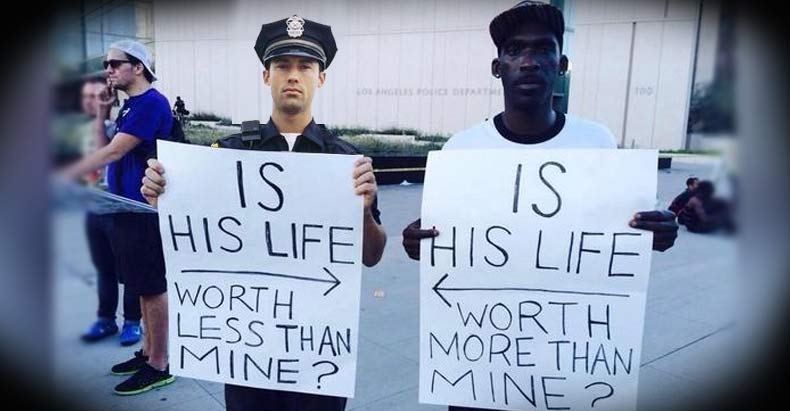
The current election has shifted a lot of attention away from the issue of police violence, but in searching through some of Sam Harris’ podcasts I found an episode that I found to be very very engaging.  If you want to get the perspective from a well-educated, well-trained police officer (Scott Reitz). I highly recommend listening to this podcast (Episode 25 of Waking up with Sam Harris). I felt it was important to hear this side of things.  I am a big supporter of the black lives matter movement as well, and my goal here isn’t to delegitimatize what is a very legitimate movement, but if we are also in the business of solving problems we need to hear from police officers, and we need to understand what problems they see.

Most people I know are even-minded about the issue.  They know most cops are good people.  They recognize that police are an important part of our society, and they don’t want to see police die.  They also know that there are bad cops, and there are systematic problems with the justice system that need to be addressed.

He raised a number of I think important issues about cops that I found very information.  For instance he said that the difference between the minimum proficiency requirement that cops need to have, and what a good cop needs to have are far apart.  But there is no training you can take for better shooting skills, or better hand to hand combat skills, unless you do it on your own time and own money.  He talked about why cops often fire so many shots at a target.  It’s simply because the hit rate is only at like 13%.  They are trained to take many shots at a subject.  There have been also many changes on how police do their job that have made it harder.  The choke hold for instance which killed Eric Garner, was outlawed, and perhaps for good reason given how it might have impacted somebody with certain health issues.  Garner being no exception.  However, what Mr. Reitz said was that the removal of a cops ability to use this method, took away a main method of incapacitation often used previously.  He also talked about how often tasers and other incapacitation method’s fail.  It was mentioned how recruitment standards have fallen greatly in who they accept.  When he first became an officer in the 70’s he said it was typical for police officers to have university degrees.  This is no longer the case, so standards are being lowered in terms of who they accept.   He was also agreeable to the idea that there are just a lot of cops who shouldn’t be cops.

There were a couple of places I disagreed with Mr. Reitz in the podcast and I wanted to discuss in a little more detail.  At around the 50 minute mark they discuss the topic of “back talk to officers, disrespect, how you should deal with illegal actions by a police officer”.  Mr. Reitz’s advice is that you don’t know the kind of day or week an officer has had.  They see the darker side of society, they often work long hours, and starting off your conversation with a police officer in a combative way, even verbally is a recipe for escalating the situation.  I am not sure that I necessarily disagree with this advice.  But what I started thinking was the following:

  • Nobody likes being treated like a criminal if they’ve done nothing wrong.  Nobody likes having their rights violated even if they have.  Nobody deserves to be shot just for a traffic violation.  I guess in the end, it’s not a reasonable excuse to me that the cop is overworked, or that he’s had a bad week or day that I am somehow asking for abuse by not being as passive and compliant as possible.  That’s victim blaming, and I can agree that to some degree cops are also victims of a system that isn’t giving them the training or the workload to reduce their stress levels.
  • Following from that, why is it not on the cop to think that maybe this person is also having a bad day or week? We are usually not going to be in the best of moods when we are pulled over, but if this is just a small bad incident in a line of bigger ones our attitude may not be great either.  Isn’t possible that a black person might just have felt racially profiled one too many times in his or her life, that they are in a bad mood?  When two people who are having a bad day meet. Right and wrong still matter.  The cop has as much responsibility to act right as the person does.  I think that, and Mr. Reitz seems to argue this at times, is that we are probably better off recognizing the reality that cops face, and that most of them aren’t particularly well-trained, and don’t necessarily have a lot of experience.  Sometimes you do have to be smart over being right.
  • Finally and most importantly, the idea that an officers wrong actions can be rectified after the fact, is not necessarily a guarantee. This is a big part of the frustration expressed by the Black Lives Matters movement.  The wrong actions of the cop, are supported by other cops, and are supported by judges.  In many criminal cases people can’t afford lawyers and they are often bullied into accepting a plea bargain by an overworked public defender and prosecution.  So there is frustration here by many.  They’ve seen what has happened to people they know, especially those with less financial means, and for many, even though they may be putting their very lives in danger by standing up to a cop, don’t have faith in the rest of the system to protect them.  I think we have to recognize this reality as well.
Another area they talked about was gun control.  Sam Harris I think tried to get him out of the practical side of things and just look more at ethics, but I suspect Mr. Reitz is extremely pragmatic, because I think you have to be in his line of work.  As I’ve argued before I think that the love of guns here is something that you have to accept to be in the U.S., but that we can try to fight for a society where we don’t them as much.  Anyway, Mr. Reitz supports the ownership of guns for home protection, but is less than enthusiastic about open carry or conceal carry.  I would expect most cops feel the same way.  In regards to personal protection, I can’t argue in some ways with the idea that a gun is an equalizer.  There are very bad people out there, and they are far meaner and stronger, and having that gun, just in case, is a practical solution to the problem.  Mr. Reitz seemed to take it as a given, however, that those of us in positions where we might be worried about the worst, would still see owning a gun as the only solution.  I know many people who have been victims of crimes, but not all of them seek guns after.  When you come from a place with very few guns, or where it’s more difficult to get one, even when bad situations do happen, guns aren’t the first thing we think of to be safe.  I think that it’s a very American attitude to think that a gun is the only solution.  And the type of violent crime of a complete stranger coming into your home to do unspeakable things to you and your family, while possible, is rare compared to people being victims of homicide or rape by people they know.  I guess it raises the ethical question of: How far do we go to let people feel safe, knowing that a very small percentage of those people would actually be victims in a situation they could have stopped with gun and knowing that the large amount of guns it keeps in society makes more gun violence possible?

I found Mr. Reitz to be quite reasonable and well-informed overall.  He believes that guns should be in lockers and only for hunting or home protection.  Because he also accepts the reality that few people are likely to get the training they need to be able to use a firearm well, and to have practiced shooting targets, and to store and care for it properly.

In the end it was nice to listen to a conversation that was substantive in which the right things were being discussed.  So often on this very important issue we don’t get to have this conversation, because it immediately turns into things like “Cops are heroes!” or “Banning all guns is against the second amendment!”  Imagine if we could always have such thoughtful conversations, we might be able to solve problems that might meet the concerns of both Black Lives Matter and Blue Lives Matter.

In the end I really appreciated Mr. Reitz’ perspective.  I imagine it is generally impossible not to be impacted when your entire career has been dealing with hard cases and the worst of people, even if it’s just a small percentage of the population.  It’s great that he has remained even-minded and thoughtful about his own job.  I really can’t imagine how stressful it is.  In a way we have perhaps made strides in more sensible policing from a policy point of view, but I think when you want to put more public safety and compassion into policing (which is the right thing) that does impact its structure, and what type of resources we have to put in.  To make it work we have to support better training, better mental health support, higher qualifications.  An acquaintance of mine here, when I talked about the attack on public education, said it’s not much better for the police either.  Nobody wants to pay taxes, nobody wants to support the institutions that make for a better society.  Mr. Reitz summed up his thoughts on policing today by the following quote:

“Most police officers out there feel overwhelmed with the demands on them…[we’re saying to them] ‘I want you to hazard your life, but I want you to be really careful in defending yourself’….it’s hard”.

If you have time give the whole thing a listen.  If not, keep trying to have good conversations about this, because it is important.

In the Words of Sam Harris re: Trump

I have wanted to do a blog post on Sam Harris for some time.  I’ve had trouble sort of knowing where to begin.  My first introduction to his work was his short book, or perhaps long essay, on free will.  I found him to be an excellent thinker.  Then I noticed that he was being attacked a lot by the left and I wanted to learn why.  Like many great thinkers, they can seem unfeeling, and I do think there have been many instances where atheists like Richard Dawkins or Sam Harris have been taking completely out of context.  For them ideas are not something that can be handled in a sound bite.  They like to break down arguments into their components and take a line of reasoning in a particular direction and test it out.  And I can see why people find distaste for Dawkins at times, and after reading a lot of Sam Harris I can see why there is distaste for him as well.  But I would say if you don’t like Sam Harris it’s because you haven’t really read what he has to say and have been going by what critics say about him, or you find what he has to say uncomfortable.  He is critical of the left, even though he himself is clearly a liberal.  Like me, he is against bad ideas.  And he is very good at reasoning what is a good idea and a bad idea.  In this era of identity politics it seems like there should only be us and them and Sam Harris is trying to find common ground.  Trying to promote reasoned discourse.  I connect with him for this reason, and I connect with him because he is scientifically minded, and I find him to be brilliant.  That doesn’t mean that I always agree with him.  I’ve come to a place in my life where I feel sure enough of my intelligence that I can even disagree with someone I find profoundly brilliant.  I’ll tell you this much though, if you are a liberal, you do yourself a disservice if you’ve written him off.  Whether you end up agreeing or disagreeing, if you want to be liberal and progressive, truly try to take in what he is saying and follow his logic, it will at the very least lead to some quality introspection.  Proving him wrong through reasoned arguments will make you richer than dismissing him on an emotional level.

The main reason for this post is that I was listening to his podcast called Waking Up With Sam Harris, and there was a segment that was so wonderfully said that I had to transcribe it and share it.  I know myself, my wife, and many that I know have been feeling this sense of complete disbelief at Trump’s win.  Not that Republican’s won, but Trump in particular.  It’s so obvious to many of us what a complete liar and con man he is, and he’s not even a good one.  It makes 100% sense why many people would vote for almost any other Republican candidate, but in many ways Trump still remains a mystery to many.  We can read story after story about why Trump won, but in the end, there is still this sense that many other politicians could have also had this appeal.  Anyway, Sam Harris here simply breaks it down perfectly and provided structure to my disbelief in all this, and why I find Trump as such a dangerous person to be president of this country and why I worry about our future and wonder if we, as a nation, can head in the right direction once again.  So without more of my rambling I wanted to share these words with you from episode #64: Ask Me Anything 6.

“There is a difference between truth and lies.  There is a difference between real news and fake news.  There is a difference between actual conspiracies and imagined ones.  And we cannot afford to have 100’s of millions of people, in our own society, on the wrong side of those epistemological chasms.  And we certainly can’t afford to have members of our own government on the wrong side of it.  As I’ve said many times before, all we have is conversation…you have conversation and violence.  That’s how we can influence one another.  When things really matter and words are insufficient, people show up with guns. That’s the way things are. So we have to create the conditions where conversations work.  And now we’re living in an environment where words have become totally ineffectual.  This is what has been so harmful about Trump’s candidacy and his first few weeks as president.  The degree to which the man lies, and the degree to which his supporters do not care, that is one of the most dangerous things to happen in my lifetime, politically.  There simply has to be a consequence for lying on this level.  And the retort from a Trump fan is “Well all politicians lie.” No.  All politicians don’t lie like this.  What we are witnessing with Trump and the people around him is something quite new.  Even if I grant that all politicians lie a lot.  I don’t know if I should grant that.  All politicians lie sometimes, say…but…even in their lying they have to endorse the norm of truth telling.  That’s what it means to lie successfully in politics (in a former age of the Earth).  You can’t obviously be lying.  You can’t be repudiating the very norm of honest communication.  But what Trump has done, and the people around him get caught in the same vortex, it’s almost like a giddy nihilism in politics, you just say whatever you want.  And it doesn’t matter if it’s true.  “Just try to stop me”, is the attitude.  It’s unbelievable.

Finding ways to span this chasm between people, finding ways where we can reliably influence one another, through conversation, based on shared norms of argumentation and self-criticism, that is the operating systems we need.  That is the only thing that stands between us and chaos.  And there are the people who are trying to build that, and there are the people who are trying to take it down.  Now one of those people is people is president. And I really don’t think this is too strong.  Trump is, by all appearances, consciously destroying the fabric of civil conversation, and his supporters really don’t seem to care.  I’m sure those of you support him will think I’m just winging now in the spirit of partisanship.  That I’m a democrat, or that I’m a liberal, but that’s just not the case.  Most normal Republican candidates, who I might dislike for a variety of reasons like Marco Rubio, or Jeb Bush, or even a quasi-theocrat like Ted Cruz, would still function within the normal channels of attempting a fact based conversation about the world. Their lies would be normal lies, and when caught there would be a penalty to pay.  They would lose face.  Trump has no face to lose.  This is an epistemological pot latch.” (Sam Harris then describes what a pot latch is: a Native American practice of burning up your prized possessions as a way of showing how wealthy you are).  “This is a pot latch of civil discourse.  Every time Trump speaks he’s saying, “I don’t have to make sense.  I’m too powerful to even have to make sense.”  That is his message.  And half the country, or nearly half, seems to love it.  So when he’s caught in a lie, he has no face to lose.  Trump is chaos.  And one of the measures of how bad he seems to me is that I don’t even care about the theocrats he has brought to power with him, and there are many of them.  He has brought in Christian fundamentalists to a degree that would have been unthinkable 10 years ago, and 10 years ago I was spending a lot of time worrying about the rise of the Christian right in this country.  Well it has risen under Trump, but honestly it seems like the least of our problems at this moment.  And it’s amazing for me to say that given what it means and what it might mean to have people like Pence and Jeff Sessions and the other Christian fundamentalists in his orbit, empowered in this way. ”

Resist my friends.

Opposition and Divisiveness

This is going to be a little bit of a rant, so if it seems like I forgot to breathe at times, don’t worry I assure you I’m alright. 🙂

We’ve all heard the tone of those who voted for Trump, maybe they were third party voters, or didn’t vote at all “let’s give him a chance”, “let’s see how he does”, “I am going to support him since he’s my president”.  As nauseating as this can be, there is something worse to me that’s driving me up the wall.

“You’re being divisive”.

This is hard for me to understand.  Look, there is no question that we are a nation very much divided right now, and we need to, somehow, try to unite as a people.  There is no question about that.  During the past 8 years I heard people say all sorts of ridiculous things about Obama being a socialist, death panels, taking away everybody’s guns, and host of fabricated tales mean to discredit the president and his administration.  I tried presenting counter information without name calling.  I did not see their disagreement as divisive, just somebody who wasn’t informed or had a different point of view.  I never accused anybody of being divisive.

Now all of a sudden everybody on the right is concerned about how divided this nation is, and at that by opposing Trump’s terrible ideas we are being divisive.  When the right said they didn’t like the ACA, did anybody tell them to shut up they are being divisive?  That they aren’t helping?  To get behind the president?

I am a scientist.  I try to base my opinions based on something, and defend my point of view.  Sometimes my information isn’t the best and I own up to it.  But when my disagreement is being labeled as divisiveness, this is pure distortion and I will not take ownership of that label.  I’m not being derisive to people personally, but I will challenge ideas that I think are harmful.  And these people who label me as being divisive were never calling out people on their own side for the same behavior.  I mean if you know a large portion of the country is pro-choice…shouldn’t you tell your pro-life friend to stop posting videos of bloody fetuses on Facebook?  Never seen that happen once.  Never seen a Republican tell the birther’s they were being divisive.  I’ve never seen a Republican ever tell another Republican they are being divisive for posting something that the other side disagrees with.  But all of a sudden liberals are all divisive.  We are the ones causing division.

It’s not divisive to make abortion illegal, to normalize sexual assault, to call scientific consensus a hoax, to label illegal aliens as drug dealers and rapists, to build a giant wall, to freeze immigration on refugees if they are Muslim, to say gay people can’t marry the people they love, to say you are going to lock up your political opponent in jail….an entire campaign run entirely on divisiveness.

And because I not only resist those notions, but can defend those positions with evidence and statistics, that is deemed divisive.

Look, I am not saying their aren’t a great deal of liberals calling people names, or calling Trump names gets us nowhere and is arguably divisive.  But posting tips for activism, pointing out hypocrisy, presenting one’s viewpoint in a reasoned manner should not be seen as divisiveness.  One person, who dropped me off of Facebook, even told me that my divisiveness was of the kind that would lead to war.  And this was somebody who told me that she doesn’t vote for any party that doesn’t support banning abortion and told me Trump would restore morality to the country.

So I’m not sure what you want from me.  If it’s silence, that isn’t going to happen.  I am going to keep presenting what I think are informative and well-argued articles, and I am still going to reasonably explain why I think a certain action or ideology is wrong.  People act like I don’t spend a great deal of time trying to understand other points of view, I’ve reached across the aisle more than anybody has reached across to me to understand my point of view and I’ve actually adjusted a number of my positions on issues as a result of it.

So when somebody who denies the existence of climate change is put in charge of the EPA, or a white nationalist is put on the National Security Council, or a completely unqualified person is put in charge of the Department of Education and you are silent about it.  You are the one being divisive.  You are the one who voted for someone who used divisiveness as a tactic to win your support.  I am speaking out because you won’t, because I feel we will all lose at the hands of the people in charge of government.

And in the end, if you still think that’s being divisive, well then I can accept that, because I have no business being on the side of someone who, if they find my viewpoint disagreeable, can’t engage in civic discourse about it.  I still bear you no ill will, but I have a country to worry about and I really don’t have time for your hypocritical judgment.

Rant over.

Female Future Leaders

In response to bloggers who say I don’t talk about women’s issues very much I thought I’d capitulate and see if I can come up with something that they would like.  Of course if I were to be honest, I’d say the real reason is because the inspiration I felt from the women’s march on inauguration day gave me so much strength.  It was a great way to begin what are likely going to be 4 hard years.

An article that I thought was very well written was a response to post that made its rounds on inauguration day that was no in support of the women’s march.  That response is titled “You Are Not Equal. I’m Sorry.”

Not surprisingly this article elicited a response and I’ve chosen to critique this response for two reasons.  One this article was posted on a website called Future Female Leaders – America’s leading social movement for young conservative women. They have merchandise by the way, and all future female leaders are apparently thin, white, and pretty (and also apparently only two women), but I digress.  I also wanted to critique this article because I found the rhetoric in the article to be full of the very things that tend to harm women.  There are Christian undertones without actually talking about Christianity, there are weak and fallacious arguments that do nothing to demonstrate that there are strong intelligent women out there, and then there is also the beginning sprouts of the Republican establishment philosophy which I am sure will make the author quite popular with the patriarchy and those who wish to be complicit with it.  So feel free to check it out for yourself, it’s called: “Yes, I Am Equal. I’m Sorry You Are Offended By Us Women Who Lack A Victim Mindset”.

From the very start we have one logical fallacy.  The title contains a strawman argument.  If you’re a feminist who believes that women should be equal to men in society, and apparently disagree with her, then you must have a victim mindset.  Apparently that’s what feminists are.

  1. The first point here begins with a misquote and demonstrate that this future female leader is someone who is unable to research well and is willing to take things out of context to argue her points.  Here is a well-researched article from politifact about Sanger’s quote.

“Those who think Sanger wanted black genocide cite the Negro Project. But even their strongest evidence, a passage from a letter she wrote advocating that organizers recruit black ministers for the project, does not come close to proving a genocidal plot.

Sanger wrote that “We don’t want word to go out that we want to exterminate the Negro population and the minister is the man who can straighten out that idea if it ever occurs.”

But her correspondence shows this sentence advocates for black doctors and ministers to play leadership roles in the Negro Project to avoid misunderstandings. Lynchings and Jim Crow laws gave blacks good reason to be wary of attempts to limit the number of children they bore. In Harlem, she hired a black doctor and social worker to quell those fears.”

This should be enough to not take this writer seriously, but since she might be a future female leader let’s move on.

  1. It’s true that we have laws set up that give women equal pay for equal work. But this isn’t at the heart of gender gap in pay.  The wage gap is based not on a straight calculation of pay, but other factors that impact the careers options women have in society. Most jobs if they do give parental leave, it’s only for the women.  What the pay gap is about is demonstrating that we still live in a society where women are the ones expected to shoulder a larger share of the parenting duties in favor of their career.  This impacts the careers they choose, and the fact that they often choose flexibility over pay as a result of this as well.  Women also face difficulties where their assertiveness is not valued, even though for men it would be.  They are seen as a bitch or abrasive.  Asking for raises is such a behavior and is often not looked kindly on in the workplace.
  1. Scientifically speaking, a fetus also isn’t a tenant in a woman’s body who can come and go if it pleases and compensates each month with rent. Also a fetus is NOT the very definition of a human being, which makes me wonder if this future leader has picked up the dictionary.  Look, I know the debate about personhood may never be resolved.  But the fact remains that the fetus takes from the mother in order to live.  It’s not even a symbiotic relationship, it’s closer to parasitic.  Now you can chide me for being unromantic about the most beautiful experience ever, and, believe me, when my son was born it was a beautiful thing.  But I also saw my wife go through pregnancy and I am aware of how taxing it can be, how delicate her life becomes for a mother when something is trying to feed off of her in order to survive.  My wife had very high blood pressure near the end, and was essentially on bed rest.  In the end it is her body, and her right to decide what happens to it. A fetus is not a human being, and if you want to call it that, fine, but consider the woman’s humanity too.  That seems to always get lost on so many pro-lifers.
  1. Not sure what her argument is here. There is an issue about the Tampon Tax.  I could find no evidence of it being taxed more than other items, but there has been lots of research that women pay more for identical products than men.  Whether this is sexism, or price gouging, or both, we can debate, but certainly points to the emphasis in society of female appearance.
  1. She thinks rape and sexual assault is because society lack of morals. And apparently the way to deal with a lack of morals is to carry a gun.  She’s a regular Republican talking point there.  Whether you carry mace or a gun isn’t the point, and it does nothing to solve the moral problem.  People are getting raped.  That’s the problem.  Also why is it society’s lack of morals?  Isn’t a rapist’s lack of morals?  Which as it turns out, tend to be men.
  1. Yes both men and women are objectified. But I think we might be a bit confusion on the issue of proportion as well as the attitudes such things generate toward the different genders. I think there is pretty clear evidence that women are objectified more than men.  An interesting study here demonstrates why that might be.
  1. While it’s true that men are also victims of domestic violence, the one place where this future female leader decided to post a link in support of her argument is irrelevant at demonstrating the women have little to fear, but seems aimed to try to demonstrate that women are more dangerous than men. Overall statistics that look at violence against women demonstrate that women are most often victims (in the U.S. it’s better than in many other countries in the world), and when you factor in things like stalking, and rape, the level of fear that women experience is far greater than what men go through.
  1. Talk about a reductionist argument here. This is about how girls are raised, and treated by others, not meeting them on the street.
  1. Legally guaranteed rights doesn’t mean that oppression goes away. I mean the same laws exist to protect African-Americans but racism still exists.  Of course I suppose since she a future female conservative leader she probably disagrees.  I mean we had a black president right?!  The constitution has guaranteed equal rights for all citizens of India, so the caste system is gone as well!  Millennia of oppression is always instantly wiped out with laws!  Sorry for the sarcasm here, but I couldn’t help it.
  1. Well she doesn’t think that women are less than equal here in the U.S. So not much to say here.  But it’s insulting.  And apparently if you’re a feminist if you’re fighting for the right to legislate your own body you aren’t a real feminist.
  1. Feminism is about empowering women. I know many who have been empowered by the ideals of feminism.  I am not sure where you are getting your definition.  Perhaps you are getting it from the most extreme in the particular group.  Every group has it.  There are those that call themselves feminists who are not after equality but dominance.  These are small amount.  Just as there are small amount of Christians who are the Westboro Baptist Church.  Thus your argument is a fallacy of composition.  And it may be true that many women are afraid to label themselves feminist.  Because labels carry with them complications.  But maybe they are afraid of the label because of people like you who misunderstand feminism.  I consider myself a feminist and am unafraid of that label, because I know what the movement is really about.

And this young lady’s response of course ignores many of the statistics in the first article, and so there is a lot of intellectual dishonesty here, whether purposeful or not.  Look I’m not going to make assumptions about her back ground but if this is the attitude behind our future female leaders, I am going to say no thanks for now.  The fact that you can even have a dream of being a future female leaders is because of this feminist movement that you are denigrating.  Elisa is still young, just a college student.  I hope in that time she will learn more, and most importantly get to know more women.  Not just ones like her.  Really understand what women go through and realize that there are many strong women who don’t consider themselves victims but would steadily oppose her views as I do.  And for her to put down this march is really insulting to so many women.  We have a president right now who is very much a misogynist.  It’s not just about abortion.  It’s about having a leader who normalized sexual assault, and the objectification of women in the way he speaks.  And how that wasn’t enough to prevent over 60 million people to vote for him.  Most of them men.  Women have cause for concern, and the millions of women who marched for the purposes of saying their freedom, their autonomy, their equality, and their humanity should not be belittled.  Especially from a future female leader, who hasn’t done her homework.

Thoughts for today Jan. 20th, 2017

Many of my friends have had great things to say today. I have felt fairly empty lately.  Empty of creativity, or anything wise to say.  A lot of intellectual energy has been focused on keeping down a background of feeling of worry and dread for what’s to come in this country I have made my home.

Watching this video gave me pause for thought. They are old words, which have relevance today. But what it made me think of is that there is much in this universe that is bigger than I am. The events that led to Trump being elected, and the events that follow…may well beyond my control. There are maybe only a handful of causes that I can be active in, and I will fight and stand up for those who may fall under oppression and to those who people in power are denying them their humanity. I will always try to be more than I am, but I’ve realized that what I am today is also important.

I am a scientist.  The scientific method is simply the best tool we have for knowing, and well humans utilizing it may make mistakes, it is more reliable than anything I know.  I will continue to re-evaluate my views, and defend my views through the vehicle of science.  Introspection and advocating effecting methods for discovering our universe is a way out of the darkness.

I am an educator.  The reason I became one is because I love learning, and I love thinking about things.  I need to make sure to continue to pass that on through my job.  Curiosity and learning are wonderful and fundamental human qualities.  It is a way out of the darkness.

I am a husband.  I have this amazing wife who is strong, capable, and compassionate.  She doesn’t let herself be guided by convention or rules placed on her by society.  I am simply better because of her.  She reminds me that whether we are different by gender, or by race, we are better together.  Humans survive through cooperation.  It is a way out of the darkness.

I am a father.  As I watch my son grow, I know exactly what humanity is.  We are affectionate, we are kind, we play, we learn, and we love.  As a species we have propagated over countless generations.  Everybody is part of a family.  And we are all the same species, thus we all share so much and spend too much time focusing on the differences.  Children are the future, and if I falter as a father, I am also not doing what I can to make the world a better place.   The beauty and innocence of children is a way out of the darkness.

The history of humanity is long.  The Earth much longer.  I live in a small point in time and space, and even in the context of human history there is only so much I can do.  And most important is that I do it well.  Throughout history there has been great suffering, there has been great inequality and those places of suffering and joys have moved around to different parts of the globe and it’s still happening.  It could simply be our turn.  But there have always been good people in the worst of places, because most people are good.  It is their nature to be so.  If a social species evolved any other way, we simply would not be here today.

Alone I would not be the person I am today.  If I am proud of who I am, and if I am considered a good person, it is the people along the way that have made me so, and I am grateful to you all.  Stay vigilant and strong and I shall do the same.

Climate Scientists Embarrassed but Thankful for People on Internet Telling Them About the Sun

In a surprise reversal of position, numerous climate scientists now say they could be all wrong about climate change, thanks to a plucky group of public skeptics who have spent numerous hours on the internet reading articles by people not associated with the climate research in any way.  For years climate researchers have failed to listen to these pleas for reason and understanding.  Much to the chagrin of the climate community, a major misstep has been brought to light, climate researchers have forgotten to take into account the sun in the now shaky theory about human-induced climate change.

The moment of truth came Dec. 9th when an article that was reporting 2016 was shaping up to be the hottest year on record when a commenter who goes by the name “drillbaby” said the warming we are seeing is caused by the sun.  We were able to track down this commenter as internet climate expert and full-time real estate agent, Derek Laskin, to ask him how this revelation came to him.  “It really was the stuff of stories the way I was inspired,” exclaimed an excited and proud Laskin, “it was a cool morning, but the sun was out, and I noticed that throughout the day things started to get warmer.  That’s when I came upon this article about climate change and global warming, where the scientists are blaming on carbon dioxide from fossil fuels, but based on my experience on how the sun seemed to be working, I decided to comment on this article to suggest that maybe we shouldn’t be looking at carbon dioxide, and that the sun is responsible for the warming.”

This comment may have been missed by the climate science community if not for a bit a random luck.  Climate researcher, Dr. Mike Hulme, received a text message from his sister who happened in the article that simply read “Holy shit, some guy commented on an article and mentioned the sun!  I’ve never heard you talk about the sun before in telling me about your work.  WTF!?”  The word spread at the speed of light in the scientific community, and while some resistance remains to this new development, the change has been visible and scientists are now contemplating a spectrum of new ideas in regards to the warming we are seeing.  We had a chance to go to King’s College in London to talk to Hulme.  “Needless to say I am shocked.,” said a shaken Hulme, ” All those years in school studying weather and climate, and nobody ever brought up this glowing orb in the sky called the sun.  I’ll admit it made the physics of climate somewhat implausible, but you know we tend to respect our teachers and believe what they tell us without every going through that process of discovery on our own.  I am just glad that we have internet commenters like drillbaby to clue us in to important things we have missed.”

When asked why some researchers are still resistant to this very pervasive idea of the sun causing warming, Hulme replied “Well I have no idea why they would prefer to remain in the dark as it were, but I guess most scientists care more about money, and it’s a tragedy really.  But I have no other explanation.  I will say that there really is a lot of confusion right now and so some scientists are reticent about changing their views yet until all the information comes out.  Currently we are still mining internet comments and finding out all sorts of things we previously did not know.  As it turns out there are many people who haven’t spent years studying atmospheric physics and research climate data who are writing some pretty in depth articles about how we got it all wrong.”  We then asked Hulme if there was anything else these internet comments were shedding important light on.  “Absolutely,” responded Hulme, “Quite a lot really, but one thing stands out.  As it turns out there are many people saying that the climate has actually changed naturally over the course of Earth’s history and there really is no need to worry.  Apparently if things change naturally any suggestion that changes may be enhanced or made more severe unnaturally is a pointless argument.  I’ve even changed my views about gun control.  People die naturally, thus homicide is irrelevant.  I’m just going to retire early and hang out with my Scottish Terrier”

Silence ensued for a few minutes as the exasperated Hulme simply shook his head in quiet contemplation.  I then asked him about the field of paleoclimatology that looks at how climate has changed in the past.  Hulme looked up at me wild-eyed and said, “Don’t you understand, it’s all been a lie? We missed the part about the sun and so you can’t trust any of our understanding about past climate either!  Honestly how can you trust us or anything we say ever again?!”

The Sun, featured here in the upper right.  The missing piece of the global warming puzzle, previously missed by scientists.
The Sun, featured here in the upper right. The missing piece of the global warming puzzle, previously missed by scientists.

We left the sobbing Hulme, but there still seemed to be some questions.  Previously computers models had demonstrated the warming could only be explained with the additional CO2 going into the atmosphere, and not by natural causes alone.  What then were those computer models even showing?  We sat down with a distraught Dr. Michael Mann at his office at Penn State University to ask him.  “We’ve all been taken aback by this sun thing, and it’s really made us look more carefully at the qualifications of the people involved in this research.  Models are really complex and most of us don’t really understand it.  As it turns out those who make these models don’t have years of experience studying computational fluid dynamics, but are rather out of work video game designers.  Apparently it’s quite common to randomize things in a video game, and this is apparently what the designers were doing – just randomly throwing in some false warming into the models.  Overall it’s pretty disappointing that we missed the sun in our models.  Right now I’m in the processing of going through my old syllabi that I have from my many years in college to make sure that there was no section called “the sun”.  If not, I think I have grounds to ask for a refund on my tuition.”

Finally, we asked Mann when the climate research community would have an official statement to make to the public they lied to all these years.  Mann, like Hulme, said there are many more internet comments to troll through, but he did say this “Right now I’d just like to say thank you to all those who persevered through perhaps 6 or 7 articles from right wing media outlets and were still able to find time to post their well-defended comments underneath articles with our nonsensical babbling which represents, to be honest, some of the shoddiest science mankind has ever seen.”

A Ramble About Capitalism and Socialism and Whether it all Really Matters

Discussions about politics always lead to many arguments over capitalism and socialism.  I don’t really have principles with capitalism in theory.  I think a lot of good can come out of it.  Through that spirit of competition, things that companies compete at can lead to many improvements in technology, and the development of things that people want to help them solve problems and make their lives better.  It’s been difficult to really verbalize what I don’t like about capitalism other than a gut feeling that it misses the mark, so I wanted to explore the topic a bit, and also talk about socialism as well.  Both words sort of don’t do us justice as humans.

*Spoiler alert*

If you haven’t seen the movie Gattaca, which everyone should, then you might not want to read this, although the part of the story I am going to tell isn’t really central to the plot.  The main character Vincent had a younger brother, Anton, who was genetically superior in this sci-movie, Vincent had a heart defect.  They would compete with each other as children by swimming out to the ocean to see who could swim the farthest without getting worried and needing to swim back.  Anton would always win, until one day Vincent won and left home never looking back.  In the future, their paths cross again by circumstance.  Anton is a cop.  Vincent is someone who could be turned in by his brother in this future where genetics is everything.  So Anton and Vincent have a moment of truth, and Anton challenges Vincent once again to their swimming competition, never understanding how it was that he lost to his brother who had a defective heart.  Their initial competition was important for Vincent to realize his dreams and have the courage to follow them.  So as they compete once again and swim out to sea, a determined Vincent is going strong, and his brother Anton falters, is exhausted and starts to drown.  Vincent stops and rescues him, and swims him back to shore.

This is humanity, or what humanity should be.  We may compete as a means of helping ourselves improve, but in the end we are brothers and sisters and when another is suffering, we forget about the competition and we help each other.  This is not capitalism, at least it is generally practiced today.  In capitalism today, you compete to get ahead and whatever the damage in your wake, whatever suffering that might be happening outside the realm of your drive for growth is not your problem.  Can capitalism be separated from selfishness?  In theory the answer is yes, but this doesn’t often seem to be the case.  Does capitalism promote greed, promote the corruption of our better nature? Ultimately it seems to me to promote capitalism as a system to live by that is truly beneficial to all, that promotes liberty, and happiness is a mistake.  Capitalism at best much a sub-system under a larger framework that is focused on the well-being of the planet and its inhabitants. Capitalism is a system designed by humans, it was never meant to be a system to design humans.   On the surface it seems to maximize freedom, but I would say that it’s very enslaving.  We are slaves to consumerism, slaves to the constant making of money, slaves to the clock, with no real thought to our happiness which supposedly we are so free to make happen.

amp-quot-capitalism-rewards-hard-work-amp-quot-yeah-right_o_2033411So is socialism better? First let me explain how I define socialism, the word has come to mean so many things:

“A political and economic theory of social organization that advocates that the means of production, distribution, and exchange should be owned or regulated by the community as a whole.”

I will start out by saying that any ideology can be corrupted by greed and if there is a governing body the chance is there.  Socialism is something that seems to be an antithesis to freedom, and in some ways this is correct.  But maybe the better question is, how free are we really meant to be?  We evolved in tribes of about several hundred.  We were mobile out of necessity, and not sedentary.  Resources were uncertain as the environment changed, and as we most likely made occasional mistakes with damaging an ecosystem which we depended on.  But it was like a small town.  Everybody knew each other and took care of each other.  Taking care of children was communal, the idea of ownership was non-existent.  You passed down skills, and I am sure there was competition to help improve skills, but in the end success for the tribe was about cooperation.  Some people had lesser skills, some people were likely injured from time to time, some might have been too old or too young to be very effective, but that was life.  Everybody did what they were able, and for those that weren’t able, you took care of them.  You didn’t work for yourself.  As the best hunter you didn’t say, I’m taking all the meat today, good luck suckers!  At our core, our brains are wired for this idea of the collective, and the empowerment of the collective is an important tenet of socialism.  We are after all a social species.

So why do we see so many flaws in socialism?  The difference between that tribe of several hundred, and cities, or states, or countries, or the entire globe is that we don’t all know each other.  While we may be built for empathy, the fact remains that empathy is much easier to have when you’ve known someone personally (the longer the better), and in a tribe everybody knows everybody and you depend on each other.

In many ways, I feel that capitalism vs socialism boils down to a similar debate between individualism and collectivism.  Two things I’ve blogged about before.  When I frame capitalism as a sub-system in a larger framework I guess I now see individualism sort of similarly.  I am sure individuality played an important role in the tribe.  Someone having creative ideas was surely encouraged, having a diversity of expertise (even if everybody had to have similar skills), would have also been beneficial.  But if someone came up with a better way to catch more fish, it certainly wasn’t profited from.  They wouldn’t have just kept storing fish for themselves and sold them to their hungry tribe members, they would have taught this method to others and shared their haul while others learned.

In the end I just don’t see capitalism as the ideology that saves us all.  It is always going to produce winners and losers, and winners can keep rigging the game to make sure they keep winning.  And even if they intentionally don’t rig the game the privileges they and their offspring gain, compared to those with less makes sure that the deck gets continually stacked in their favor.

But if socialism is a better mirror of our tribal life that our brains are wired for, how do we get around the disconnect between the people we know and those we don’t?  Of course we could look at science and say, hey genetically we are pretty much the same and despite the fact that we are brought up in different environments, fundamentally the same things keep us happy and prosperous.  We could remain curious and continue to learn about other cultures and other problems people face, and see how similar their struggles are to our own, or what we might have gone through in the past.  We could believe in that Greek concept of “agape” a love of mankind, or a higher love that transcends our day to day to lives.  Can these things ever replace truly knowing each other, and develop empathy in the same way?  But they seem like good things to embrace even if in a lot of ways, we have to take them on faith.  We take so many religious myths on faith, so why not something that increases empathy for our fellow human?

I mean the truth is that capitalism can work, but it doesn’t mean you can get away from sharing, helping each other, and working for the rest of your tribe which is quite large in the present day given how much our population has grown and how global the economy has become.  Civilization is such a large departure from how we are wired, but for as many wonders it has created, it has spawned deeply disparate class structures and large populations in which a wealth of resources floats beneath the noses of those who have the most power to help people, and temptation to take over give becomes too great for our fragile minds who evolved in a far more uncertain world than we live in now.  Our fears and uncertainties can also be exploited by others, trapping us into a never ending cycle of divisiveness eroding the empathy which made us the successful species we are.  We are better when we cooperate.  At the end of the day I don’t really care to argue about capitalism vs. socialism, but whatever system we decide as best has to do away with greed.  I hope that one day we can find a path back to that communal culture from whence we came.


Post-Election Soul Searching: No Quarter

Well I promised that I was going to talk more about my Trump concerns, but unfortunately there is a little more scolding left to do of liberals, which includes me.  I want to talk about complacency and to do that I am going to start with a short YouTube video.

I don’t like her tone very much, and there are a few points I would disagree with, but much of it is hard to hear, because she’s right.  At least in my opinion. Because I was somebody who when Barack Obama was elected I thought that a black man being elected president was a giant step forward and he was so full of hope I felt it.  I felt it so strongly, that I fell into complacency.

The words of JFK continue to ring true, “Ask not what your country can do for you, but what you can do for your country.”  There have been several studies that demonstrate optimism can lead to complacency and perhaps we are all victims of that.  A country this size has many problems and maybe too many people relied on government to fix them all.  The hope and change that Obama talked about was the responsibility of all us.  And as much I really do like Obama.  He had his flaws as we all do.  Hero worship gets us nowhere.  He still bowed down to the establishment more than he should have.  He still continued foreign policy mistakes of previous administrations, and while the economy recovered there was still growing income inequality and many of the American’s at the bottom saw no improvement in their situation.  This article shows that while there was overall growth in employment, the type of jobs and the quality of jobs matter. Hell we have to pay attention to the fact that even a Muslim…nay a Muslim woman voted for Trump.  I mean holy crap!  If you were to make a list of top 10 types of people to not vote for Trump that would have been near the top of the list.  Now while I believe this woman, given her overall viewpoint, seemed to focus on only a couple of issues compared to all the other ones it certainly tells us that the homogeneity that we apply to Trump supporters isn’t right and isn’t helping.

The other point the video makes is that Hillary is not perfect.  There are valid criticisms to be made.  An article I read today gave probably the most important reason she lost, which is that she didn’t offer anything new.

“But, the desire for change last Tuesday was bigger than any worries Clinton was able to raise about Trump. Four in 10 voters said the most important character trait in deciding their vote was a candidate who “can bring needed change” to Washington. Of that group, Trump won 83 percent to Clinton’s 14 percent — 83 to 14!!!!”
She was going to be the first female president, and I think that will be an amazing day when it happens.  But how would she have been any different than Obama?  Nobody had been able to convince me that she was progressive in any way.  And I’m not saying it’s a bad thing.  She’s worked very hard in her life and has accomplished a lot.  She’s smart.  But I found her to be reactive, not progressive, not a visionary.  There was no change that was the center of platform that was going to be the answer than many struggling Americans are looking for.  This is just my opinion, and I am sure there are those that would disagree.  As the article states, change is what people were looking for.  A change from the establishment, a definitive improvement on Obama’s policies, a voice that speaks to all Americans and not just the ones in swing states who already support her.  In that desperation for change….well…we got Trump.

You can feel the empathy.
You can feel the empathy  with many memes like this.

It’s unclear to me how much change this really represents, and change can certainly be negative.  I was also desperate for change, but I’ll choose slow decline over disaster any day.  But it is a terrible choice to have to make when you know that establishment politics isn’t working and the only choices you are given is the establishment and outsider who runs his campaign on lies, racism, misogyny, and xenophobia.  And what of those last 3 words.  I know many people are upset at being labeled that way in supporting Trump.  Here is the thing.  If all your concerns were legitimate economic ones, were related to health care costs, or just going for change and wanting to vote for an outsider, why did Trump bother with all the racist comments?  Why did he bother fear mongering about existential threats from immigrants and Muslims?  Why did he say that was going to take away women’s rights to determine what happens to their own bodies?  Why was any of that necessary if, as a Trump voter, none of you are these things?  Why weren’t you critique Trump about it while also praising his strengths? This is what we are all struggling with.  So here is what I want to say to the Trump voters.

Dear Trump Supporter,

I will believe you when you say you are not a racist, not a xenophobe, not a misogynist.  I understand you are feeling like your voice has been demeaned and/or ignored, and that your life hasn’t improved or gotten worse.  I understand maybe you just really wanted somebody you felt was going to cause change.  But here’s the thing.  Your candidate said many racist, xenophobic and misogynistic things.  The very words that came out of his mouth was the worst kind of populism that was intended to exploit your fears and spur your anger.  As a result, you demonized a hardworking woman who, regardless of your disagreements with her views or her ethics, she has served this country for many years, introduced a lot of legislation to try and help people and has been an active voice for equality for race, gender, and other minority groups.  I disagree with many of her policy decisions but I have no idea what it’s like being her, trying to be a woman achieving success in a man’s world of politics.  So now you have voted to put a man in power, who, if he does the things he says we will see the violation of numerous constitutional and human rights.  If he enacts the policies he says he will enact we will see the national debt skyrocket, damage relations with foreign countries, and do great damage to the environment.  And the RNC platform is supportive of many of the things Trump said he was going to do during the campaign. This was the cost of your vote.  For many people that are potential victims of the views Trump espoused during the campaign, they are having a hard time understanding how your vote was not in support of those hateful views, but solely rooted in economic change and health care issues.  You want our empathy and understanding, and you will have it, but not at the expense of injustices acted upon other people.  There are plenty of countries where governments work to make all people happy.  We should not be an Us vs. Them scenario.  It is not moral to say “now it’s time to pay attention to you, and screw everybody else.”  So let me know how I can help you, but if you are asking me to hurt somebody else to do so, I simply won’t do it.

And this empathy that you want, this desire to be seen as a human, and complex, and knowledgeable and aware.  It runs both ways.  While I have seen many of my liberal friends condemning the violence at anti-Trump protests, I have yet to see one Trump supporter that I know is on my Facebook News Feed speak out against any of the bullying and violence from Trump supporters.  The most common responses are “These are Hillary plants”, “What about the violence and anti-Trump rallies”, “Give Trump a chance”, or links to fake stories or pictures about anti-Trump protestors.  Remember we also sat through 8 years of “birther” conspiracy theories, denigrating names towards the president, constant lies about how Obama wanted to take your guns, blaming Obama for pretty much everything, and so when you now say we should respect the new president-elect, please understand how hard that hypocrisy is for us to swallow.  The person you have elected has run a campaign based on division, has espoused hate and vowed to infringe on the rights of many people that we care deeply about.  We will not trade their safety for your prosperity.  So you must also work to find a way where we can all get along or nothing will really get better for anybody. 

Finally, we don’t have to like a person who, in his very own words, has promoted ideas that bring harm to people.  We don’t have to show tolerance to the hate, the authoritarianism, and the lies he told.  The cabinet he is building currently leans towards the idea that he really doesn’t care about the working class and that you’ve all been taken in by a snake oil salesman.  I hope this isn’t the case.  I hope that you can show the same amount of understanding and empathy that you expect from us right now, because quite honestly, looking over the rhetoric from the past 8 years, hearing the hateful chants at the Trump rallies, and the bullying and intimidation that’s been going on post-election, it’s difficult to see why I should be doing all the work in this relationship.  So I’ll refrain from calling you those divisive names and labels, if you work to prove that you are unworthy of them.

With Love,
Libtard, socialist, communist, bleeding heart, elitist, femiNazi, clueless liberal

P.S. And if Trump does become the disaster to American ideals of freedom and equality that he espoused during his campaign, anybody who didn’t actively try to stop him from becoming president in this election is responsible regardless of whether you feel the labels hurled against you are fair.

And finally, because every once in awhile we just need some inspirational words here is the response of Buddhist teachers to Trump’s win.

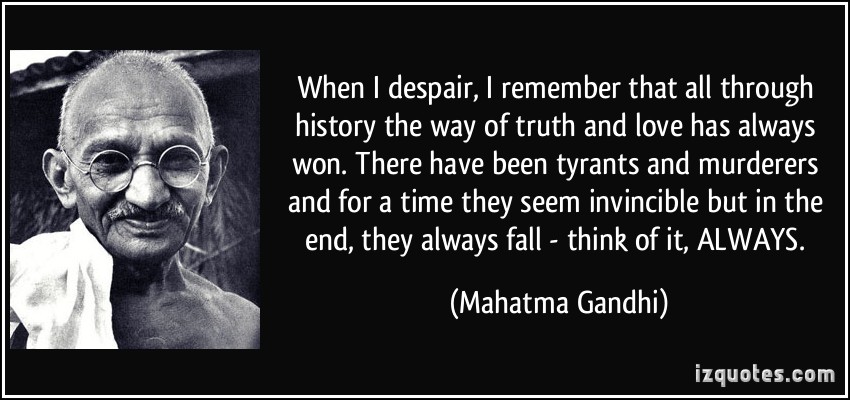
quote-when-i-despair-i-remember-that-all-through-history-the-way-of-truth-and-love-has-always-won-there-mahatma-gandhi-328441

Post-Election Soul Searching: What We’ve Forgotten

In talking with many of my friends who share similar political views it has been up and down this past week.  We search for silver linings, we express anger and sadness, we try to calm ourselves down, and we aren’t always synchronized with others and so everybody can end up arguing with each other at some point.  For me, when something unfathomable to me happens I try to understand as hard as I can.  In many ways this is what led me to understand more about beliefs and why we have them and headed me down the path of neuroscience and cognitive science.  This post will be a bit long, but please don’t be intimidated most of it is copy and pasted from an article that I thought was very well written.  I hope you read the full articles, but if you don’t have time for that, you’ll have to settle for what I think are the most salient aspects.

A few weeks ago I wrote a post, that was the beginning of my investigation into trying to understand the support for Trump and generating some empathy for people who voted for him. And it worked.  The eventual Trump win however caused me to go through some deeper introspection as to how I played a role in divisiveness and demonstrated a lack of empathy.  So I came across a couple of wonderful articles (here is one nice balanced perspective) that looks at this rule vs. urban phenomenon more deeply and I think they are excellent reads.  One of these articles I want to quote several passages.  It is an interview with a UW-Madison sociology professor (Kathy Kramer) who has done a lot of research with rural Wisconsinites.  Let’s take a look at some important passages from the article:

“Cramer argues that this “rural consciousness” is key to understanding which political arguments ring true to her subjects. For instance, she says, most rural Wisconsinites supported the tea party’s quest to shrink government not out of any belief in the virtues of small government but because they did not trust the government to help “people like them.”

“Support for less government among lower-income people is often derided as the opinions of people who have been duped,” she writes. However, she continues: “Listening in on these conversations, it is hard to conclude that the people I studied believe what they do because they have been hoodwinked. Their views are rooted in identities and values, as well as in economic perceptions; and these things are all intertwined.”

Here we can see an important problem.  And the problem perhaps goes for many liberals as well.  Our identities are tied up in our politics.  Perhaps this should not be so.  We know inside we will never get a candidate he really caters to everything we belief.  In fact, most politicians don’t end up doing most of the things they say they are going to do in an election.  It is because our identities are associated with politics that populists exploit them to gain support.  What if instead we expected politicians to give detailed plans on how they would address the issues of all Americans?  You might not be a person living in the rural counties of the rust belt,  but what are their problems?  And if you are a democratic party member should your candidate not be addressing those people?  Sitting down and talking to them.  The same goes for Republican candidates also.

“What I was hearing was this general sense of being on the short end of the stick. Rural people felt like they not getting their fair share.

That feeling is primarily composed of three things. First, people felt that they were not getting their fair share of decision-making power. For example, people would say: All the decisions are made in Madison and Milwaukee and nobody’s listening to us. Nobody’s paying attention, nobody’s coming out here and asking us what we think. Decisions are made in the cities, and we have to abide by them.

Second, people would complain that they weren’t getting their fair share of stuff, that they weren’t getting their fair share of public resources. That often came up in perceptions of taxation. People had this sense that all the money is sucked in by Madison, but never spent on places like theirs.

And third, people felt that they weren’t getting respect. They would say: The real kicker is that people in the city don’t understand us. They don’t understand what rural life is like, what’s important to us and what challenges that we’re facing. They think we’re a bunch of redneck racists.”

I thought this section of the article was very meaningful.  The first point is something very similar to what I’ve experienced in Canada.  People say things like “The feds aren’t listening to Francophones”, “the government is in the east, and nobody is listening to the west”, “government isn’t helping anyone in the rural areas”.  If you are a journalist doing an in depth story on the problems of the day, you probably live in a city, and there are so many people of different walks of life there, you probably would never step outside the city limits.  But the problems of the day are both urban and rural issues.  I can imagine it must be difficult for people in rural areas to pay taxes but not see benefits from that.  Now maybe they are and they don’t know it, but the fact that they have this perception is a valid thing that needs to be addressed.  I can imagine a majority of tax money being used for urban purposes.  Cities make the most noise usually, especially since that’s where the media focus is as well as where politicians spend most of their time.  And her third point speaks to our own contribution to divisiveness between rural and urban.  I’ll own up and say that I have over generalized in that manner and it was wrong.  And even if they are racist, they are still human.  Why do they have that attitude?  Is it just ignorance?  Is it that they have been fed false information?  Is it anecdotal experience that was taken as truth instead of an exception?  We all know we can easily succumb to such things and develop incorrect or harmful opinions and attitudes, despite the fact that we have the best of intentions.

In looking at attitudes of resentment Cramer has this to say:

income-inequality-usa-15“Look at all the graphs showing how economic inequality has been increasing for decades. Many of the stories that people would tell about the trajectories of their own lives map onto those graphs, which show that since the mid-’70s, something has increasingly been going wrong.

It’s just been harder and harder for the vast majority of people to make ends meet. So I think that’s part of this story. It’s been this slow burn.

Resentment is like that. It builds and builds and builds until something happens. Some confluence of things makes people notice: I am so pissed off. I am really the victim of injustice here.

Not much to say here other than problems don’t just go away, they keep getting worse when left unaddressed.  I suspect democrats aren’t entirely to blame either.  It’s been going on for years under various administrations.  Maybe we can even see this as a source of a lot of racial issues that are cropping up now as well.  Problems that have been happening for years and now resentment is just so high people are angry and upset.

On the issue of race there were several good points raised:

We know that when people think about their support for policies, a lot of the time what they’re doing is thinking about whether the recipients of these policies are deserving. Those calculations are often intertwined with notions of hard work, because in the American political culture, we tend to equate hard work with deservingness.

And a lot of racial stereotypes carry this notion of laziness, so when people are making these judgments about who’s working hard, oftentimes people of color don’t fare well in those judgments. But it’s not just people of color. People are like: Are you sitting behind a desk all day? Well that’s not hard work. Hard work is someone like me — I’m a logger, I get up at 4:30 and break my back. For my entire life that’s what I’m doing. I’m wearing my body out in the process of earning a living.

In my mind, through resentment and these notions of deservingness, that’s where you can see how economic anxiety and racial anxiety are intertwined.”

While race certainly plays a role there is again this blue collar vs white collar, rural vs. urban issue popping up again.  My father was a machinist and so really appreciate the value of his work and others like him.  I have often worried about how my son will perceive those people in society given that he won’t have personal experience the way that I have.  But we do live very much in a society where blue collar jobs, low wage workers in retail or the restaurant industry are looked down upon.  I had read an article a few years ago from the perspective of a poor single mother who worked every day, lived paycheck to paycheck, and was on welfare.  She said that she didn’t mind being poor or being somebody who had to work a lot harder than everybody else and not really get ahead, but what mattered most was that people actually felt that she had value.  We shame and dehumanize a lot in this society.  Some people are not good people.  Some are lazy, racist, misogynistic, xenophobes, apathetic, selfish, but they are still human and we have to ask always, how did they get that way?  And if they are treated with kindness and humanity, is there a way in which we can make them a better person?  Cramer continues with:

It’s absolutely racist to think that black people don’t work as hard as white people. So what? We write off a huge chunk of the population as racist and therefore their concerns aren’t worth attending to?

How do we ever address racial injustice with that limited understanding?

Of course [some of this resentment] is about race, but it’s also very much about the actual lived conditions that people are experiencing. We do need to pay attention to both.

Great words.  The interviewer then asks about the idea of people not feeling like they are getting what they deserve:

“Part of where that comes from is just the overarching story that we tell ourselves in the U.S. One of the key stories in our political culture has been the American Dream — the sense that if you work hard, you will get ahead.

Well, holy cow, the people I encountered seem to me to be working extremely hard. I’m with them when they’re getting their coffee before they start their workday at 5:30 a.m. I can see the fatigue in their eyes. And I think the notion that they are not getting what they deserve, it comes from them feeling like they’re struggling. They feel like they’re doing what they were told they needed to do to get ahead. And somehow it’s not enough.

Oftentimes in some of these smaller communities, people are in the occupations their parents were in, they’re farmers and loggers. They sayit used to be the case that my dad could do this job and retire at a relatively decent age, and make a decent wage. We had a pretty good quality of life, the community was thriving. Now I’m doing what he did, but my life is really much more difficult.”

When I read this passage it really made me think that this is what a lot of Americans are facing, not just ones in rural areas.  I’ve seen many articles about how the millennial generation struggle compared to their parents simply with costs being much higher in comparison to wages.  Even with a professor wage I know I have less buying power per dollar than my parents did.  There are so many Americans facing the same struggle financially.  The theme continues and Bernie Sanders gets a mention:

         “It’s not inevitable that people should assume that the decline in their quality           of life is the fault of other population groups. In my book I talk about rural              folks resenting people in the city. In the presidential campaign, Trump is very          clear about saying: You’re right, you’re not getting your fair share, and look            at these other groups of people who are getting more than their fair share.                Immigrants. Muslims. Uppity women.

But here’s where having Bernie Sanders and Donald Trump running alongside one another for a while was so interesting. I think the support for Sanders represented a different interpretation of the problem. For Sanders supporters, the problem is not that other population groups are getting more than their fair share, but that the government isn’t doing enough to intervene here and right a ship that’s headed in the wrong direction.”

leaderI thought this was an interesting observation.  I too saw the excitement Bernie had been getting among more rural and working class voters.  Whether you agreed with his solutions are not, he was also resonating with those that were angry at the government, those that felt the government wasn’t serving their best interests.  Maybe he still wouldn’t have won the presidency, but I do think he at least took the right approach into reaching people and finding common ground among both urban and rural working class citizens.

So what is the way out of this all? Cramer had this to say:

“People for months now have been told they’re absolutely right to be angry at the federal government, and they should absolutely not trust this woman, she’s a liar and a cheat, and heaven forbid if she becomes president of the United States. Our political leaders have to model for us what it’s like to disagree, but also to not lose basic faith in the system. Unless our national leaders do that, I don’t think we should expect people to.”

As much as I’d like to believe that everybody can just pick themselves up by their bootstraps I know that it is really not possible.  I’ve felt for some time that it is our leadership who actually have to convince us that they serve us and not special interest groups.  They need be more vocal about us coming together.  Sadly I think many of them know that keeping us divided is a more effective way to keep power than to get us to unite.

In the end Cramer reminds us that empathy, that talking to each other face-to-face and listening are the most valuable tools we have as individuals:

“One of the very sad aspects of resentment is that it breeds more of itself. Now you have liberals saying, “There is no justification for these points of view, and why would I ever show respect for these points of view by spending time and listening to them?”

Thank God I was as naive as I was when I started. If I knew then what I know now about the level of resentment people have toward urban, professional elite women, would I walk into a gas station at 5:30 in the morning and say, “Hi! I’m Kathy from the University of Madison”?

I’d be scared to death after this presidential campaign! But thankfully I wasn’t aware of these views. So what happened to me is that, within three minutes, people knew I was a professor at UW-Madison, and they gave me an earful about the many ways in which that riled them up — and then we kept talking.

And then I would go back for a second visit, a third visit, a fourth, fifth and sixth. And we liked each other. Even at the end of my first visit, they would say, “You know, you’re the first professor from Madison I’ve ever met, and you’re actually kind of normal.” And we’d laugh. We got to know each other as human beings.

That’s partly about listening, and that’s partly about spending time with people from a different walk of life, from a different perspective. There’s nothing like it. You can’t achieve it through online communication. You can’t achieve it through having good intentions. It’s the act of being with other people that establishes the sense we actually are all in this together.

I’ve always grown in my life when I’ve gotten to know people from different walks of life and I need to continue.  Make an effort to do so.  It was easier growing up because I met so many people from other countries, with various levels of education and careers.  When one has a career themselves it gets a little harder.  I know pretty much other professors and students.  Maybe I need to help Kathy Cramer with her research. 🙂

rural__disenfranchised_voters_push_trump_0_6563315_ver1-0_640_360When it comes to terrorism and the issue of Syrian refugees I’ve spent a lot of time showing research and trying to explain to people the importance of compassion and how disenfranchising people who need our help is likely to increase the level of extremism and not reduce it.  It plays into ISIS’ hands.  And this is all true.  But what if, and I know it’s not all people who voted for Trump, but what is there are lot of disenfranchised white rural voters living in poverty?  Is it likely that they might start adopt more extreme views as well?  It’s an interesting pause for thought.

So in this post I maybe haven’t give a lot of love to all of us who are hurting right now, but I felt this part of the discussion is important.  In my next post, I will talk more about why I think many of us have cause for concern at the new government we face, and how the empathy that I have tried to build here for the Trump voter is not just a one way street.

The Grand Illusion

It’s difficult to organize thoughts this morning after the election, but I have been getting some thoughtful words on Facebook and from friends that I think are important to express right now.   In discussion with a friend I was saying how Trump was never really successful at anything in life and his success is built solely on the illusion of his brand.  My friend responded “well isn’t that a sign of success?”  As much as it hurt to admit I think he’s right.   He has sold America an illusion, and America bought it.  He isn’t going to build a wall, he can’t bring coal jobs back, he isn’t going to magically fix inner cities, he isn’t going to make America great again.  Especially consider nobody really knows what that means, and how we define greatness is highly subjective.  We went on to discuss this illusion and how Trump’s illusion is really America’s.  Once again I couldn’t help but agree.  I’ve been mulling this thought over for a few hours and really makes sense.

America has branded itself over the years.  The country that can’t fail.  The country that does it right, and that other countries should look to as a model of freedom and democracy.  We sell the American Dream, and people believe in it, even though we have been struggling to deliver that for some time.  And when I say we’ve bought into it, I am talking about all of us to varying degrees.  We’ve even convinced many people outside the U.S. that this is the case. But it is an illusion as grand as the Trump brand.  We aren’t perfect and we’ve got a lot of problems.  There are other countries out there who are doing things better than we are.  We spend more time convincing other countries that we are the strongest and the best, and less time giving our own people something substantive to believe this is the case.  Obama called us the greatest nation on Earth.  Where is the humility?  Hillary referred to half of the voting population as deplorables.  How extreme is that righteousness?  Those of us who see behind the veil of Trump’s brand to what he really is, convinced ourselves that there would be no way Trump could be elected.  I included.  As a nation we have made some great progress at social justice and equality, but we’ve also let far too many people fall into poverty, we had some poorly executed and designed policy, even if well-intentioned.  We’ve made some terrible foreign policy decisions that has cost us money and lives.  And all these things are excusable, but we also refuse to admit it.  Why?  Because we are the greatest nation on Earth.

I believe that to earn that title, we need to have empathy, we need to have courage, and we need to have humility.  We also need to have honest introspection.  We have to create our sense of self-worth over substantive matters.  We have to demonstrate that we are as capable of celebrating our successes as well as admitting and learning from our failures.  These are the values that make for great people, and great nations.  I’m not sure any nation can be said to be there, but some are closer than others.  We have further to go than we’d like to believe, and I hope that in these next 4 years we can break through this illusion and find a way to heal a divided nation.   Democrats are just as guilty as Republicans for not reaching across the aisle.  That’s the beginning of the humility we all need to have.  All of us regardless of race, religion, sexual orientation are human.  That’s the love we need to have.  And then we have to ask “How can I live my life so that it helps raise all humans up?”  That’s the courage we need to have.  And we need to keep at these qualities, everyday of our life, because hate, self-righteousness, and fear are always with us, waiting to shake us fragile humans to our core.