The Unwise and the Immoral

The title of this post is related to another incident of victim blaming that was in the news not too long ago.  The incident involved model Bella Thorne having her computer hacked and the hacker making off with a number of private nude photos.  Bella Thorne, to sort of give a big “fuck you” to the hacker, released the photos herself on Twitter.  On The View, Whoopi Goldberg criticized Thorne saying essentially that one has to know in this day and age that storing such photos on a device connected to the internet (and you are a famous beautiful celebrity) is setting yourself up for this type of theft.  Goldberg then received a ton of backlash including some strong words from Thorne herself for being criticized when it was of course the hacker who was the person who did something wrong and that Goldberg “should know better”.  I suspect Goldberg does know better.  There is nothing about her that makes me think she isn’t a good feminist.  She has always had a no nonsense, blunt style and her comment here I don’t think is meant to give the hacker a pass.  I’ll go so far as to say that I think she makes a good point.  A point we should be able to talk about if framed correctly.  Before I get accused of victim blaming, let me go into more detail about what I mean.

Hacking is a reality of this day and age, and Thorne isn’t the first victim of this type of attack.  This has to be part of our consciousness.  There are laws against hacking, which is invading someone’s privacy and stealing personal property, and their should be.  It is theft and violation, plain and simple.  We can say that the hacker is immoral in his actions.  I think we can say that we all wish we lived in a world in which there were no hackers, and in which a woman’s body wasn’t a commodity that someone could profit on, such that this hacker could ostensibly get leverage over Thorne or other victims of this crime.  As a society we must continue to strive to fix this bigger problem.  Since we don’t live in that kind of society yet, we must also act wisely.  To do so requires us to be able to have conversations about wise and unwise actions to keep people and property from harm.  I am sort of reminded of that old joke where a guy meets a doctor at a social gathering and tries to get some free medical advice and says “Hey doc, my arm hurts whenever I do this. (Imagine whatever arm motion you like).  What should I do?”  And the doctor responds “Don’t move your arm like that.”  Clearly there is a bigger issue to solve Image result for moving arm gifwith that person’s arm, but in the short term, not doing a motion that causes you pain might be wise.  We should be able to simultaneously talk about short term solutions to protect ourselves, while also addressing bigger issues that increase equality and safety for all people rendering this short term acts of caution more irrelevant over time.

If there is a neighborhood where you have an increased chance of being mugged or harmed, all sorts of people will tell you to avoid walking through that neighborhood.  It is not meant to say that they condone violence or theft upon you or anybody else, it is simply meant as advice to keep you out of harms way.  We don’t get all bent out of shape by such advice, but the conversation goes south when women are blamed for their decisions in these types of incidents, or worse crimes like sexual violence.  And I think for good reason.  There have been some criticisms of social media for the fighting that erupted between two women who are likely on the same side of the fight against the patriarchy, but I’m actually not too upset about social media here, because maybe this is a conversation that needs to be had more often.

We have an older and wiser Goldberg, criticizing the wisdom of a younger Thorne.  Perhaps Goldberg feels like she was helping young girls everywhere be wary of putting compromising pictures of themselves in less than secure places based on what can happen to them.  Goldberg’s mistake however was that she also lacked some wisdom here.  As much as I’d like to live in a society where we could have honest conversations about what is a wise or unwise decision when crimes happen, when it comes to crimes against women there is just a long history of the “unwise” decision of a woman being used as an excuse for a man’s immorality and criminal behavior.  If a person is beaten and robbed in that unsafe neighborhood, the police will still arrest and charge the perpetrators, but too many men have gotten off Scot free because of what was deemed a woman’s unwise decision.  Furthermore the basis of what was considered unwise for a woman, does not apply to a man.  In fact very often their unwise decisions are used to further excuse them from wrongdoing.  A woman drinks too much at a party?  Well then of course she kind of Image result for victim blamingdeserves to be raped.  A guy drinks too much at a party? Well clearly he didn’t really mean to rape her, he just had too many beers and didn’t know what he was doing.  Let’s just sentence him to talk about the dangers of drinking.  It’s a huge problem and women have a right to absolutely tired of it.  Goldberg could have said what she said in a much better way that made it clear who the bad actor was in this situation.
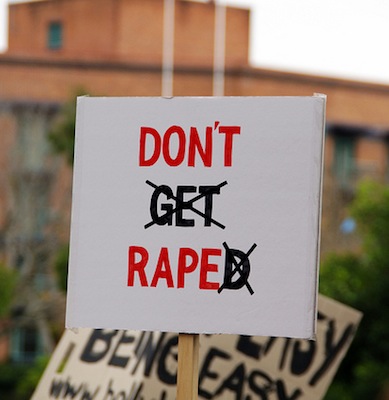
Let me also add that the best people in our society are ones who could take advantage but don’t and instead help people be more safe.  Thorne was already punished and probably knows by now what she should have done and doesn’t need Goldberg’s advice after the fact.  So the timing of the comment is also unhelpful.  Like Fareed Zakaria’s advice to Sam Harris after another rant about Islam being the mother lode of bad ideas “Yeah, you’re right, but you’re not helping.”  Being right, and being helpful are often two different things.

The Moral of the Story

I was ‘talking’ with a fellow blogger who is a nurse, and as I am a meteorologist we were trying to figure out who had it worse.  Was it more annoying to deal with the “climate change deniers” or the “anti-vaxxers”.   I agreed his was more annoying, because while human induced climate changed is well-evidenced it is always going to receive a lot of political blowback in a fossil fuel dependent world and it is both a complex and new problem facing us.  Vaccinations on the other hand have worked so well and have eradicated disease so completely that people don’t remember why they even get them and instead have invented dangers to receiving them because they can no longer see the purpose.    It’s as routine as opening your mouth and saying “Ahhh”.  People don’t really question that, but it doesn’t inject anything into you and is sort of hard to get upset about, but I think when some medical advancement has been around so long and so successful we forget the reason and just see it as possibly something that isn’t necessary.

This led me to wonder if the same thing wasn’t true for how we understand morals.  One of the common things you hear from atheists is that many theists are under the impression that we do not have a moral and ethical code.  That such thing is not possible if we don’t have God and some supernatural system of punishment and reward.  I remember my mom, who is Christian, telling me at some point that our sense of right and wrong must come from God or else where would we get it from?  The general answer is easy of course, we are taught them by our parents and others.  We have authority figures that tell us what is right and what is wrong (even though you can convince a child that things that are wrong are actually write, like prejudice and intolerance).  The point is if as children we seem to get our morality from the authority figures in our life, perhaps it’s not surprising that many people, especially those who have no qualms about relying on the “rightness” of authority, that morality comes from what many consider the ultimate authority, God.  But it seems obvious to me that morality can easily be derived through scientific investigation.  Morality though has been around well before the scientific method, but humans have been around for a long enough time that we’ve been living a social experiment of morality and have simply been learning.  At one time the things we take as obvious might not have been overtly obvious, even though I think some of the big ones we could figure out rather quickly as they would not be a beneficial for survival.  Just like we stopped questioning why vaccines are important, perhaps we stopped questioning why certain immoral acts are wrong, such that people assume that it all must have come from some other plane of existence.

Some morals are certainly cross-cultural, like physical and sexual harm to other people’s children.  This one would be a pretty obvious natural (perhaps genetic) trait because our survival does depend on the survival of the next generation.  Anything that threatens that would be considered immoral.  Unfortunately in many places physically or psychologically hurting your own child is not seen as wrong.  It wasn’t so long ago here that, unless something got really severe, you were hardly considered in the wrong for disciplining your child with a belt or the back of your hand.  Some people still adopt that attitude unfortunately in North America, and it can be worse in other countries.  Regardless though we generally do go to ridiculous (and perhaps psychologically detrimental) lengths to protect children.  In general though killing is not quite viewed the same way.  Many think it’s okay to kill criminals (apparently it sometimes doesn’t even matter the crime…resisting arrest is enough), and killing in war is not only tolerated, but often cheered about.   For some time killing your wife in a crime of passion was often considered justifiable.  And many civilizations have committed genocide in our past and that has gone unpunished.   So even of the most basic commandments “thou shall not kill” isn’t clear cut, so this obvious sense of right and wrong we are supposed to get from God looks pretty muddy.  And if we are worried about some sort of eternal punishment system it’s amazing the ways we can justify killing when we need to dodge that one.

But let’s look at it from the perspective of “unlawful killing” which is why modern translations say “murder” instead of kill in the 10 commandments.  Thus we already have human law deciding what killing is lawful and unlawful.  This is not an overly divine commandment already.  We know that before civilization we roamed in smallish hunter gatherer bands.  Maybe a few hundred people at most.  This was a time before Christianity, before the 10 commandments, so let’s assume this group doesn’t know right from wrong.  Like a small town, in these small groups, you knew everyone.  Surviving in the wild is not easy and everybody had a role to play, and everybody shared and worked together.  Studies of hunter-gatherer tribes today show them to be rather egalitarian in compared with much of civilized society so let’s look at this as a group that gets along.  So we have a group of a few 100 people, and because they have no God to tell them between right and wrong they think murder might be just something that’s okay to do.  What would be the results of a few people that decided to commit a murder every once in awhile:

  1. Population decline and lack of genetic diversity – We could at the very least learn that there is a murder rate that is not healthy for the survival of the group. Through cooperation, life was made easier, but the group gets smaller, things get harder. Population can only increase so fast. So at the very least, if murder is okay, we can’t do it too often.
  2. Loss of those with specialized or exceptional skill. While daily tasks required teamwork there would have been certain people with more extraordinary skill. A tribe may also only have one person who does a particular job. Murder could reduce the chance for survival if such people are killed.
  3. Growing fear and distrust. If people are being murdered, people are less likely to cooperative. Some people will simply be scared they will be next and be more cautious and protective. Some people will be angry at the loss of their child, brother, sister, etc. This will cause others to fight back. There may be false accusations, which builds more anger and distrust.
  4. They are diminishing their own chance for survival. Once a murderer is discovered, those that committed the murders may find themselves a victim.

Now there are probably even more things that could be listed as to why murdering would not be a good idea, the least of which that we are by definition a social species for whom survival depends on our being in a group, and being able to work well in that group.  It simply isn’t in our nature to murder our own, and there is a lot of good reasons why murder would not be a good idea.  However when it comes to other groups, all bets are off.  We may be xenophobic due to bad experiences with other groups before, or simply be xenophobic because someone who we don’t know simply isn’t somebody we can implicitly trust, and thus we can justify killing others that are not part of our society.  This is why war is not against the law, but murder is.  We can do similar thought experiments with many other basic things that cause harm, like stealing, or any action that causes harm both physically and emotionally.   But even if it was not in our nature, this social experiment has been going on for some time and it seems quite reasonable to assume that even if there was not a morality inherent in us through birth, if at the very least we have a driving force to survive then many of the morals we have today would result through experience and observation and concluding how to survive better.

As a population we continue to adjust.  Different groups share moral truths just as they would share any other type of knowledge.  And so perhaps much of what we consider right and wrong is handed to us without that rediscovering process, but you can still see the impact of people doing the right thing and wrong thing today.  Because even though I think that on average humans are more moral in civilized society today than in the earlier days of civilization, we still have a ways to go.  People who are doing good and bad things are not of one particular faith or philosophy.  If you have compassion and care about how you make others feel, you will discover yourself how to behave in a way that’s more positive everyday as you grow and learn also.  It is the scientist in us that helps us become more moral.  If anything, the Bible demonstrates this more completely as the old testament has very much an eye-for-an-eye mentality, but the new testament is very much about forgiveness, redemption, and compassion.  Even God seemed to find a more moral way of dealing with enemies. Thus I don’t think it’s surprising that morality should progress in the same way that science does.