

The title of this post is related to another incident of victim blaming that was in the news not too long ago. The incident involved model Bella Thorne having her computer hacked and the hacker making off with a number of private nude photos. Bella Thorne, to sort of give a big “fuck you” to the hacker, released the photos herself on Twitter. On The View, Whoopi Goldberg criticized Thorne saying essentially that one has to know in this day and age that storing such photos on a device connected to the internet (and you are a famous beautiful celebrity) is setting yourself up for this type of theft. Goldberg then received a ton of backlash including some strong words from Thorne herself for being criticized when it was of course the hacker who was the person who did something wrong and that Goldberg “should know better”. I suspect Goldberg does know better. There is nothing about her that makes me think she isn’t a good feminist. She has always had a no nonsense, blunt style and her comment here I don’t think is meant to give the hacker a pass. I’ll go so far as to say that I think she makes a good point. A point we should be able to talk about if framed correctly. Before I get accused of victim blaming, let me go into more detail about what I mean.
Hacking is a reality of this day and age, and Thorne isn’t the first victim of this type of attack. This has to be part of our consciousness. There are laws against hacking, which is invading someone’s privacy and stealing personal property, and their should be. It is theft and violation, plain and simple. We can say that the hacker is immoral in his actions. I think we can say that we all wish we lived in a world in which there were no hackers, and in which a woman’s body wasn’t a commodity that someone could profit on, such that this hacker could ostensibly get leverage over Thorne or other victims of this crime. As a society we must continue to strive to fix this bigger problem. Since we don’t live in that kind of society yet, we must also act wisely. To do so requires us to be able to have conversations about wise and unwise actions to keep people and property from harm. I am sort of reminded of that old joke where a guy meets a doctor at a social gathering and tries to get some free medical advice and says “Hey doc, my arm hurts whenever I do this. (Imagine whatever arm motion you like). What should I do?” And the doctor responds “Don’t move your arm like that.” Clearly there is a bigger issue to solve  with that person’s arm, but in the short term, not doing a motion that causes you pain might be wise. We should be able to simultaneously talk about short term solutions to protect ourselves, while also addressing bigger issues that increase equality and safety for all people rendering this short term acts of caution more irrelevant over time.
If there is a neighborhood where you have an increased chance of being mugged or harmed, all sorts of people will tell you to avoid walking through that neighborhood. It is not meant to say that they condone violence or theft upon you or anybody else, it is simply meant as advice to keep you out of harms way. We don’t get all bent out of shape by such advice, but the conversation goes south when women are blamed for their decisions in these types of incidents, or worse crimes like sexual violence. And I think for good reason. There have been some criticisms of social media for the fighting that erupted between two women who are likely on the same side of the fight against the patriarchy, but I’m actually not too upset about social media here, because maybe this is a conversation that needs to be had more often.
We have an older and wiser Goldberg, criticizing the wisdom of a younger Thorne. Perhaps Goldberg feels like she was helping young girls everywhere be wary of putting compromising pictures of themselves in less than secure places based on what can happen to them. Goldberg’s mistake however was that she also lacked some wisdom here. As much as I’d like to live in a society where we could have honest conversations about what is a wise or unwise decision when crimes happen, when it comes to crimes against women there is just a long history of the “unwise” decision of a woman being used as an excuse for a man’s immorality and criminal behavior. If a person is beaten and robbed in that unsafe neighborhood, the police will still arrest and charge the perpetrators, but too many men have gotten off Scot free because of what was deemed a woman’s unwise decision. Furthermore the basis of what was considered unwise for a woman, does not apply to a man. In fact very often their unwise decisions are used to further excuse them from wrongdoing. A woman drinks too much at a party? Well then of course she kind of 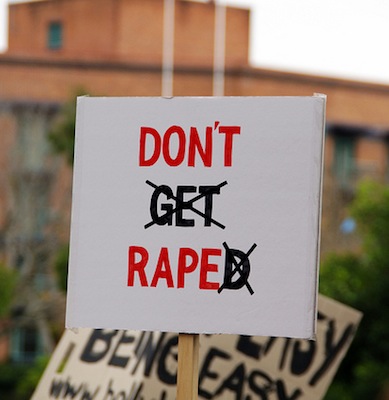 deserves to be raped. A guy drinks too much at a party? Well clearly he didn’t really mean to rape her, he just had too many beers and didn’t know what he was doing. Let’s just sentence him to talk about the dangers of drinking. It’s a huge problem and women have a right to absolutely tired of it. Goldberg could have said what she said in a much better way that made it clear who the bad actor was in this situation.
Let me also add that the best people in our society are ones who could take advantage but don’t and instead help people be more safe. Thorne was already punished and probably knows by now what she should have done and doesn’t need Goldberg’s advice after the fact. So the timing of the comment is also unhelpful. Like Fareed Zakaria’s advice to Sam Harris after another rant about Islam being the mother lode of bad ideas “Yeah, you’re right, but you’re not helping.” Being right, and being helpful are often two different things.

 Cloak Unfurled