What Makes A Good Human?: Faith

Well, if you know me, you might be surprised at this quality.  And to be honest this is one that I wasn’t sure I was going to include but could not really make it fit as part of any of the other ones and so have put it here. This one is 6th in the series and so if you were keeping count there will still be two more to come for a total of 8 (as opposed to the 7 I thought I was going to blog about in my intro to this series).  Hey I did say that this list was not set in stone, and my final quality justifies this change quite well so stay tuned. 🙂
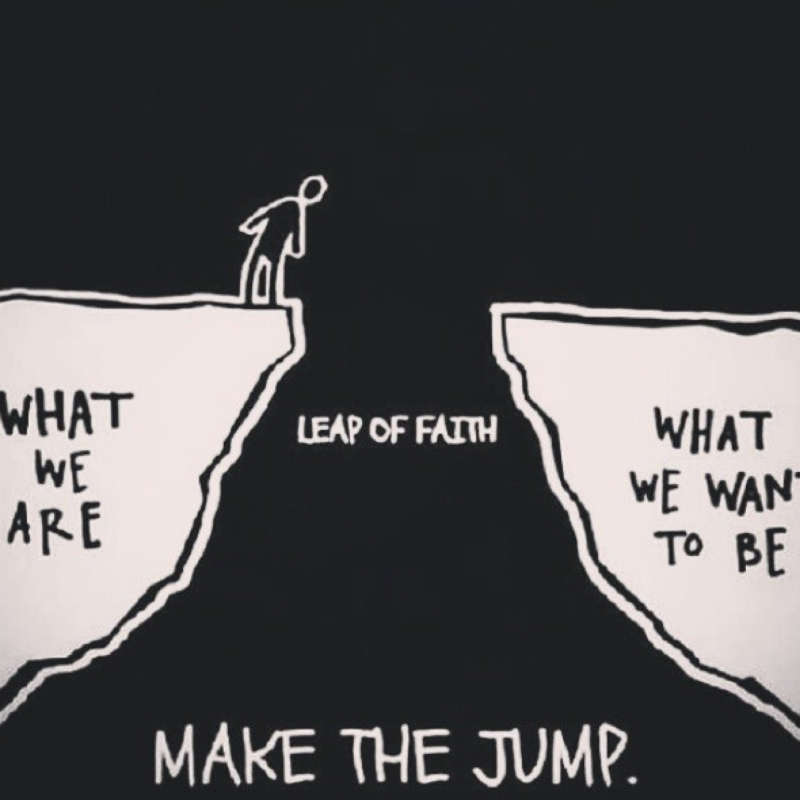
So let me be clear here that when I say faith, I do not mean religious faith, nor do I mean blind faith.  The first definition of faith is “complete trust or confidence in someone or something”, and this is the faith I am talking about. Perhaps I place too much importance on stress and too much importance on living in the present moment, but one of my reason for including faith is borne out of the fact that we are exceptionally good future thinkers. It might be somewhat natural to think about the past, and of course we live in the present, but what value is thinking about the future, when the future is uncertain. Of course we can see the value in thinking about the future from simple mechanical movements like anticipating the trajectory of a ball as we reach out to catch it, to having grand visions of the future that we work to make a reality. Our imaginations and our ability to envision a path to turn what is in our minds into a reality is a great strength, and it’s safe to say our ability to think about the future is greater than any other creature. There is a double edge to this sword and that is worry. We worry about that uncertain future at times, and we worry that what we want to happen will not come to pass. Much of the grief we often feel when we lose somebody important (whether from death or breaking up our relationships) comes from a loss of a future that will now no longer exist with that person. Our ability to imagine the future is so strong that it can feel as real as any present moment. In a previous post in this series I talked about the value of play for helping us be in the moment, so too does faith. Whereas play helps us become lost in the moment, faith can help us focus on the present by making us feel like “everything will be alright”. Faith can give us hope and keep us steady.

One of the reasons that the future is so uncertain is that we can’t account for all the variables in any particular problem. And even if we could, there would be several that are simply not in our control. Wanting to fix things that are beyond our control is one big source of worry and stress whether it is a personal situation or the larger sadness we might feel over big problems like world hunger, gender inequality, or racism as individuals most of us can only do so much. The weight and burden of the future can drag us down and we need something to ease the mind and focus on the present. It is not surprising that faith is always used in the context of something that we feel is good. Whether it is a supernatural being who we believe is watching out for us, loves us, and protects us, to more tangible things like faith that a good friend will come through for us, a general optimism about the improvement of society, and perhaps most importantly a faith in ourselves that we can overcome challenges in our way. In reality none of these things are sure things despite what past experience might tell you. You may actually fail at what you are attempting, even if you’ve handled similar or even the same situations before. Society may get worse. Your friend may not come through despite how often they might have come through for you before.  The world is dynamic and constantly changing. Your friend is changing, you are changing, and society is changing and so there will always be some unknown variables. We can also be wrong that we understood a past experience properly to ensure similar results in the future. Humans are prone to Type I errors (seeing patterns or connections where none exist) and quite often we don’t understand our experiences fully. However, without some faith we’d always be questioning and doubting and while there may be a time for questions and doubt, to dwell on such things constantly can also be equally wasteful. Doubting your friend all the time may actually strain your relationship. Doubting yourself all the time may make you actually more prone to making mistakes. Being pessimistic about the world may actually make you less happy and less able to make a positive impact, which is the only way the world is going to get better, if we do something about it.

Richard Dawkins and others are often quoted as saying that faith and science are not compatible because science makes conclusions based on evidence, where as faith makes conclusions despite evidence. I tend to disagree with this notion, because I feel that to develop faith it cannot be built on nothing. In my experience what people disagree on is what people consider evidence. I wrote about this previously here and here. A large of the aim of religious institutions in keeping members of their faith is to discredit contrary evidence. If the evidence against what you have faith in seems faulty you are less likely to let it change your mind. But we’ve all had changes of faith as evidence is presented to us. What happens if that friend lets us down a few times? Chances are, our faith in them will be lessened. What happens if we start getting inundated with all the evil that happens in the world? We start to lose our faith and optimism in humanity. What can happen when let ourself down? We start to lose faith in ourself, which is often a scary place emotionally to be at. I think faith is born honestly in most cases, and I think if left unhindered we would adjust the things we have faith in over time as we continue to question, experience and learn. The important part is that faith should be changeable and it should be personal. When we indoctrinate children about what they should have faith in this is from a developmental context abusive, because the stronger our faith becomes in something, the less likely we are able to adjust it over time because of how beliefs work in our brain. The inability to change what we have faith in as we experience and learn new things leads to an unhealthy conflict: the struggle to remain static in a dynamic world. I think some people might wonder, what is the point of having faith if it may change some time in the future? Because the world may seem chaotic, painful and beyond comprehension at times, it makes some sense to have faith in an order, an intention, or a purpose that is forever and unchangeable. However, it’s only a convenient illusion that will become harder and harder to maintain with time without willfully ignoring contrary evidence.

There are no guarantees in life and it’s okay to be wrong about what you put your faith in. Everybody has been wrong about things before. Being wrong is one of the greatest shared human experiences. I do understand, however, that it can be distressing to admit when we are wrong about things, even more so when we invest a lot of time into having faith about someone or something. Faith as a result is perhaps the trickiest of all the qualities I’ve discussed so far because it can cause us to double down even when the odds are against us. In my opinion the thing to keep in mind is to let your faith work for you, and to not let your faith gain mastery over you. And don’t expect others to share your faith. That’s simply not realistic. But if I were to pick some basic things to have faith in, it would be this:

  1. Change is inevitable
  2. You have it in you to deal with that change
  3. Everything will be alright because changing what you have faith in is not a loss, it’s a gain – for you must have learned something new in order to get to where you are now.

What Makes A Good Human?: Humility

It is with pride that I introduce the next important quality to being a good human.  Well not too much pride.  I mean I could be wrong.  This is all just my opinion after all.  Anyway it’s humility.  Out of all the seven deadly sins, the one considered the worst and the one in which all others can stem from, it is pride.  It was pride that caused Lucifer’s fall into Hell in the Bible.  Pride, ego, conceit, whichever turn you prefer to use all of these are ultimately harmful to an individual and society.  When the self, or when a group puts themselves above others, saying they are better, failing to notice the achievements of others, and excessively admires themselves this is a recipe for disaster.  A lack of empathy, narcissism, bullying, oppression all stem from conceit.  Humility is the cure for this disease.

Sitting down, Jesus called the Twelve and said, “Anyone who wants to be first must be the very last, and the servant of all.” – Mark 9:35

Humility in practice can be difficult to achieve, however.  For instance, we know that having a positive self-esteem can be beneficial for increased happiness and confidence.  So isn’t having some pride important?  Should I not be proud of my accomplishments?  And what about the other end of the spectrum?  Should I go around saying “I’m not worthy, I’m but a speck of dust at the bottom of your shoe, I shall default to your wisdom, intelligence, and might?”  This is not humility either.  It’s either not genuine, or simply fear.  Humility is not submission.  Humility does not ask us to put ourselves beneath others, only to consider the possibility.  Anyone we meet regardless of age, status, race, gender, etc., may have something to teach us. They may be doing something in a better way that we are not.  They may have a piece of wisdom about something that we do not have.  It asks to consider the possibility that we may enjoy a privilege that they do not and to understand that should that privilege be taken away, we may be no better than anybody else. Humility asks to accept the fact that we may be different but no better or worse and thus is a seed for equality.

“When pride comes, then comes disgrace, but with the humble is wisdom.” – Proverbs 11:2

Humility is challenging to master because of its subtlety.  It does not eliminate pride, but it tempers pride.  There’s a difference between telling someone you are a good teacher, and that you are the best teacher.  This is why “excessive” admiration of self is included in the definition of pride.  So you may become an expert in something, but you can admit that someone might know more.  You can admit that you might not know everything.  You can admit that you might have been wrong about something.  Humility doesn’t prevent us from being confident and proud of our accomplishments but it simply reminds us that we are far from perfect, that we can still grow and learn.  Humility feeds into curiosity in this way, and then curiosity can feed back into humility.  As we continue to learn new things we may realize we didn’t know as much as we thought we did, thus humbling us.

The servants of the Most Merciful are those who walk upon the earth in humility, and when the ignorant address them, they say words of peace. – Surah Al-Furqan 25:63

Humility is probably one of the central tenets of every major religion; speaking to the dangers of pride and the importance of being humble before others and before God.  I feel that one of positive aspects of God is to be a constant reminder that there are forces more powerful than yourself in the universe.  As an atheist we can get our feelings of humility through science itself.  One cannot help but feel small in the context of a universe that science has shown to be quite large and magnificent.  We know we are mostly helpless against major disasters like hurricanes, floods, earthquakes, and volcanoes.  We know we are the product of evolution, one of many animals and plants on this planet and that we must share it.  Evolution teaches us that we are specially adapted to our environment, but so is every other species and thus we have no more right to life than any other. Our actions impact others and ourselves, and we must be careful not to have too much conceit as a species lest we bring about the end to our own existence or the existence of other species.  Science by its very nature is humble, because it is constantly skeptical, constantly asking questions, constantly self-corrects as it moves forward.  It can never be too big for its britches because it usually isn’t long before someone comes along and improves, refines, or disproves an idea already established.  And this is why those who have fundamental religious views can never truly be humble, because if you are in position that you are so certain that you are correct that no other well-evidenced idea has the ability to change your mind then humility is not one of your strong suits.  Humility is also accepting the possibility that you might be wrong, perhaps even about some very important things you believe in.

Be humble, be harmless,
Have no pretension,
Be upright, forbearing;
Serve your teacher in true obedience,
Keeping the mind and body in cleanness,
Tranquil, steadfast, master of ego,
Standing apart from the things of the senses,
Free from self;
Aware of the weakness in mortal nature. 

-Bhagavad Gita

Another important aspect of humility comes about in the aspect of love.  For most of us we have our strengths and weakness, but when entering into a relationship it is easy to put our defenses up, to make positive impressions, and to be our best self.  This is a difficult illusion to keep up, and some are better than others.  We can fearful of exposing our weaknesses and faults.  However, if we really want someone to love us for who we are, we must be genuine.  Humility tears down the walls of conceit and gives way to revealing our vulnerability.  This is often the scariest part of any relationship because when someone sees your vulnerability they can exploit it and really hurt you.  Humility is there to remind you that neither you or the person you love is perfect. And for someone to truly love you for who you are, such humble exposure to each other is, I believe, a necessary part of a long lasting, loving relationship.

It is humility that exalts one and favors him against his friends. – Kipsigis Proverb (Kenya)

Can one be too humble? Yes.  There are times when at least the appearance of confidence, and/or decisiveness is important.  There are times when you may have to take charge.  There are times when you are the smartest or most capable person in the room.  Being humble to the point where your self-esteem is so negatively impacted that you fail to recognize your own accomplishments is harmful.  Humility to the extreme can often just seem self-deprecating and is not a strong quality to have. Humility’s role is to always be there, hovering, and keeping us from getting too complacent.  Humility keeps us vigilant.  Humility reminds us we may have more to learn.  Humility helps us love better.  Humility helps us recognize that we are finite and have limits.  The most wonderful thing about humility is that while it erodes pride, ego, conceit, whatever you want to call it, it is at the same time very empowering.  I believe it draws good people to you, and surrounds you with love and friendship; people you can trust. It also empowers by giving you a sense of gratitude for all the blessings, good fortune, and love that you have in your life.  When you are genuinely humble you know that life isn’t always in your hands and that one must take time to be thankful for what you have.  This is something we all need to do more often.

What Makes A Good Human?: Curiosity

If you’ve been reading so far, you might not be convinced with vigilance or play as being important and that love does not conquer all.  As I said, my goal here is not to make any one quality more important than the other, and I hope with this topic I will convince you that life isn’t all about love.

As natural as our capacity to love, is our inherent curiosity about the world.  If you’ve had children, and hopefully paid attention to them, one of the first things you will notice about them is how curious they are.  From simply being curious about who you are when they start seeing 6 inches beyond their face, to be curious about what this thing called a hand is, to starting to interact and test objects out as they begin to grasp them.  They want to explore, they experiment with sounds, they like to watch things fall, taste different things, and they learn by watching you and then imitating.  Curiosity is learning.  The reason why I call this curiosity over learning is that when you say learning people tend to think of book learning or school learning, but learning is far more than that.  And sadly in my experience our education system today tends to squash a child’s natural curiosity in favor of more directed learning for the purposes of getting funding for the school and for you to supposedly get a good paying job.  I remember one time I gave a talk on tornado safety to a group of 2nd graders, I did not even get to start my presentation before a bunch of little hands went up to ask questions.  A lot of them were nonsensical but I loved it all, because it was clear that they were curious and questions seemed to just burst out of them.  In retrospect I was simply not prepared for that level of curiosity.  At the university level I can go through an entire lecture without 1 in a 100 students raising their hand to ask a question about how things work.  Curiosity is an important natural trait that  forces us to ask questions to ourselves and others.  As a society we need to make sure we foster this trait and not suppress it.

As a professor I have been in school for almost my entire life either as a student or a teacher; 37/41 years to be exact.  Obviously I love it, because I love to learn, but I’m not so institutionalized to believe that this is where I’ve done the entirety of my learning.  Now I know there are all sorts of great texts and books written about learning and how we learn, but I don’t want to expound too much on things you can read elsewhere, but I’d rather focus on why learning is important and the different ways we can feed our curiosity.

One important type of learning is purely experiential.  This is the type of learning that leads to wisdom.  Regardless of how much knowledge you accumulate in your head until you actually apply it, you can only understand it really in a theoretical way.  By actively experiencing something through our senses  And of course we can continue this sort of learning throughout our lives through doing.  Whether through learning different hands on skills, trying new foods and cooking new recipes, learning to play an instrument and listening to new music, and traveling.

Now I’d like to spend a little bit more time on traveling.  Certainly traveling to things like museums or traveling to any sort of wonder of nature can be a learning experience.  It can be very fulfilling in the additional for the additional sensory input you gain,  but in some ways is very similar to book learning.  I speak very personally here, but I believe traveling to places different from your everyday world is a very important learning experience. Traveling to a different country is the best way to understand what different societies, cultures and people are like.  There is learning about people of different faiths, different values, and different perspectives.  Curiosity drives us to explore the world, and the world has more to teach you than you think.

In my blog post about love in this series, I talked about how empathy needs to be fed.  Empathy can be broken up into two categories (as illustrated by this great video) into affective empathy and cognitive empathy.  Affective empathy is the compassion we feel when we observe the suffering from another.  Cognitive empathy however is the empathy we gain through learning about others, putting ourselves in their situation, and trying to see something from their perspective.  Something the world could surely use more of.  It is this type of empathy that we can develop through being curious about others regardless of whether they are close to home or far away.  The important thing is to try and know a diverse group of people.   If we can understand someone else’s troubles, pains, and/or suffering, even without going through it ourselves, we are more likely to want to help raise those people up than to allow a situation to continue that harms them.  Many times we are responsible for that harm without even realizing it.  I find it interesting how many politicians change their stance on homosexuality upon finding out that their son or daughter has come out as gay.  The more we intimately know someone the less likely we are to do any action that causes them harm.  How our actions cause harm is the basis of morality.  Thus, actively learning about others makes for a more moral society.

Curiosity also allows us to build our intellect.  For most of us we have done this formally for many years.  Intellectual pursuits, with the exception of those with a clear goal of what they want to achieve in life, often don’t seem to have much value in our day to day lives.  The oft heard complaint, “when am I ever going to use this” speaks to this disconnect between what we learn and what use every day.  Given the wide variety of interests amongst individuals it is unlikely that any one person will feel that everything they are learning has value.  The learning of knowledge, however, is always teaching you one important lesson.  And that’s how to learn.  The more you learn, the more easily you will be able to learn new things.  Humanity has been around for a long time.  It would be nearly impossible to determine a set of knowledge that was important for everybody.  It may also be true that the purpose of school is also to introduce you to things that you don’t know anything about, but might be important to you, that might inspire you and turn into a passion.  The large accumulation of knowledge through human history also means that most of the first things you will learn our foundational and must be built upon to realize their application and use.  Thus diligence plays an important role in learning.

In terms of what knowledge you should learn, in general a breadth of knowledge is best.  Regardless of what your passion might be, it is clear for a democracy to truly be successful it requires people to be knowledgeable about a wide range of issues. But even beyond its value in politics, life is never really about one thing.  One of the ways that you connect with people you meet is by having the knowledge to understand the basics of their interests which would allow you to ask better questions.  When we let our curious nature, then people notice the genuine interest you have for the knowledge base that they have which makes people feel closer and may cause them to become curious about you.  Many academic fields are focusing on interdisciplinary research, because as knowledge has advanced we see how many other areas of study the problems we face include.  For instance take a look at something like climate change.  The scientific basis itself requires knowledge of physics, meteorology, geology, oceanography, geography, biology, and statistics.  Then if we want to act on the issue of climate change we need to understand things like economics, communications, commerce, law, education, emergency management, etc.  Of course one can’t know everything about everything, but that doesn’t mean you can’t try. 🙂

Is there a dark side to curiosity? I honestly don’t see much of a downside to always being curious.  The only thing that comes to mind is the expanded ego that might come from knowing a lot of things in comparison with others.  The battle against such conceit is dealt with in the next post in this series.

The most important thing to remember is that time spent learning is never wasted and you should never stop.  There are a variety ways we can learn, there is a multitude of people and knowledge to learn from, and it is the best way to continue to grow in an ever changing world.  Being curious is a perfectly natural drive from the day we are born and it requires only an effort of maintenance than an effort in development.  Adults I meet who have that same thirst for knowledge as those 7 year olds in the 2nd grade are always some of the most thoughtful, and enjoyable people to be around.  The best part of traveling on that road of knowledge is that single roads branch in many directions and you never know where you might end up.

What Makes A Good Human?: Play

In talking about what makes a good human, I wanted to clarify that this series isn’t trying to focus on solely qualities that are only virtuous in the eyes of others but also on qualities that are good personally.  I believe that the goodness we display outward and our energy and drive to become better are fostered also by the good things we do for ourselves.  I also want to highlight qualities that I think we would be well served to promote in society in general.

Stress is a killer.  Even if it hasn’t killed you yet, it’s likely making you tired, irritable, and is causing you to develop less than healthy eating habits and/or overusing drugs.  The volume of literature on health problems associated with stress is large.  As a result I can’t “stress” the importance of play enough.  The dictionary defines play as “engagement in an activity for enjoyment and recreation rather than a serious or practical purpose.” Now I have a bit of a problem with this definition, because it depends on what is meant by practical. Reduced stress, happiness, and better health seem fairly practical to me. That being said I do understand the spirit of the dictionary definition since these tend not to be the reasons we play. We play because we want to have fun, so let’s look at what play is all about.

Now certainly when it comes to health there are many things we can do to improve our health, but not all of them qualify as play.  Exercise directly for the purpose of getting healthier, may be important, but often feels like work and doesn’t always reduce stress.  Although an overall sense of well-being can make the exercise feel worth it, but I would argue that it’s still not play.  Now one of the ways I like to exercise is by playing racquetball, because I find racquetball fun.  As a side product I also do get healthier, but if I had to jog to get healthy, it would feel like work and not play.  So as the definition states, play does have to be something you enjoy doing and that you find fun.  For most of us, our careers don’t count either.  Not that a career can’t be rewarding, fulfilling and bring happiness, but most jobs have at least some unpleasant parts, and a good deal of stress too, even if it is something you enjoy as a whole.

Leisure is a big part of play and I am sure some of my colleagues who teach recreation and leisure in my department could give me a more academic breakdown of the different types of leisure, but I don’t want to focus too much on that, but instead look at what makes leisure enjoyable. There is a difference in what one might call a leisurely activity and feelings of leisure.  There are plenty of people who take vacations, and probably spend half their time checking work e-mails etc, or sit there and worry about all the things they have to do when they get back.  I have been guilty of this myself, and in general it is not healthy.  One of the most important aspects of play, and therefore leisure, is that it must be an activity that absorbs you and allows you to live in the moment.

Life is, however, full of troubles and worries and these are often important and must be dealt with.  They often require a great deal of thought, planning, and energy.  And although hedonistic people tend to be the happiest, we can’t always afford to be that way.  So play is our escape; a way to lose ourselves in fun, joy, and pleasure.  No doubt the importance of play in life has been enhanced by having a child.  Play, for children, has been demonstrated to be extremely important.  More worrisome is that play for children has been declining.  As standardized testing continues to occupy more and more of a child’s time in the classroom and some school districts in the U.S. are not letting children play outside at temperature below 55 F (almost no kid in Canada would ever have recess), free play time is being eliminated or replaced with directed play, which is a developmentally important difference for children.  I remember recess play times where me and my friends would usually act out various cartoons, comics, TV shows, all taking different roles and of course those roles would get modified pretty significantly over the course of the recess break.  Every day was something different and for 15-30 minutes we were completely lost in what we are doing.  As the article I linked suggests play develops important social skills, and also children learn through play even if they don’t realize they are doing it.  Again this goes back to the spirit of the definition of play, it may seem like it is not serving a practical purpose but it is.  In playing with my child I find that I am laughing and losing track of time as well (at least until my toddler’s inexhaustible energy surpasses my own) and so playing with your child is not only important for them but also important for you.

As adults, play time is just as important.  This NPR article does a good job at looking at the different aspects of adult play and why it is important.  My favorite quotes from the article are:

“Play is something done for its own sake,” he explains. “It’s voluntary, it’s pleasurable, it offers a sense of engagement, it takes you out of time. And the act itself is more important than the outcome.”

And:

“I think it’s important for adults to be silly.”

I have long been a believer in the importance of silliness; like making silly faces, making silly motions or other slapstick-like comedy periods of complete nonsense, and giggling uncontrollably. Making others laugh and doing things that make us laugh is an extremely healthy activity.   Having people in your life that can make you laugh, or who have similar senses of humor can make life much richer and happier.  Playing games can also help keep adults sharp into old age, improving memory, coordination, and movement.  Adult play, as the article points out, can also involve sex.  You didn’t think I was going to leave sex out of this series did you?  While society tends to focus on the “love” aspect of sex (which is a limiting focus for sex, since sex and love are different biological drives) we also tend to forget that sex is fun.  You are in the moment and probably pretty happy during and after.

If there is a darker side of play, like any quality, it is letting it dominate your life.  We can’t play all the time, and as I mentioned there is time for being serious, feeling a little stress, and dealing with difficult situations.  But we can approach these situations fresher, more energetic and more skillfully when we do make time for play.  In the U.S. where leisure time is rapidly decreasing as we pursue the dollar over happiness it is ever more important that we make sure to make an effort to work play into our day.  I think inherently we all know this important but we let ourselves get swept away by the stresses of life and convince ourselves that we don’t have time.  Chances are you do and if you don’t think you do, start by literally trying to put “play” into your schedule.  I love playing racquetball and if I don’t block off that time for racquetball I will much more easily miss playing in favor of work.  By valuing play we not only help ourselves but we can also work to promote play in other areas of society, by giving children adequate playgrounds, by promoting play in school, and by making sure we do our best to help our friends and family play and have fun.

What Makes A Good Human?: Love

My second quality for what makes a good human comes as no surprise to anyone.  Who doesn’t like love?  Who doesn’t want love?  Is this a quality I really have to try at? Is this something that I have to be vigilant about?  The word love tends to conjure up images romance and being in love.  But anybody who has thought about love for any length of time knows that romantic love is really just one aspect of love.  In fact I would argue that your ability to romantically love someone has little to do (at least in a direct sense) with your ability to be a good human.  We all have the capacity for love and this wonderful human trait gives rise to many of other ideals and qualities that make the world a better place.

If you’ve tried to define love before, most likely you’ve had difficulty.  Music, poetry, art have all had their attempts, and one could argue that through the medium of the arts one might be more successful. Love, like art, is often open to some degree of interpretation and means different things to different people.  While neuroscience has made a lot of headway in look at love and attachment as a biological drive, I want to go back to older Socratic definition of love that separates love into four categories.

  1. Eros – Romantic love
  2. Storge – Familial love
  3. Philia – “Brotherly love”, or the love between friends
  4. Agape – Love of humanity

So in terms of having the quality of love, I assert that every one of these is important to both ourselves and others on a variety of scales.  Think how much happiness all these types of love can bring, both in loving others and feeling that love towards you.  Now from a biological level storge, and philia are shown to both to be important drives in our brain, with eros still up for debate, but at the very least eros is a secondary drive that helps give us the attachment and friendship to a possible mate.  And it is our capacity to love that I believe gives us agape as an emergent property that can extend to all humanity.  It should also be noted that most of us learn first about love from the familial love.  How our parents love each other and love us.  This, perhaps, makes storge the most important in giving us a healthy sense of what loving each other is really about.  And since loving is learned, it should also be noted that there are those who adopt and raise children that are not their own that do wonderful jobs, so the biological connection of family need not be there for familial love to be shown to children.  In fact one of the strongest cross-cultural morals we have is protecting children from harm, so it’s not surprising that love and bonding can occur between adults and children who are not their own.

Love, at least to me, is the best cure we have for suffering, whether it is suffering from sickness, poverty, fear, depression or any other situation that causes harm and pain.  When you love you have a desire to stop another’s suffering.  Thus love leads us to both compassion and empathy.  Ultimately I find that our capacity to love motivates us to do so in the best way we know how.  I would also argue that love without feelings of compassion and empathy is pointless.  It’s insincere and unhealthy and can sometimes be destructive, because then you are just loving for your own sake and not because you truly care about the other person.  Perhaps that really isn’t love at all.

Now love as a verb can be tricky.  Above I said “the best way we know how” and this can often lead to honest attempts at love that are ineffective.  Sometimes loving someone is staying close, sometimes loving someone means to let them go, sometimes loving someone is being tough and unyielding.  At this point I’d rather not get into a discussion about how best to love, because when we talk about all the other qualities that will be discussed in this series, I believe the answers about how best to love someone reveal themselves. So knowing how best to love someone is another part of what makes love so difficult to define. However, I believe that love is love, it’s just that the ways in which we can experience love, show love and give love are far too numerous to list.

Biologically we are a social species that operates on reciprocal altruism.  Love is therefore the primary way in which we build attachments to each other for our long term survival, both for reproduction and bonding.  Thus the idea that there is no unselfish act is somewhat true as a whole.  However, we are not always so shallow that we expect kindness to be repaid right away, In general if we love, and show kindness and caring to others they will hopefully love us and thus want to do the same for us when we are in need.  In a broader sense, our ability to love tells us that we survive better when we cooperate, and your motivation for cooperation is increased by the love you feel for those in your group.

The downside of reciprocal altruism is that it makes love mostly beneficial for those in your immediate circle.  Loving humanity as a whole becomes a somewhat abstract extension of our ability to love those closest to us.  Showing love to humanity may involve acts of charity, but how do we know that we are helping?  We are used to having love returned when we show it, so how does humanity give back to us?  Trying to better humanity as a whole is also an extremely slow process. The impact you may have may not be felt until beyond your lifetime. The problems of humanity are large and it takes great momentum to affect change that no individual person can do on their own.  Even great people like Gandhi And Martin Luther King, Jr. needed the support of the people.  In this way acts of kindness and charity for the greater good may be the most unselfish acts other than it give you a sense of well-being and happiness.  But just because loving humanity as a whole is more abstract, and can feel like we are just adding a drop to the ocean, it does not excuse us from the fact that it is more moral for us to love humanity.  To move from the abstract to the tangible one has to remember that empathy and compassion also have an intellectual side that must be fed.  I will address this more in another part of the series, but for now remember the following:

  • All humans are of the same species.
  • The biggest factor in why you are what you are has much more to do with where you were born and the circumstances you were born in than any inherent ability you have (or think you have).
  • Any race or gender put into the same set of circumstances will produce similar outcomes.

Therefore when we feel empathy for those suffering that we can see, feel, hear, etc it takes little imagination to determine that even those beyond our senses suffer in the same way and that doing something to alleviate the suffering of others is the moral thing to do.  One of the chief ways to morally justify inflicting pain and suffering on others is to dehumanize them.  Getting people to believe that another group of people are not of the same species lessens our empathy, therefore, logically, dehumanizing is immoral.

If love has a darker side it is only perhaps to let it envelop you to the point of not paying attention to anything else.  The oft portrayed young couple in TV shows or movies who give no thought to other things claiming they can “live off love” are ridiculed for a reason.  We’d like to believe that John Lennon was right and that “love is all you need”, but anybody past about 30 years of age knows that’s a crock.  The world can be a shitty place, and love can be hard to muster at times, and so life has to be full of other things as well that are fulfilling and happy.  Love can also be unhealthy when we direct it towards inanimate objects.  We’ve all met people who love money too much, their car, sports teams, drugs, other material goods, etc.  While love shouldn’t be predicated on whether it can be returned, it should at least have the potential to be returned.  Pouring love into things that cannot feel your love, or return your love might be okay for a light hobby, but should never take a backseat to the suffering of the living. Perhaps the common theme to the darker side of love is obsession.  Obsessions usually don’t serve one well in the long run.

It could easily be argued that love is the most important of any virtue, and given how much of our lives are spent looking for it, maintaining it, and grieving over it, it’s probably true.  Nevertheless I hope to convince you with this series that there is more to life than love and there are many things we can do to be better at love.  I encourage you all to celebrate love and show love as often as you can, and keep striving to diversify the ways in which you add love to the world.

What Makes A Good Human?: Vigilance

I start out my journey with something I have specifically blogged about: Vigilance. I sort of attempted this project about a year and half ago, but at that time I hadn’t really formed a list clearly in my mind.  So if some of this looks familiar you may have read some of it before, but I wanted to arrange my argument a little differently and have also added some other things here that I think are relevant.  I also want to note here that I have decided to highlight text where qualities are mentioned that I also think are important but fall under the umbrella of vigilance

One of my favorite quotes from a person of history is this quote by Gandhi, “Nearly everything you do is of no importance, but it is important that you do it.”  At first such a quote might seem kind of depressing, but I do not think Gandhi intended it that way.  Instead I think the quote refers to the importance of vigilance.  For most of us life is full of mundane tasks that must be done, not all of them are joyful, nor are they painful, they are just chores that need to be done, often daily; things like brushing your teeth, washing dishes, taking out the garbage, etc.  And it’s not to say that these things might not be joyful for some people too.  There is something nice about the feeling of clean teeth, or a clean kitchen, but even if there isn’t, it is important that these things be done.  Stop doing them for a length of time and you will see how difficult and/or unhealthy.  So I think Gandhi recognized this aspect of our lives and that by practicing vigilance we are learning that not everything we do has an immediate impact and that we are learning that life takes perseverance. Gandhi himself spent most of his adult life trying to free Britain from independent rule and uniting his people.  Affecting change, even small change, is usually a slow process that takes a lot of work.  The importance of perseverance also turns out to be a central tenet of many religions although it is often ignored for the more magical aspects of the religion that concern the divine and the supernatural.  But you can find passages in most religious texts that speak to the importance of doing good deeds over the entire course of one’s lifetime as the best way to get closer to God and ensure yourself the best possible future after you die.  Whether that be in some heavenly plane or through a positive reincarnation.  And while I don’t subscribe to these ideas of divine rewards, the fact remains that no religion claims that it easy to get to paradise.  It’s hard work and it takes time.

Vigilance also speaks to consistency.  Children for instance need consistency in behavior from their parents.  Relationships require trust and that demands a certain constancy of character so that you feel you can trust and rely on each other.  Good health and long life requires a lifetime of good choices about hygiene, nutrition, and exercise.  I have often told people that getting a Ph.D. is not as much about how smart you are, but your ability to persevere through a lot of work, hoops, and bureaucracy (I don’t necessarily mean this disparagingly, because for me it was worth it, for others I know it was not).  I think it is true that sometimes we even seek this constancy in things that we don’t like.  The saying “Sometimes the enemy you know, is better than the enemy you don’t”, speaks to situations where people are willing to put up with something or somebody that is unpleasant simply because they have become used to it and at least know how to deal with it.

I think it is easy for vigilance to get caught up in the idea of routine, and maybe it sometimes is, but even that is not necessarily a bad thing.  Those with autism depend on routine as a way of making sense of their world, and I don’t think we are all that different.  Most of us need some sense of routine, because our lives are always in conflict between change which brings uncertainty and those things that we can count on which makes us feel safe.  Routine can sometimes be very helpful when facing adverse moments in life.  Having something to focus on, something that you feel you need to do, however mundane the task, can help us from falling into depression and give us purpose.   I can’t speak for all people, but I have observed this being helpful for others and certainly for me when I was facing adversity.

Western Rim of the Grand Canyon

Recently I was in New Orleans for a conference and the keynote speaker for the conference was talking about how her spirituality has helped her and that she feels like God works through her because when she looks at the things she has done, she doesn’t know how she has been able to do it.  She feels like she herself is not capable.  I think it is easy to understand why many people feel that way.  For most things we do, we are used to seeing the immediate result of a particular action, but the quality of being vigilant is one that accumulates those experiences and over time builds wisdom.  In science, the field of geology teaches us excellent lessons about vigilance.  I liken the speaker’s revelation about what she accomplished to a river that erodes to make a canyon.  If you could talk to the river at any one moment in its life, if it was aware at all of the difference it was making each day, it would tell you only that it was eroding  miniscule fragments of mud and rock.  However, if we could then ask this river a couple hundred thousand years later to look around and see what it has made, I think the river would be surprised at the deep canyon it was in, since each day it had perceived little to no change.  The speaker dedicated her life to social change.  Should she really be surprised at all she has accomplished?  And this is an important point about life is that we often focus on the end result instead of paying attention to the journey.  We might idolize celebrities for their achievements and want to be like them, but few of us ever think about the enormous amount of work that goes into those accomplishments.  We see a star sports player but do not see all the training, practice and exercise they do.  We revere an excellent actor but do not see all the rehearsing and studying that goes into what they do.  No matter how naturally talented that person may be their achievements are the result of vigilance.  Thus vigilance also helps remind us about the process by which something happens and not just the end result.  There is no Grand Canyon without the daily process of erosion.

I think it’s important to remember that cause and effect occur over various timescales.  Rewards of our labors and actions may often take years to come to fruition.  The most important lesson from vigilance is that it gives us a better sense of time.  Thus vigilance also teaches us about patience.  Even waiting is a form of vigilance. Keeping this in mind helps me find more value in the mundane, and gives me the courage to push through when life seems difficult.

If there is a dark side to vigilance it is the quality of stubbornness.  Our energy in this life is finite and we have to also recognize those moments that what we are doing isn’t working at all and make adjustments.  Sometimes to achieve a certain goal we have to rethink the process.  How to avoid the pitfalls of stubbornness and refusing to change will hopefully become clearer as move down my list of important qualities.  Those qualities also require vigilance which is why I felt that vigilance was the best place to start.

What Makes A Good Human?: An Introduction

If you read the title you are probably wondering, who am I to write prologues, or preludes, or introductions?  What’s all this about?  Your blogs are only marginally interesting to begin with, why should I read anything doesn’t really tell me anything?  All fair questions, and the best answer I can come up with is that, good things come to those who wait.  Of course it’s also true that sometimes good things come to people in an instant, but this is not one of those occasions.

A fellow blogger I met when I first started my blog asked me what I was my goal in having a blog, because clearly it’s not all for yourself or you wouldn’t be putting your writing on the internet.  I knew the answer at the time, but was modest about saying it aloud, and I guess I still am, but ultimately I do want to inspire people.  Inspiration is an interesting topic in itself, something worth having a blog post about someday, but the truth is I don’t know that anybody could say how to inspire others.  It’s something you can’t really predict.  Sure there are ways you can communicate more effectively, more enthusiastically.  Inspiring someone through written word I think is more difficult than face to face, and I am not sure that my writing is that good yet.  But I believe inspiration comes also through expressing ideas and asking questions and that is the route I have taken.  Given the number of followers I have that read my blog I can tell that my writing is limited in how it has impacted others, and that’s okay.  Ultimately some of the blogs I enjoy following the most are ones that have a nice sense of community, and it would be nice to get to that point and just have a handful of people that regularly comment and read my blogs who have interesting things to say and interesting and well thought out points of view.  I think I’m moving closer to that as I have met some wonderfully intelligent and thoughtful bloggers over the past couple of years.  But that doesn’t mean that the blog  isn’t also for me.  It is also where I can explore, where I can get my thoughts out and help me sort out things in my own mind.  So while I hope the things I write mean something to others, I am also happy in the way that it helps me grow and learn.

My next series of blogs, which this is an introduction for, are what I consider to be the essential qualities of a good human.  These qualities that I am going to write about represent a culmination of years of thought on the matter.  So while it might seem overly bold, and though there may be disagreements, these are not qualities I have arrived at quickly or arbitrarily.  I make no claims that such a list may not change as I continue to learn and grow, and I have also, through careful thought, tried to condense it to as small a list as possible.  Not because that is necessarily important, but because over the course of my life I have come to see connections between certain qualities and realized that perhaps such qualities might exist under a much larger umbrella.  These qualities have been alluded to in my writing before and blogging thus far has helped crystallize ideas in my mind.   I also don’t make the claim either that these are overly original either, but I hope to make people think about these qualities in a slightly different way, specifically to try to broaden one’s views of this quality as very often people have a very narrow definition.

I like to have pictures in my blog posts, but really couldn’t think of any. I’m Canadian though and there will be 7 qualities. Boom.

One of my first posts when I started my blog discussed the dangers of categorization.  We are species who constantly makes poor correlations as a result of our tendency to make Type I errors, which is to find patterns and connections where none exist.  As I have also written before I grew up in two cultures being biracial and this helped me see from an early age that the innate goodness of a human being had little to do with religion or culture and yet these are characteristics that we seem to tie to goodness or badness most often.  And of course as I grew older I have seen even more judgments of character based on gender, class, job, education, etc.  It might be natural that we make these poor assumptions simply because we are bound to make determinations about a person’s quality based on the people we know throughout our lifetimes.  I have often observed that most prejudice of any kind comes from a lack of exposure to diversity, not because of it.   If I were to say something positive about myself, it’s that I do always try to look for the goodness in all people. As a result I have never shied away from getting to know somebody from a different walk of life because it seems the more people I get to know, the more I am convinced that they way we separate ourselves from others is false and ultimately harmful.  In that vein I have thought a lot about what are the qualities that good people have in all those different walks of life I have encountered.  This, in addition to what I’ve learned through my education has led to me to conclude that there are 7 things that we must all have.  The fact that 7 became the number has me already a little worried that I’m not right, because the number 7 is full of romance, but try as I might I couldn’t think of any more or any less, so I’m just going to go with it.

Finally I just want to emphasize that all these qualities I will blog about over the coming months are equally important.  So much so that missing even one of these qualities can be problematic.  While the degree to which each of us has these qualities may depend on the individual I believe that all are qualities we must demonstrate and develop every day.  There were times that I thought there was a ranking to these qualities, but now I am not so sure.   Anyway, enough of this introductory business.  I shall end this by thanking you for reading this and my blog and hope to hear your thoughts in the coming months as I complete this series of posts.

Finding Equilibrium

In a previous blog post I wrote about some of my questions about equality.  Why do some people actively seek it and why don’t others?  Is that they already see the world as equal as it can be?  Do they simply accept a natural order in which things are going to be unequal?  Or are they simply selfish, knowing inside that equality might remove them from a position of privilege?

Whatever the answer to that question is, a recent conversation with a friend, and articles about the inequality that exists in areas of Baltimore, got me thinking a little more about equality.  I started to think about the question:  What does equality even look like?  Is equality a state of perfection that we cannot attain?  Are we caught in idealism and not being practical?  How can equality be achieved, when we are all different?  I think those of us who fight for equality have visions for what that might look like, but have we ever actually seen it?  Does this sense of equality only lie in our hearts and we push in a direction not really thinking about where we end up?  Even though nature often tends towards balanced, it is state rarely reached if ever.  Instead we find most things oscillating about a state of equilibrium.  Many times that oscillation is damped, meaning that while we never quite reach a state of balance, each oscillation is not as wild (or in other words doesn’t take us as far from equilibrium as the preceding oscillation).  Is this perhaps what the fight for equality looks like – swinging back and forth until finally the oscillations about that state of equality or so minute that we can no longer detect the inequality anymore?  In a complex society where one can find many areas in which inequality exists, do we prioritize the most obvious ones first, until other ones seem resolved to the point that new areas of inequality see more important?  Or as a fellow blogger wrote when addressing the issues of vaccines, can we sometimes make the issue worse by continually fighting for something even when the problem doesn’t exist because of the time and energy we have invested into a cause?  A recent Daily Show piece discussed how anti-GMO groups have actually helped large corporations, like Monsanto, to gain more of a stranglehold on the food supply because they are now the only ones with the money to be able to afford all the bureaucracy it takes to get a patent on a genetically modified seed.

It occurred to me that although we might be great at pointing out inequality, how often do we have a conversation about what equality looks like, and does it exist anywhere?  Are there real examples we can use?  Are there any microcosms of the larger society we all want to live in?  It is has only been within the past 30 years or so that a lot of psychological research shifted away from just looking and ailments of the mind and started focusing on the more positive aspects of our humanity, like happiness.  While depression is terrible and it is important to help those with depression out of those states, is learning how not to be depressed that same as knowing how to be happy?  Can we always derive what a good example is, by simply only looking at bad examples?  I believe the answer to that is no.  Growing up with an alcoholic father, I learned about the kind of husband and father I didn’t want to be.  But as I had marriage troubles in my own life it occurred to me I never thought enough about what a good father and husband is supposed to be like.  It required a certain rewiring in my thinking.  When it comes to studying happiness it required asking a set of questions that haven’t been asked before.  What makes people happy?  What kind of behavior to happy people exhibit?  What kinds of societies are happier? These questions are important to ask and science has helped make a lot of progress in the area of happiness.

So while we are all pretty great at point out inequality maybe we should shift our focus to talking about what equality would look like.  Find real world examples.  Analyze how and why those societies work and how they are advantageous to what we already have.  Pointing out inequalities between men and women have value, but let’s have a conversation about what are the positive values we want a human to have, regardless of gender.  Let’s have an idea of where we are going, before we push.  It might even help us get there faster

The Moral of the Story

I was ‘talking’ with a fellow blogger who is a nurse, and as I am a meteorologist we were trying to figure out who had it worse.  Was it more annoying to deal with the “climate change deniers” or the “anti-vaxxers”.   I agreed his was more annoying, because while human induced climate changed is well-evidenced it is always going to receive a lot of political blowback in a fossil fuel dependent world and it is both a complex and new problem facing us.  Vaccinations on the other hand have worked so well and have eradicated disease so completely that people don’t remember why they even get them and instead have invented dangers to receiving them because they can no longer see the purpose.    It’s as routine as opening your mouth and saying “Ahhh”.  People don’t really question that, but it doesn’t inject anything into you and is sort of hard to get upset about, but I think when some medical advancement has been around so long and so successful we forget the reason and just see it as possibly something that isn’t necessary.

This led me to wonder if the same thing wasn’t true for how we understand morals.  One of the common things you hear from atheists is that many theists are under the impression that we do not have a moral and ethical code.  That such thing is not possible if we don’t have God and some supernatural system of punishment and reward.  I remember my mom, who is Christian, telling me at some point that our sense of right and wrong must come from God or else where would we get it from?  The general answer is easy of course, we are taught them by our parents and others.  We have authority figures that tell us what is right and what is wrong (even though you can convince a child that things that are wrong are actually write, like prejudice and intolerance).  The point is if as children we seem to get our morality from the authority figures in our life, perhaps it’s not surprising that many people, especially those who have no qualms about relying on the “rightness” of authority, that morality comes from what many consider the ultimate authority, God.  But it seems obvious to me that morality can easily be derived through scientific investigation.  Morality though has been around well before the scientific method, but humans have been around for a long enough time that we’ve been living a social experiment of morality and have simply been learning.  At one time the things we take as obvious might not have been overtly obvious, even though I think some of the big ones we could figure out rather quickly as they would not be a beneficial for survival.  Just like we stopped questioning why vaccines are important, perhaps we stopped questioning why certain immoral acts are wrong, such that people assume that it all must have come from some other plane of existence.

Some morals are certainly cross-cultural, like physical and sexual harm to other people’s children.  This one would be a pretty obvious natural (perhaps genetic) trait because our survival does depend on the survival of the next generation.  Anything that threatens that would be considered immoral.  Unfortunately in many places physically or psychologically hurting your own child is not seen as wrong.  It wasn’t so long ago here that, unless something got really severe, you were hardly considered in the wrong for disciplining your child with a belt or the back of your hand.  Some people still adopt that attitude unfortunately in North America, and it can be worse in other countries.  Regardless though we generally do go to ridiculous (and perhaps psychologically detrimental) lengths to protect children.  In general though killing is not quite viewed the same way.  Many think it’s okay to kill criminals (apparently it sometimes doesn’t even matter the crime…resisting arrest is enough), and killing in war is not only tolerated, but often cheered about.   For some time killing your wife in a crime of passion was often considered justifiable.  And many civilizations have committed genocide in our past and that has gone unpunished.   So even of the most basic commandments “thou shall not kill” isn’t clear cut, so this obvious sense of right and wrong we are supposed to get from God looks pretty muddy.  And if we are worried about some sort of eternal punishment system it’s amazing the ways we can justify killing when we need to dodge that one.

But let’s look at it from the perspective of “unlawful killing” which is why modern translations say “murder” instead of kill in the 10 commandments.  Thus we already have human law deciding what killing is lawful and unlawful.  This is not an overly divine commandment already.  We know that before civilization we roamed in smallish hunter gatherer bands.  Maybe a few hundred people at most.  This was a time before Christianity, before the 10 commandments, so let’s assume this group doesn’t know right from wrong.  Like a small town, in these small groups, you knew everyone.  Surviving in the wild is not easy and everybody had a role to play, and everybody shared and worked together.  Studies of hunter-gatherer tribes today show them to be rather egalitarian in compared with much of civilized society so let’s look at this as a group that gets along.  So we have a group of a few 100 people, and because they have no God to tell them between right and wrong they think murder might be just something that’s okay to do.  What would be the results of a few people that decided to commit a murder every once in awhile:

  1. Population decline and lack of genetic diversity – We could at the very least learn that there is a murder rate that is not healthy for the survival of the group. Through cooperation, life was made easier, but the group gets smaller, things get harder. Population can only increase so fast. So at the very least, if murder is okay, we can’t do it too often.
  2. Loss of those with specialized or exceptional skill. While daily tasks required teamwork there would have been certain people with more extraordinary skill. A tribe may also only have one person who does a particular job. Murder could reduce the chance for survival if such people are killed.
  3. Growing fear and distrust. If people are being murdered, people are less likely to cooperative. Some people will simply be scared they will be next and be more cautious and protective. Some people will be angry at the loss of their child, brother, sister, etc. This will cause others to fight back. There may be false accusations, which builds more anger and distrust.
  4. They are diminishing their own chance for survival. Once a murderer is discovered, those that committed the murders may find themselves a victim.

Now there are probably even more things that could be listed as to why murdering would not be a good idea, the least of which that we are by definition a social species for whom survival depends on our being in a group, and being able to work well in that group.  It simply isn’t in our nature to murder our own, and there is a lot of good reasons why murder would not be a good idea.  However when it comes to other groups, all bets are off.  We may be xenophobic due to bad experiences with other groups before, or simply be xenophobic because someone who we don’t know simply isn’t somebody we can implicitly trust, and thus we can justify killing others that are not part of our society.  This is why war is not against the law, but murder is.  We can do similar thought experiments with many other basic things that cause harm, like stealing, or any action that causes harm both physically and emotionally.   But even if it was not in our nature, this social experiment has been going on for some time and it seems quite reasonable to assume that even if there was not a morality inherent in us through birth, if at the very least we have a driving force to survive then many of the morals we have today would result through experience and observation and concluding how to survive better.

As a population we continue to adjust.  Different groups share moral truths just as they would share any other type of knowledge.  And so perhaps much of what we consider right and wrong is handed to us without that rediscovering process, but you can still see the impact of people doing the right thing and wrong thing today.  Because even though I think that on average humans are more moral in civilized society today than in the earlier days of civilization, we still have a ways to go.  People who are doing good and bad things are not of one particular faith or philosophy.  If you have compassion and care about how you make others feel, you will discover yourself how to behave in a way that’s more positive everyday as you grow and learn also.  It is the scientist in us that helps us become more moral.  If anything, the Bible demonstrates this more completely as the old testament has very much an eye-for-an-eye mentality, but the new testament is very much about forgiveness, redemption, and compassion.  Even God seemed to find a more moral way of dealing with enemies. Thus I don’t think it’s surprising that morality should progress in the same way that science does.


Tin Foil Hats

Hey, Travis, when everybody is out to get you, paranoid is just good thinking!

– Dr. Johnny Fever


If there is one group of people that I despise arguing with, it is conspiracy theorists.  I find it even more frustrating than debating someone with strong religious convictions.  Maybe it’s just because I can sympathize better with people with strong religious beliefs because I have been exposed to religion and have had family who have strong religious beliefs.  Now both types of people are belief driven and in many ways there is no difference at least in terms of how neural pathways are formed and how the impact of reinforcing those neural pathways impacts the brain, but there is something about conspiracy theorists that seems more concerning.  Maybe this is true only for religious fundamentalists in the west.  In other areas of the world I would fear religious fundamentalists much more, but maybe it’s because with religion the crux of the debate falls to the supernatural and with the supernatural there is no way to disprove it.  For those who have faith it’s tangible and real and this is what governs their thinking.  A lot of times if you bring into the realm of the real world you can often find common ground and agree on things, even if you disagree on the mechanism.  In fact I’m pretty sure I’d be less surprised if someone found actual evidence of the existence of God than some of the conspiracy theories that some people believe in as being real.

When it comes to conspiracy theorists, the troubling part to me is that all of what they believe is easily disprovable.  There are no supernatural forces at work; it’s a conspiracy that involves this plane of existence.  It’s physical and tangible in a very real sense.  We can actually settle the debate.  With God, you’re never going to settle it, because God cannot be disproven in a strictly logical sense (of course that’s because for something to exist the onus for proof is on those that would assert its existence).

I was talking to a colleague recently who is a geologist.  He had told me before that his father was very conservative and does not think evolution is real.  More than not accepting the scientific evidence he has invented a conspiracy theory in which all fossils are fabricated and made in a factory somewhere and then scientists plant them around the world so that they pretend they have evidence.  It just blew my mind when he told me.  The amount of fossils we have is enormous and the time and energy to make all of those, plant them all over the world, all so that we could tell a false narrative about the origins of life are astronomical for me to even wrap my head around it.  Of course I’ve heard the general theme before that evolution is just a conspiracy to try and disprove the Bible and I literally don’t understand.

As an atmospheric scientist of course the one I deal with the most is the conspiracy associated with global warming.   Thousands and thousands of scientists all banding together trying to get greedy off that alternative energy money and trying to destroy the poor fossil fuel companies who apparently are struggling to make ends meet.  Debates usually go something like this:

Me. “As somebody who studies this and understands how the atmosphere works…” I list a lot of hard evidence, and explain how the greenhouse effect works.

CT (Conspiracy Theorist)  Evidence ignored and the grand retort is “But other people are experts too and they disagree”.

Me. Thinking, ohh they want to try to take that right now  “Actually not really, few people who deny climate change are actually atmospheric scientists, and none of them have been able to publish any scientifically sound papers in peer-reviewed journals on the subject.  Such scientist’s research is always funded by oil companies.”

CT:  “That’s because the journals are controlled by the IPCC and they prevent any contrary evidence from getting published.”

Me: *bangs head*

The back and forths are usually longer, but this was just a glimpse. One thing I have noticed that is common with all these debates is that they never address any scientific evidence you present directly.  So in retrospect, debate is a bad word.  They have no defense on the workings of antigens, the physics behind the greenhouse effect, or the random mutations of genes.  There is always some larger organization involved pulling the strings, shadow networks, cover-ups, secret e-mails, vast sums of money involved.  They post links to sites that reference other articles written by someone with equally little knowledge of what they are talking about.  There are vague references to events that never happen, or if they did happen there is no way to prove that they happened.   And why do these conspiracy theories always involve the government or scientists?

Governments are for the most part, simply incompetent.  The level of organization they need to have to pull some of the shit off that people give them credit for is truly astounding.   The really corrupt ones are so obviously corrupt and drunk on power there is no need of secrecy they do it right in front of your face.  And of course I know many scientists.  They are some of the finest people I know: curious, intelligent, and for the most part noble and compassionate.   Corrupt scientists are few and far between and are easily exposed because scientists believe that what they are doing is valuable and important and have zero tolerance for those that would make a mockery of the scientific process and allow bad science to flourish.

Now certainly you might say at this point, while we have never proven the existence of a supernatural deity, there have been conspiracies.  To that, I say most definitely and in fact that’s what makes conspiracies relatively short-lived and small.  Because people are generally good and if there is some conspiracy that is causing harm to people, and lying to people it’s not long before somebody’s conscience gets the better of them and they get the message out.  In fact, this would seem to put a natural limit into how large a conspiracy can grow.  Once it gets too big or too harmful, whistleblowers will come out of the woodwork.  And there will be tangible evidence of this conspiracy and unsubstantiated hypotheses are no longer necessary.

I have decided that I need to stop engaging such people.  But it’s hard, because there some of the conspiracy theories, if allowed to spread, can cause real harm.  Like ones related to climate change or vaccinations and then I find it hard to keep quiet because lives are literally at stake.  Ultimately it feels like people who purport conspiracy theories enjoy the attention, the feeling of importance that they are part of the minority and they get it and everybody else has been duped.  Perhaps it’s just ego.  Perhaps it’s just pure and utter fear of a world they don’t understand. Perhaps it’s just people wanting to believe in something do badly that they will invent anything to rationalize that belief.  I don’t know.  I’d be curious to learn how some of my other readers deal with conspiracy theorists.


Note:  A study was conducted to determine whether Tin Foil Hats really protect your thoughts being read.  Turns out it makes it worse.  At least that’s what “physics” tells us. (That’s the punch line if you don’t want to read the article).