Blogs for my Climate Change Course

Dear Readers,

I am hoping, if you have the time, that you can help me out.  I am teaching a course on global climate change this year, and I decided that to develop students communication skills and to be better activists in the public sector I would have them start blogs and have it themed on an area of climate.  There are 7 students in the class and I don’t expect everyone to read each one of them, but if there is a topic that interests you, I’d love if you read it, give feedback, ask questions, provide helpful additional information on the topic, give suggestions on how they might improve their blog, and/or even argue (respectfully) if you like.  And if you like the blog enough share it with your followers and other social media like Facebook or Twiitter.  Thank you!

A blog on geoengineering.  The first post isn’t ready yet, but I am sure it will be up in the next few days:  https://zcwa.wordpress.com

A blog on how water resources will be impacted by climate change: https://mattqweather.wordpress.com/

A blog that seems to be about prediction. Not sure. https://http132001239.wordpress.com/

A blog on alternative energy. https://altenergypossibilities.wordpress.com/

A blog on climate change and tourism. https://climatechangeontourism.wordpress.com/

A blog that looks at negative health effects caused by climate change. https://climateandyourhealth.wordpress.com/

The writing is likely to be rough around the edges.  Hopefully that will improve as the semester goes on.  Thank you for your help in advance!

I Have My Reasons

I had this idea in my early 20s that there was an equation that could define what it mean to live a fulfilling life.  I had reasoned this based on what I had observed that seemed common to the well being of all people.  People would generally laugh at me when I’d say something like this just as you may be doing now.  To be sure when I said equation I was describing nothing so trite as x+y=3, or anything like that.  This equation was look and full of many variables.  Some of those variables might be simple, like having oxygen and water.  Other variables could not be settled so easily and they would not have the exact same value for each person.  In fact the same could be true of oxygen and water, but there were certainly variables in that equation which might be more broad and whose details might on the surface look quite different for different people.  An example might be something like art.  Art is important.  For some it’s the doing of art, for others it’s the appreciation and enjoyment of it, for some it’s both.  For some people it’s painting, for some it’s writing, for some it could be making floral arrangements.  I think it’s true to say that I didn’t even have the equation worked out myself and I still don’t but it seems obvious to me that there is common ground when it comes to these variables that can be used for this equation to come up with a solution for a productive and meaningful life.

I was listening to a podcast recently where writer Andrew Sullivan was arguing with Sam Harris that reason could not form a basis for happiness.  This idea was reinforced in another podcast where Russell Brand was trying to make the point on his podcast that this secular world that is edging out religion is also edging out spirituality and thus making our world bereft of meaning in some way.  I would first say that I am not altogether sure that this is even true in that there is a lot of evidence to demonstrate that our world has a lot less suffering (as a percentage of the population) than we had even a 100 years ago.  But let’s say that Russell Brand’s assertion is true in his more deist outlook, and I know many other theists who share similar concerns.  As I look at the person I am now, I am someone who leans strongly in the direction and importance of reason.  More specifically scientific reasoning.  And I reflected on this claim by Sullivan.  Are things like love and spirituality eroded by reason?  If I hold reason, logic, empiricism, and all that stuff as guiding principles in my quest for truth, am I going to miss out on important meaning that could be present in my life?  The anecdote I started with here came to my mind, an idea that came to me from beauty I saw in mathematics, but also the reasoning I had done in observance of the human condition.  So I decided to write a post why I think reason is wonderful, in my humble opinion.

Image result for reason quotes

I will start by saying reasoning can be flawed, but not all reasoning.  Saying reason has no value because reasoning can be flawed is flawed reasoning.

Reason tells us that spirituality is important to humans.  Reason has shown us that you don’t need to believe in the divine to have spiritual experiences.  It’s reasonable to seek spiritual experiences.  When I reflect on why a certain experience was spiritual for me this helps me understand what factors might lead to more of these experiences.

Reason tells us that love is important to humans.  Feelings of intense love can be spiritual, and like spiritual experiences enjoying the emotion and not thinking to much about it the moments is a good idea.  Reason tells us that love is a lot like a drug, and makes act irrationally.  I don’t mind this fact actually.  Being aware of that though can help us think twice making a decision based solely on love, which also isn’t a bad thing.  Just as one might claim that life is more than just reason, life is also more than just love.  And even if love often defies reasons, we know there are reasons why humans love.  When I reflect on the reasons why I love, I understand myself better and this can lead to me having more experiences where I get to have those wonderful feelings of love run through me.

Reason informs me that humans must have meaning or purpose – things that drive us to more, to live another day just for the possibility of fulfilling that purpose or experiencing that meaning.  These things vary wildly among people as there are many ways to find meaning.  Too many perhaps because some seem to not know what direction to go in.  When I use my reasoning skills to evaluate meaning and purpose I feel like I understand how to make life more fulfilling.

Reason tells us that sometimes you have to do things for no reason at all.  Perhaps a better way of putting this is that it’s reasonable to do something that you’ve never done before, even if it makes you feel uncomfortable.  It means taking a risk.  Fail or succeed you grow, and spending a lot of time reasoning about the possible outcomes can ruin the value you might get from taking the risk.  Without risk we don’t grow.  Reason tells us that when we stagnate we become apathetic and life loses meaning and purpose.  Time seems to fly by as it becomes routine and this precious existence is over before we know it.  So I’ve reasoned that I need to keep challenging myself, and sometimes it’s made life harder, but never dull.

Reason informs me that we all reason and by being clearer about our own reasons we can better communicate them.  Conversation can help expose us to different lines of reasoning, and help evaluate what lines or reasoning are better, worse, or just different.  Reason tells us that there is no right answer to the best flavor of ice cream, but there is a right answer to how to jump the battery in your car.  And this may be the reason why you have to sit and have an ice cream while you wait for AAA to come and tow your car to the mechanic.

Reason informs me that there are better and worse ways of thinking about problems and that there are rules to reasoning.  Reason has shown how prone to cognitive biases and delusion we are.  Reason tells me that it is hard to overcome these problems and it takes being conscious of it, and takes perseverance to continue to learn and to be reflective.   When we aren’t aware of how our reasoning can be flawed that’s when conversation can breakdown.  And once we can no longer have conversations through shared norms of sound reasoning, when conversation fails to resolve our differences, reason tells us that violence becomes a much more likely option in resolving differences.

Reason tells me that even though emotion can often guide my reasoning, I serve my compassion better when I detach emotion from reasoning because life also isn’t all about how I feel about it.  Reason tells me sometimes I have to step outside of myself so I can be more sure that reasoning isn’t flawed by my emotions.

Reason tells me that ignorance might be more blissful, but that there is nothing about life that says it is supposed to be one happy moment after another.  Sometimes reasoning will make us sad, anxious or scared.  But we can use that to drive us to make the world a better place and not let ourselves be paralyzed by it.  If more people used this type of reasoning, reasoning would lead to less experiences of sadness, anxiety and fear.

It’s reasonable to assume that you might not agree with my reasoning, but it was important for me to demonstrate that reason doesn’t have to be the antithesis to meaning and that it can actually enhance it.  It also may be that my reasoning is flawed.  There is a reason why I write a blog to have conversations.  There is also a reason that I keep trying to learn more, because good reasoning sometimes just requires more information.  There is a reason why I love reason, and hopefully you love it a little more after reading this.

How Can Science Inform About Whether it’s Okay to Murder?

If you’re an atheist, you are no stranger to the notion that you probably don’t have morals.  Or at least good ones.  The idea shared my many theists, and why electing a Muslim as president (at least historically) has seemed more palatable than electing an atheist, is that without a belief in divine guidance there is no proper moral path for you to take.  In a related argument many theists believe that science has nothing to say about morals or ethics.  And my life of thinking science can lead me to a moral life is a waste of time.  If I’m moral it had to have come from somewhere other than science.  I’ve argued often that morality can be explained by science and it can be derived by science.  The idea is rejected so immediately by theists that I am sure they are as shocked by the suggestion as I am shocked that they don’t understand.

The real answer is in evolution, but I thought it would be fun to look at it from a research perspective and imagine we were in a situation where we really didn’t have any moral guidance and we didn’t know why something like murder was morally wrong.  Imagine a godless world.  One where we know about evolution, and we know all the things that we currently know about humans and behavior, but all of a sudden everybody is unaware about what morally right actions are.  Scientists still exists and some study human behavior and society and they are watching us.  Let’s start with the most universally agreed upon moral: murder.  Thou shalt not commit it.  Ending another person’s life. In this world without any moral touchstone you might just kill anybody.  Randomly.  Without provocation.  Because there is no God thus no divine punishment after you die, there is seemingly no earthly reason to prevent you from murdering anybody.

Our scientists are out looking at what life is like in the suburbs, and they see Jim out in his yard trimming the evergreen bushes in his front yard.  Cathy, the neighbor, walks out of her house and sees Jim there.  They’ve chatted a few times.  Jim has seemed a reasonable person, but Cathy all of a sudden says to herself, “You know what let’s just kill Jim.  There is nothing wrong with it, and there is no punishment in this life or the next one for it.”  She walks back into her house and gets her pistol she keeps in her purse and walks out shooting Jim, quite unaware, and kills him.

The scientists watch in amazement.  Suddenly Jim’s front door opens.  His two young boys are there and immediately start screaming in grief and terror at the sight of their father on the ground bleeding.  Cathy in a moment realizes what she has done.  Deprived his two boys of their father.  She is deeply affected by their grief, and begins sobbing herself.  Suddenly Jim’s wife Susan comes the door.  She sees Jim dead, and sees Cathy, her gun now dropped to the ground as Cathy’s empathy has kicked in and she’s buckled over in horror at what she’s done.  Susan’s anger though is understandable.  Her husband whom she loves his dead, her kids are traumatized, in pain and will grow up without a father.  She walks into her house and gets a big knife and walks over to Cathy and stabs her in anger.  The scientists scribble away at their notes at all this.  A week later, Cathy’s father completely distraught by Susan killing her daughter, decides to go after Susan.  One of the boys who saw what Cathy did has grown up now, and felt like Cathy deserved what she got, and that Cathy’s father had no right to kill their mother, Susan.  He now decides to go after Cathy’s father. The scientists see a cycle of vengeance possibly without end.   They note that the kids, who had been good at school, now have an education that suffers greatly.  Both of them end up having addiction problems.

As they tour other cities they see similar events unfold.  They notice a growing distrust in their fellow humans.  They notice people being more cautious, less interactive, unable to even form coalitions given that someone they thought they knew might murder them because murder is simply not something that occurs as an immoral act.

They fly to a city in another country, let’s say Paris.  In Paris they’ve newly figured out the harm of stealing people’s stuff, but they still don’t recognize the morality or immorality of murder.  Now they find murder is happening more often.  Some of those who want to steal or feel like they have to steal from others realize they are going to be punished if they are caught and decide that if they murder any witnesses they can get away with their crime.  This creates even more tension in the society and people are even more fearful.

The scientists wonder whether or not these “civilized humans” are just weird so they go observe a hunter-gatherer tribe in New Guinea.  There while one member is gathering berries with their child, they are killed by another tribesmen, Poku, who saw no harm in just murdering somebody.  The tribe feel that cannot punish Poku as they no law that murder was wrong.  Poku is one of the strongest and fiercest of the group and while he had previously been one of the stronger members of the tribe, he is no longer trusted and people in the tribe sleep further away from him.  Some of the tribe say they should keep watch and lose some sleep keeping guard.  The tribe had loved him and are in grief that he has betrayed them.  They are also in grief at the loss of the victims.  The one who was picking berries was also one of the best storytellers in the tribe and weaved baskets well.  The loss will be felt.  They note that despite Poku’s strength he is still finding it difficult to get enough food on his own.  To hunt animals is a group activity and he struggles to find enough other food all the time.  The scientists note that none of the women in the tribe wish to mate with him.  Being one of their best hunters and being of impressive stature his genes, and abilities would have been helpful to the tribe.

As a couple more years go by observation they see the breakdown of communities and people notice the change too.  Many feel the pain of seeing loved ones being killed, they remember times when they used to get along with their neighbors and that they use to work together and collaborate to do more than they could on their own.  The scientists conclude:

  • there must be laws against murder to discourage those who commit smaller crimes from committing greater ones
  • people can work together more and solve problems that impact their lives
  • PTSD and other mental illnesses are lessened when there is less murder in the society which impacts each person’s individual ability to prosper
  • murder eliminates people with important skills that might be needed.  The chance of knowledge being lost before being passed on increases when murders occur unabated
  • a free pass to murder increases the chance that genetic material might be lost before reproduction can occur.  In extreme cases, this loss of genetic diversity can be detrimental

The consciousness of the people to accept such findings would be increased as they too see what has become of their society without an initial idea that murder is good or bad.  Society embraces the laws, and their own desire to not live in a society with endless cycles of violence to increase their own chances of survival, leads to a change in culture.

Thus concludes my little thought experiment.  I would welcome those who wish to pick it apart.  Of course it all might seem quite horrific to you, and that’s good.  There is a reason why we don’t conduct experiments in this way.  The point is that A) It wouldn’t take very much observation by an objective outsider to see how harmful murder would be to a society and B) For those of us living in the experiment our emotions, our intuitions would also be able to pick up the harm quite easily.

The good news of course is that we don’t need such an experiment.  We’ve been living in the experiment for millions and millions of years.  The slow march of evolution inching us in the direction of social cooperation, the development of more and more complex emotions, and the development of empathy and love to help us bond with fellow members of our species to increase the chance of survival of ourselves and our offspring has required only a dim awareness of the direction we were headed.  Science explains this all quite well, and we could do a similar thought experiment for many other ethical and moral practices.  And if you can’t find a scientific explanation for, let’s say, why eating pork is an immoral as compared to other meats.  Then you probably have found something that probably shouldn’t be considered immoral.

Finally it’s important to note that the reason we have the morality that we do is because of the particular evolved species that we are.  Mammal – primate – human.  We might expect a very different set of moral principles were we intelligent being who evolved from spiders or frogs.  And while I’d like to believe that any species who had reached our level of intelligence and realized the effectiveness of cooperation and reducing suffering in other life would converge into a similar morality in the end, the path to get there is certainly not going to be the same for every species that could evolve our level of intelligence.

Ask an Expert

Currently I am in Austin, TX attending the national American Meteorological Society meeting.  The conference continues to grow in size as the field becomes more interdisciplinary and attracts professionals from both the private and government sectors.  You meet researchers, educators, broadcasters.  Of course one of the big topics here remains climate change.  You won’t see many speakers spending time proving that it’s happening.  There are a few, but a bulk of the people will be talking about how to we get more people on board to take action?  How do we get government to listen?  How do we communicate more effectively to the public?  What are the kinds of policies we need to mollify people who are worried about jobs and livelihood as we switch to more and more renewable energy?  But climate change itself isn’t what I wanted to talk about although it is part of the inspiration for this post.  That and a podcast I listened to with Tom Nichols who wrote a book called The Death of Expertise.

As someone who writes a blog, uses social media, and is a professor, I am fairly outspoken about climate change and have had my expertise challenged many times.  I consider myself an expert of sorts, but as I sit here surrounded by greats in our field and even lesser known ones, I also know that I am a light expert when it comes to climate change.  And I know a lot.  But there are people who know more.  There are people who have a great depth of expertise.  I spent 11 years in university becoming what I am.  There are people who have spent the same amount of time and then on top of that spend year after year researching problems and testing hypotheses and collecting and analyzing data.  Why do they do such things?  We live in a time where much information is available instantly.  Have people like myself and others here simply wasted all our time and just should have waited for the internet to be in its current state so that we could gain the same level of expertise through a few days (hours?) of googling?

I have tried different methods of engaging people on the subject of climate change publicly (some I’ll admit I knew weren’t helpful to anybody but myself), but nothing really seems to make much of a difference.  In the end, someone who might be a line chef at a restaurant will adamantly disagree with you.  And of course I have had far more educated people disagree with me as well, but they have not been educated in meteorology or a related field. And it shows.  I’ll be honest if you want to be critical of climate change with me, I can tell the moment you start speaking, how much you actually know about the science.  Now that’s not to say that you couldn’t have a lively debate should you talk about policy, law, or the pros and cons of renewable energy.  These are all things I am not an expert at, and don’t pretend to be.  So why do so many people pretend they can be an expert on the topic of climate change?

You might say that skepticism is healthy, and this is true.  But that skepticism needs to also come from other experts.  Within the scientific community disagreement and skepticism are everywhere, and scientists within a discipline are constantly challenging each other to do better.  Yes there are times when science fails, but more often than not the expertise of people makes a positive difference.  It seems that it’s our penchant for noticing the failures that perhaps skews our perceptions.  But the amount of expertise it takes just for a plane to successfully take off and land is immense, and there are over 100,000 commercial flights per day.  Many people of course falsely see planes as unsafe modes of travel, but most of us know there is no safer way to travel.  Assuming people in aviation don’t know what they are doing because of the rare plane crash would be an obviously false perception.  For people who deny the validity of climate science I often ask them why the scientific findings are inherently different than the science that was used to make the computer they are using to argue with me?  One of the more intelligent people (non-expert however) I’ve argued with about climate change plainly stated that he trusted a prediction 2 years out of an asteroid collision with Earth, but still maintained that any climate model that tried to predict climate was no better than flipping a coin.

It’s clear that climate science is much more about politics than the science, but since the truth of the results lies outside of the purview of political leanings, the science gets attacked, weakly but loudly.  What other choice is there for such people?  With instant access to information, the perception that one can be knowledgeable enough over a number of hours to speak authoritatively on issues gives them the confidence to do so.  This simply isn’t true.  This post might seem boastful to some or elitist.  In some ways I suppose the latter is true.  I do feel that I represent a very small portion of the population that understands the atmosphere well.  But as I’ve said I’m also smart enough to know how much more there is to know.  And while I am generally smart enough to slog my way through scholarly articles in most field, never would I assume that this makes me an expert.  Put me in the presence of an expert and you’ll find me asking more questions than being argumentative.  And there is expertise to be found in many walks of life.  I don’t go in telling mechanics what their job is about, or spend a lot of time second guessing how accountants do their job, or tell a carpenter he’s hammering a nail all wrong.  I feel I am humble enough about the things for which I know little, but appropriately confident about the things in which I have expertise.  Too often that expertise is challenged by people with none and too often I feel like I should almost apologize for knowing a lot about something.  Personally, I am glad there are experts out there.  I am glad there are people who devote their lives to the understanding something well, to perform tasks everyday knowledgeably and skillfully.  And I am also glad that there are enough experts to challenge other people with similar expertise, who are there to spot mistakes and make improvements over each other’s works.

It seems that we have drifted in this country away from the appreciation of expertise.  And I don’t think one side of the political spectrum is immune to it.  As I watch the numerous cheers for Oprah Winfrey to be our next president, I get deeply concern that the value we place on expertise has waned to dangerous levels.  It is a great age, because there are so many places where we need people with expertise.  Everybody has the ability to be an expert in something.  But this takes time, study, and experience, and this fact should never be forgotten.  Take some time to think about how your day is made better by the experts in your world.

The Wrong Standards – Arguments against the relevancy of biological differences between men and women as having meaning in society

In my last post I talked about a hoax perpetuated by Peter Boghossian and James Lindsay, which I argued was not only a bad hoax that didn’t prove what it set out to prove, but seems to be indicative of misogyny in higher academic circles as well.  I’d like to use this as a launching point into two future posts.  This one I am going to address James Lindsay’s claim that gender studies ignores biological differences completely and whether or not this is even important, and then I thought it would be interesting to look in more detail at the gender imbalance that does exist at the higher echelons of intelligence,  and academics.

So let’s begin our investigation into biological differences between men and women with the assumption that such differences exist.  There are clearly some genetic differences and if it’s a collection of genes that go into our various behavioral qualities it’s plausible that there are differences.  But let’s go a step further and say some of the stereotypical ones are true.  An employee at Google reminded us of several of them.  So let’s say men or more aggressive/assertive, more competitive, they are about things, and have a high drive for status, and let’s say, and I hate to even pretend this is the case, that men handle stress better and are less neurotic.  Anybody who’s seen the typical working mother knows that it’s probably more likely that men just don’t have as much stress, but for now let’s assume this is the case.  So conversely this assumes that women are more agreeable, cooperative, don’t have a high drive for status and prefer to have a more balanced lifestyle, are more about people over things (this sort of translates also to the stereotype of women being better nurturers than men), and don’t handle stress as well.

The first thing that matters of course is how different are these things.  In a previous post I talked about some basics about statistics and that any trait is distributed about some mean value.  If the difference between men and women in some trait like aggression is small, there is a lot of overlap.  Meaning there are many women who are as aggressive as men and increased probability that some women will be more aggressive than some men. The main difference is that you will only find men in the hyper-aggressive end of the distribution, and only find women at the far opposite end of the aggression distribution (super timid?).  Whatever metric you might use to measure aggression the closer the averages between men and women the less presumptive you could be about any particular gender having that trait.  It’s arguable though that even if there is more separation if you were interviewing applicants for a job this would not be something you could simply assume and use as a basis for making your decision.  That is still discrimination.  Even if the odds are in your favor there is still a chance you could be unfairly punishing somebody solely based on their gender instead of their individual qualities.

But let’s say the differences were significant enough to have some meaning.  Are any of the traits that women are supposed to have bad for any reason?  Our friend at Google actually doesn’t consider them bad, but simply wants to say that maybe there is just some natural reason for why there aren’t more women in tech and hey who are we to fight nature?

Imagine a society that was built valuing the traits that are so “obviously” female.  What would that world look like?  Could we say it was worse?  Let’s say you were a man going in for a job interview at a corporation.  In this world where the feminine traits were valued, where they are the ones that society was built around you might hear things like this at your interview:

EMPLOYER:  Now you list here on your application that one of your strengths is competitiveness.  How do you think you would fit into the cooperative philosophy we have here at our company?

EMPLOYER:  I’m a bit worried that your aggressiveness might be a problem in a leadership role.  We’re looking for someone who is more thoughtful before making decisions and listens more carefully to ideas that come from their team over making decisions unilaterally.

EMPLOYER:  As a man we know you are more about things, but things are used by people, and so really what we are looking for is a more people focused person.

EMPLOYER:  We think it’s great that as a man you can handle stress really well, but our company has gone to great lengths to creating a stress free environment so that’s not a quality we are looking for.

EMPLOYER:  As you know children are the future and the key to a child’s development is having a parent home in those early times especially.  Given that men aren’t interested in a more balanced lifestyle you’ll simply be expected to take on more responsibilities as your female colleagues go on leave without compensation for those extra duties.  And given that we are playing an important role in our children’s welfare, those extra duties you take aren’t considered as additional experience when being considered for promotion.

A female friend of mine were talking and she just said to me, “I am not exactly sure what life should look like, but if I were to build it all back up from scratch, it wouldn’t look like this.”  I think another thing we have to consider when we are analyzing studies that purport differences between males and females is how much of our society is structured with maleness as the standard.  If women and men have different traits as a result of their biology then much of what we see in society will naturally show women as being disadvantaged as compared to men in a society that is built on traits they on average excel at.  There is nothing inherently better about favoring competitiveness over cooperativeness, there is nothing inherently better about favoring things over people.   Why should assertiveness be more rewarded over being agreeable?  These are all examples of a male standard that women are being forced to meet for no reason other than this is a man’s world.  Even the way we do education could be argued as being structured with male education in mind, given for a long time educating women wasn’t a priority as they weren’t expected to utilize that knowledge in a career.  So if men and women learn differently, maybe we are forcing them to conform to a different style of learning.  Now, I’m not saying that biologic differences don’t exist, but it seriously casts some doubt on any study that is trying to disentangle biological differences between men and women in a world that still uses maleness as the gold standard that everyone must meet.

Finally the onus is on those who purport biological differences in traits between male and female to demonstrate that they are significant and useful in any way.  There a lot of reasons to doubt that this is the case.  In a series of meta-studies and research findings by psychologists by Janet Shibley Hyde, Elizabeth Spelke, and Diane Helpern indicate little to no difference between cognitive abilities in language and mathematics among men and women.  Their results are summarized here.  From this same summary, Spencer (1999) found:

“… that merely telling women that a math test had previously shown gender differences hurt their performance. The researchers gave a math test to men and women after telling half the women that the test had shown gender differences, and telling the rest that it found none. Women who expected gender differences did significantly worse than men. Those who were told there was no gender disparity performed equal to men.”

In another study by Gneezy et. al (2009) differences in competitiveness between women and men is challenged.  Participants from villages that are matriachal (Khasi) and patriarchal (Maasi) in India were asked to take part in a game of throwing tennis balls into a basket:

“They were given a choice of a simple payment for the task—about 40 US cents—or they could earn three times as much if they beat they the other player. Among the Maasai, half the men chose to compete, while only a quarter of the women chose to. Among the Khasi, not only were the results reversed, but Khasi women were even more competitive than the Maasai men: 54% of the women opted to compete, as did 39% of the Khasi men.”

The clear role that socialized gender roles plays in differences between men and women is highlighted in a paper by Guiso et. al (2008) where employers were asked to make quick decisions about who to hire for a job based on performance on a 4 minute math sprint exam:

“Men and women employers alike revealed their prejudice against women for a perceived lack of mathematical ability. When the only information that the employers had was a photograph of the candidate, men were twice as likely to be hired for the simple math job, no matter whether it was a man or woman doing the hiring, the team reports online today in the Proceedings of the National Academy of Sciences. The hiring bias did not disappear when candidates self-reported their ability on the task, in part because women tended to underestimate their ability while men tended to boast. And even when the employers received accurate information about the actual performance of the candidates, the bias did not fully disappear. The more prejudiced a person was, as measured by the Implicit Association Test, the less likely they were to correct their bias.”

Confirming the findings from this study as well as outlining the difficulty with pointing to biological differences as any sort of major cause for the  presence of women with high levels of cognitive abilities and leadership roles, I strongly recommending reading this article by Halpern et al (2012) published in Scientific American.

The article will make a nice launching point into my next post where I talk about the intersection of feminism and atheism or lack thereof.  What seems clear is that there continue to be strong biases against women in both academia and in the work place.  While such bias still exists in our society it seems more apt for the Boghossians, Lindsays, and Shermers of the world to spend more of their time worrying about that imbalance instead of mocking a field which may not be as bereft of scholarship as they claim, and which may have some valid arguments to make.  And if they are the scientists they claim to be and going to rail against a field which denies biological differences between men and women, they should also make sure that all the findings out there fit that assertion.  It seems far from clear that those differences are significant enough to be meaningful in any gender make up of any corporation, tech company, or university.

It may be that at some point biological differences do give us important information that can help men and women achieve better states of well-being in reaching their full potential, but it seems clear we are far from that stage in our society.  Only once we truly see that there is no career or field that women are less qualified for, and that we live in a world that puts emphasis on good human values, not male values, should biological differences really be part of the discussion.

Bad Hoaxes – The Conceptual Misogynist

Several months ago, an “exposé” came out in Skeptic Magazine about a hoax paper that was accepted in a gender studies journal.  The paper was titled The Conceptual Penis as a Social Construct, written by James Lindsay and Peter Boghossian.  It’s publication was supposed to expose the gender studies for the postmodern scam it is, that relies on political and emotional truths over scientific ones.   Michael Shermer who runs Skeptic Magazine published this, and people like Richard Dawkins, Sam Harris and many of our other favorite thinkers delighted in this hoax except there was one problem.  It wasn’t a very good hoax.  It was rejected by a mid-tier gender studies journal called Norma, and only accepted in a pay-to-publish journal.  Harris has since rejected it as a good hoax after more information came out as to how it was originally presented and published.  Sadly Shermer has tried to use some hand-waving to say that well it’s still satire and for him it doesn’t matter where it was published, it’s a fair satirical critique for what passes as scholarship.  The style of the hoax is patterned after a hoax in biology committed by Sokal and he seems to still think it was a decent hoax, but even he has admitted that I didn’t actually really prove that gender studies was bereft of scholarship.  You can find Shermer’s apologetics and Sokal’s analysis of the hoax here.  However, the authors of this hoax claim in their original article in Skeptic Magazine that they have successfully done this.  They claim:

There are at least two deeply troublesome diseases damaging the credibility of the peer-review system in fields such as gender studies:

  1. the echo-chamber of morally driven fashionable nonsense coming out of the postmodernist social “sciences” in general, and gender studies departments in particular and
  2. the complex problem of pay-to-publish journals with lax standards that cash in on the ultra-competitive publish-or-perish academic environment. At least one of these sicknesses led to “The Conceptual Penis as a Social Construct” being published as a legitimate piece of academic scholarship, and we can expect proponents of each to lay primary blame upon the other.

They also claim that since Norma recommended the pay-to-publish journal that they must have taken it somewhat seriously. However, it’s also possible that Norma played a hoax on them.  Maybe they recognize it as low grade garbage and just said, well if you want it published take it over to this other journal. Although I will concede that it still might be a problem if an academic journal is still recommending garbage for publication even in low tier journals.  You can read Lindsay and Boghossian’s response to criticisms here.

This issue for me had been put in the past, until I listened recently to a podcast (which I now adore) called Very Bad Wizards, where they interview James Lindsay, one of the co-authors.  I recommend listening to the interview (especially if you like watch mathematicians dance) which starts half way through the podcast, but Lindsay comes off as completely unwilling to concede that the paper wasn’t very successful, and in fact comes off someone who was more interested in mockery than making an honest statement.  He admitted to have no personal expertise in gender studies and thus couldn’t engage in honest criticism.  Despite not having any knowledge of the field still felt that his satire was good satire.  He also claims since the journal it did end up in had at least one reviewer with the requisite expertise to judge the paper that point #1 was in fact proven.  The hosts of the show made several excellent points:

  1. The fact that even a mid-tier journal didn’t publish the paper lends some weight to the fact that Gender Studies does have standards of scholarship.  And even if gender studies was publishing morally fashionable nonsense, this hoax did not prove that.
  2. Low tier pay-to-publish journals exist in numerous fields, so this point could have been proven in numerous areas of study.
  3. The velocity in which many male scholars jumped on the bandwagon of this hoax without giving it the serious critical thought it should have had before getting behind it, makes the reaction to the hoax guilty of the same charge of “morally fashionable”. How are we to take a criticism of gender studies seriously when it I also acts in the same way as they claim the field of gender studies acts?

Given that every field probably has some junk science and some crap journals I asked myself the question, why did these two men pick gender studies?  Why was the hilarity all coming from men.  I’ll admit, I myself fell into this without the requisite critical thinking that I should have had.  I hold Skeptic Magazine in higher regards (that’s dropped a couple notches now) and I’d like to believe that it’s just because I enjoy a good hoax, and that I do think it’s important to point out junk science, but the more I reflected, I thought it’s quite interesting how quick men were to jump on this.  There seems to be something else going on, even if somewhat unconscious.  I am quite aware of the scholarly work that is done in feminism, but on reflection, even if this hoax had proved what it attempted to prove, I was wrong to post the hoax originally on Facebook, because I don’t believe it represents anything normative about gender or feminist research, and while there may be some bad research out there, given the tilt against women in our society both nationally and internationally if there are criticisms to be had it should be done honestly and in good faith and not in the manner that this was done.  At seems at the very least there is still an undercurrent of misogyny in this hoax and it’s unnecessary.

Lindsay also claims that the field of gender studies largely ignores robust scientific evidence of differences between genders.  As a follow up to this post I’d like to challenge this evidence in a post later to come.  There I will make the case that even if we did find such evidence I’d like to address how minimal and possibly pointless such gender differences are, and that compared to socialized gender constructs, biological differences between the sexes are largely irrelevant.

For now, let’s have less hoaxes that genders that are disadvantaged by society, where many serious problems still exist.  I am quite certain that there is a lot of bad scholarship going on out there in academia, and I’d like to believe that this is the main reason I initially delighted in the hoax.  On reflection it was in poor taste and upon learning more about it, it didn’t prove what it set out to prove.  Let’s be united against bad scholarship wherever it might be and instead of being clueless about the field as James Lindsay claimed he was, let’s have educated criticism.

A Re-framing of Faith

After my previous post about faith, which led to a fruitful discussion, I’ve been thinking more about the importance of faith to humans and how it might be framed in a more useful way.  A couple summers ago I presented a series of posts about 8 virtues or qualities that make a good human, and faith was the last one I discussed.  I think that if I were to do that series again today I might change the word faith to “prediction”.

In the discussion we had on my most recent post about faith, we talked about the difference between religious faith, and the sort of everyday way we might use the word faith.  One of the things that I talked about as a difference between how a scientist might use faith, and what a religious person might call faith are two different things.  The most important difference being that a scientist would be willing to change what he has faith in, based on evidence.  I have always argue that while faith is important we should be willing to change what we have faith as we learn.  The other thing that I argued was that faith is built on evidence and there is a very big difference in having faith that the sun will rise tomorrow, and faith that there is a supernatural divine being.  The difference there being the weight of evidence, and the quality of evidence used in building those two types of“faith”.

But I started to think about it at a deeper level and it seems to me that at the heart of faith is really something else when I started to ask, “Why do we have faith at all?”  Faith is a representation of our desire to predict an uncertain future.  When I had my son, I wrote a post called Love and the Future, about how when we love we start painting pictures of the future in our mind.  It happens in romantic relationships too.  According to a friend of mine who is a counselor, one of the hardest parts of counseling someone after a difficult breakup is for them to let go of those “future plans”.  I have also written a post before about “expectations”.  In the post, I talked about the benefits of expectations in that we rise to meet them.  By having a future goal in mind, we make better progress than none at all.  Of course, there are many who would say you shouldn’t have expectations, because they will only lead to disappointment, but I am not sure it’s possible to live a life without any expectations.  It’s natural that we’d have some, but I think that it’s true we might have limits into how many failed expectations we can shoulder.  Either way it seems to me that expectations are also a type of “faith”.  A desire to place some certainty in the future based on our desires and wants.  It is something we expect to come true, even if it doesn’t.

For the past few months I have been practicing mindfulness meditation, and it has been an enjoyable experience.  I’ve been using an app called Headspace.  It avoids a lot of the new age type stuff and really focuses on the philosophy of meditation and I highly recommend it to anybody who is interested in getting into it.  The goal is to be more focused on the present, to be mindful of what we are doing in the moment.  A thought struck me yesterday when I was practicing it, as that one of the things they tell you in the guided meditation is that you want to think about “what are your goals with the meditation” and after it’s over they suggest you think about what is going to the very next thing you do.  So even in something that is supposed to be about the present, we cannot help but look forward at least a little bit in our thinking.

I have come to the conclusion that it is natural in humans to be forward thinkers.  I have had the thought before that one of the things that makes humans more intelligent is our ability to project further into the future than other species.  Now one could argue that we are also still pretty awful at it, but the fact that we try is actually impressive.  We look for patterns in the universe and we try to project those patterns into the future so that we can be less uncertain and fearful about it.  While Farmer’s almanacs would like us to believe that squirrels can predict months in advance about the severity of the winter, it is clear in an evolutionary sense life on average are poor forward thinkers.  If they were good at it, I’m not sure extinctions would happen as often as they do.  For instance, an animal can only assume a winter will lie between certain climatic norms.  Some portion of the population will develop mutations better equipped for let’s say surviving a larger range of conditions, but when change becomes to extreme large proportions of a population if not all, cannot adapt and die out.  Humans are better at it, unfortunately we are also deeply conceited and that leads to problems.  So given this human propensity to want to predict, the best thing we can do is to build value systems that allow us to be successful more often.

When we say we have faith in our partner, our ourselves, we are making a statement that there is an expectation that based on existing evidence that we will continue to handle some future situation in the same way we have before.  Making a statement like, “I have faith I will do well on my exams”.  Presumably you have taken enough exams to presume a similar outcome.  More than that, to make sure it isn’t blind faith, you have examined the patterns to your success through various study methods, getting a certain amount sleep, etc to make sure your faith is not misplaced.  Your faith is a type of prediction.  A value system that aids in this faith is your ability to be introspective and also perhaps learn from others as to how they study and learn what are good and bad practices.

So where does religious faith fit into all of this?  Hopefully by now it is pretty clear, but let’s look a little closer.  I have read several atheist and agnostic scholars speak about religion as a type of model.  This is how religion has always made the most sense to me. What is the purpose of models?  In science models are things that model scientific processes that give us more predictive capabilities.  The better we understand a process, on average, the more predictive we will be.  This is why a scientist’s ‘faith’ might be quite different than a religious person’s faith because the success of a scientific theory is its predictive capability.  The poorer it is at prediction the less certain we are about our understanding.  In my field of meteorology one of the main reasons we try to model atmospheric processes is to become better at prediction.  It is helpful to be more aware of what weather and climatic patterns are coming in the future.

Religious faith, at its root, is a kind model.  One constructed a long time ago, built largely on false patternicity errors, but given how little we understood about the universe its weak predictive capabilities (in line with empirical evidence) is hardly surprising.  Nevertheless it is an attempt to know the future.  It’s full of prophet predictions, it speaks of what happens to you when you die, how the world will end, what consequences your actions might have.  People pray or plead for diving intervention for their future endeavors.  ‘Please get me this job, please make it rain so our crops come in, please don’t let my mother die of cancer.’  These are all  attempts to give us certainty in an ever changing universe in which are predictive capabilities, especially at an individual level, are extremely limited.  The statement “God has a plan for you” is a prime example of how religion has the course of your life worked out already.  There is no need to worry about it.  Just have faith.  People find it soothing to pray, people find it peaceful to know the purpose of the universe, to know what will happen to them when they die.  In fact, on the whole, religion gives far more certainty than science, which is why I expect it is much more popular.  Science rarely claims 100% predictive capability, but religion does, and to this end religion can be easily used to exploit people.  It is a panacea to all the uncertainty in the world.  Religion pushes people to have more and more faith in times of doubt and confusion.  What they are really saying is “Be more and more certain that (religious claim x) is the truth.”  And if you’re successful, not surprisingly, you feel better.  With mental effort we can convince ourselves to be more certain of things whose outcome is uncertain.  Human history is rife with such examples.  There is no doubt in my mind that we have better models for how humans can live their lives now.  Nevertheless, we have maintained these old models, trying to ignore the worst bits of them, and developed an entire field of apologetics whose main purpose is to try to convince people that these old models still not only have value, but that they are actually superior to other models out there.

Now just because prediction is something humans do, doesn’t mean it’s necessarily a virtue.  I guess I see it as a raw instinct that needs to be tamed, which is how I have approached all beneficial human qualities.  I think it’s clear that while much happiness can be found in getting lost in the moment, we need some sort of value system that gives us a direction.  We might get there and find we have to go somewhere else, but it seems beneficial to always have some sort of idea of where we might go next.  In my life it seems that the people I have admired most are the ones who can take pleasure in the moment, but also keep their eyes ahead of them as well.  It’s dangerous to get lost in times that have not occurred, just as it is unhealthy to dwell in the past.   So if I were to choose this 8th value that makes a good human, perhaps the word “prediction” doesn’t quite do it justice, but until I come up with a better word it will have to do.  There is, however, no question in my mind that a defining quality for our species is our ability think about the future.   It encapsulates our dreams for a better future and if there is any escape from the fate of extinction that most life on this planet has faced, it will be through our ability to predict, if we can remember to be humble enough to remember we aren’t perfect.

Additional reading:

Is It All A Matter of Faith?

Recently in a debate with Scientific Christian over on Nan’s blog he presented a clip that I don’t know was supposed to represent game, set, and match about something, but I’m not sure what yet.  It seems that he was claiming that we all use faith and so any form of faith is just as valuable as the next.  In the clip, you see Dawkins debating with Dr. John Lennox.  Lennox is big into using this argument against people he debates with so let’s investigate this a bit more carefully.

I have argued before that I think faith is an important part of who we are as humans, and an important one at that.  I have not changed my view as faith being a fundamental human quality.  But so is curiosity and so is reason.  If faith alone were the only way determine reality it simply would be insufficient.

First things first, let’s assume that Lennox’s argument is a good one.  Even if that were true, and he caught Dawkins, it still isn’t proof of God.  It is only proof that faith sometimes works or that we all utilize faith to some degree.  It certainly doesn’t always work.

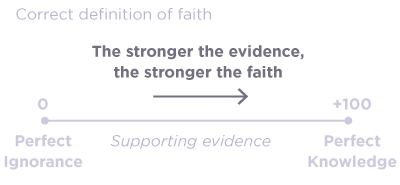
Now Dr. Lennox himself warns against the dangers of blind faith.  He would argue that no Christian (and I am sure follower of any religion) would say that they don’t have blind faith in their religion.  There is at least some evidence.  But if we, just for arguments sake, take blind faith as the extreme at one end (and I would say people who think God is just going to heal their child and they don’t give them medicine is close to that end) and that something like having faith that the sun will come up tomorrow is being at the other extreme, we can easily see that there is a world of difference between those two extremes.  So, at the outset, it is intellectually dishonest for anybody to make claims that just because you use faith and I use faith makes what we have faith in as equally valid.  As Dawkins points out in the clip and addresses in more detail in the full debate, is that the key is in the evidence.

So why do the two points of view not work out to be equivalent?  As I have argued before (here and here) and will not go into detail here, it’s because of what we consider valid evidence.  If parents who let their children die on the hopes that prayer would save them were using the same evidence as Dawkins’ uses in having faith that his wife still loves him, then both would have equal predictive capability.  And this is an important point that Dawkins tries to make is that even if we are all using faith to some extent the degree to which the work model we have of how any phenomena works must be predictive.  Given our model of the solar system, each time the sun does come up it is further reassurance that are model, which would predict the sun would come up (really the sun doesn’t come up of course we rotate on our axis), is in fact verified.  So while one could argue that it is a matter of faith that I think the sun would come up tomorrow, the evidence to which I have built that faith, is far different than those who would use faith that God will intervene on their behalf through prayer.

Of course, one might ask, “Why do people think prayer works at all?”  If that evidence is so untenable why build any faith on such things?  The answer to that questions requires a greater delving into human cognitive biases but largely it is due to our propensity to make Type I errors (false patternicity) and our cognitive bias to remember ‘hits’ and disregard misses.  And this speaks to why the scientific method is so important because it requires careful methodology, it requires replication, it requires that we be able to build off of older principles to new ones reliably.

One then often argues, well clearly you have faith in the scientific method.  And I do, but this again is because the scientific method works.  If were to use the scientific method to uncover some knowledge of the world and at every turn I was not getting reliable results, then this would be cause for me to question the very way I was trying to discover how things work.  We’ve seen the scientific method be effective so many times, that we can therefore have faith that it will be reliable again.  Once again we see how being predictive plays a role in how faith in the scientific method is different than a faith in a personal God.

Finally for as important as I think faith is to our lives, we also must be willing to change the things we have faith about.  If I do have faith that my wife loves me based on a certain set of evidence.  Even if I’m convinced that evidence is good, should that evidence change, or it’s pointed out to me that I’m not using reliable markers of one person showing love to me, then there is no reason for me to continue to have faith along that avenue.  What we have faith in, is not set in stone.  What an unsuccessful species we would be if that were the case.

What does it all ‘mean’?

I was listening to an interview with Charles Murray recently.  For those of you who aren’t familiar with him, he is the person who wrote, what became a controversial book, The Bell Curve.  Through some careful research he showed that white people had a higher IQ than black people, and had a lower IQ than Asians.  He was labeled a nazi and a racist, and many other things for this research.  Now I don’t want to get into this debate, I think that as a scholar his methodology was sound, but what his book doesn’t answer the reason for such differences.  Is it genetic?  Is it environmental?  I am sure it is more often the latter.  The more important question is, what is the value of such research?  Is it really doing any good, or does it just feed the bias of a racist, while angering others?  If you’d like to listen to the interview, I think you will find him cordial, but it’s not really the main thing I want to talk about, although what I do want to talk about is mentioned several times throughout out the interview, and that is what differences really mean.  How should perceive differences in IQ or any quality for that matter?  There are certain issues that have become very taboo in our society, and things become emotionally charged quickly when one tries to talk about them.  These includes talk about differences between people of different races, different religions, different genders, and different sexual orientation.  A discussion about any statistical differences between different populations along those lines usually doesn’t end well for the person trying to bring them up.  And it’s possible that there is little value in discussing these differences, but I thought a short post to really visualize things from a statistical perspective is important, because I think people often don’t view the statistics properly when these issues come up.  And it’s true not only for these “hot button” issues, but a lot of issues in which scientists discuss differences between populations.

For many studies, particularly in the social sciences and biological sciences you will find data is distributed.  For any two variables that you are trying to find a relationship with, you will find the outcomes range across a particular set of values.  For instance, if we were trying to determine how depression influences someone’s eating habits, even in a perfect experiment we would likely find that most people eat more to comfort themselves.  Perhaps a large majority would say take in 50% more calories than they normally would.  But a small minority would take less calories, perhaps -20%, and another small minority would take in twice as many calories.  This is called a frequency distribution.  We plot the range of outcomes versus the amount of time those outcomes occur.  There are several types of distributions.  There are skewed distributions, bimodal distributions, and then there is the normal distribution.  This is generally the most common one and the easiest to say something about statistically.  As our sample size increases, a relationship between two variables that are related to each other should get closer to a normal distribution.  I realize that I am simplifying here, but my goal is not to get deep into statistical theory, but simply to illustrate why differences between populations might be more or less meaningful.

In a normal distribution the most common occurrence (the mode of the distribution) is the mean, and it is the value you get at the middle and tallest part of the curve.  First let’s ask how useful is this to begin with?  By definition of the mean is the middle value, half of the people lie above and half of the people lie below.  So when we look at the means of two different populations we might see an overlap as illustrated here:

Despite the different averages we can see that much of the populations span the same range of values.  The source for this graph discusses the meaning of overlapping means in more detail. A more specific example is here:

This graph comes from an interesting discussion about differences between populations of men and women.  In this example we can see that the average height of women and men are different, but of course no one would say that any given man will be taller than any given woman. What this means is that if we are talking about people there is very little we can assume a priori meeting any individual member of a group.  We can only say this is how things are on average and we can decide if anything should be done about it or anything can be done about it if we desire those averages to be the same.

Averages are talked about far more than perhaps they should.  While it is a good summary of data, frequently the devil is in the details and we can say little concrete on averages alone.  Rarely do researchers themselves so narrowly focus on the statistical analysis they do, but I think much gets lost when a journalist tries to report on the findings.  The average, being the easiest to understand, is thus the easiest to report on and that’s when people start making assumptions about what the data are actually saying.  Read an actual paper and you will find all sorts of other statistics discussed.  Averages are all too common though.  We get them in school, they are reported in sports statistics, the news.  But one has to be put it in context of the entire set of data.  Let’s not define people by an average.  What is equally relevant is the variance among the population as well.

People are often easily fooled by statistics because they don’t understand them adequately.  Statistics also deals with probabilities.  Something we are terrible at from an intuitive level.  If you are interested in having a better understanding of basic statistics, I found this website to be quite helpful.   I believe that by having a better understanding of statistics we can have more meaningful reactions to the findings of data analysis, and thus have more meaningful discussions about what we can really conclude from those data.

It’s the Thought That Counts

It has been discussed by many that our brains are wired on an evolutionary scale, and that the rapid change of society through technological advances has outpaced us, leaving us with many disconnects between what we see every day and what we can actually handle.  In many ways, we might be happier if we lived in small tribes and were closely surrounded by wilderness, instead of surrounded by brick and cement, drive vehicles and get visual stimuli from computer or television screens.   One aspect of this disconnect, that I find quite intriguing, and I think is central to our ability to understand the world we find ourselves in, is what I call and order of magnitude problem.

Think about early man in those hunter gatherer days.  Counting is a base cognitive skill, important for our survival.  But what is that we might count?  You might count the amount of fruit gathered on any particular day, the number of children, or people.  Such numbers might get you into the 100s.  You might count seasonal cycles.  If you were lucky maybe you had 80 of those to count.  You might count lunar cycles.  Getting you to about 1040.  Even this would require some note making, because this is counting over time, and surely you would not sit there and count something that high.  Such cycles of time were the only things worth keeping track of.  We had no need to measure time beyond that.  No need for small units of time such as a second.  It might make sense to come up with some unit of measurement for distance. Something comparable to arm lengths or hand widths…something we might use to size an animal, measure height of people or spears.  When it came to traveling, you might then simply use something like phases of the moon, or number of diurnal cycles.  Once again such counting would leave numbers small.  Occasionally you might find yourself thinking about numbers in terms of fractions.  Maybe something like half a day, or a quarter of an armlength.  For things very small, you probably would no longer use armlength as your standard, but perhaps finger width.  Such techniques are ones that we still use today.

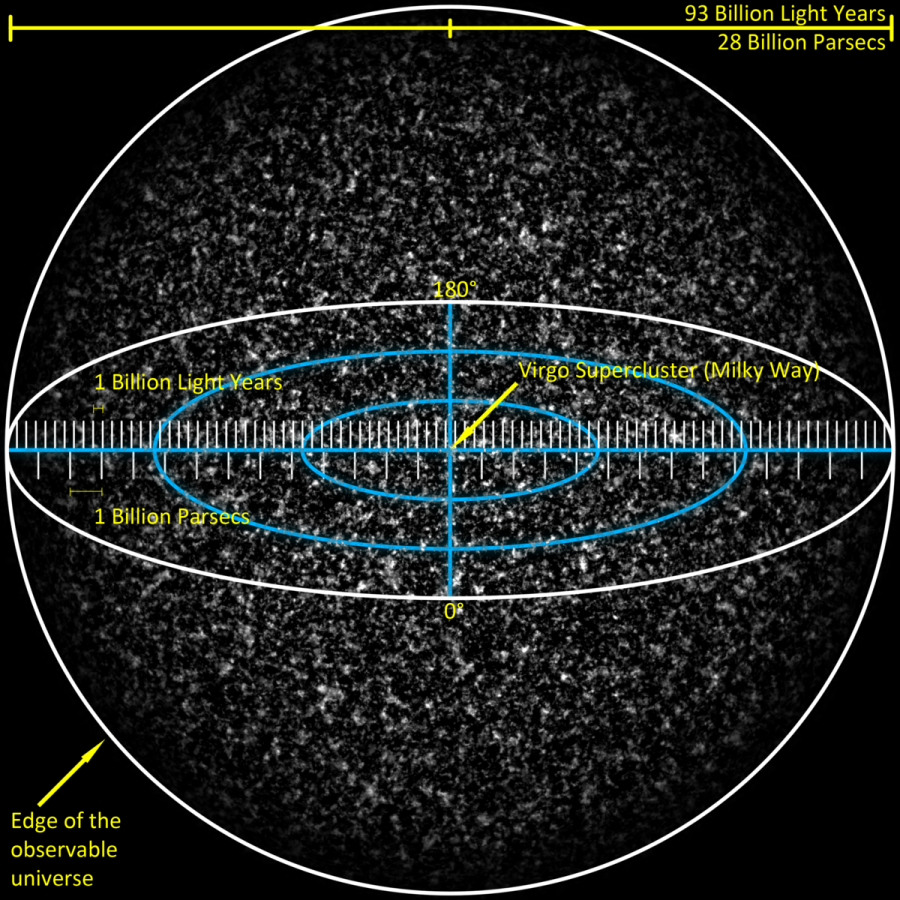
The reality is that if you think about numbers, you probably won’t get very far.  Now do a little exercise for me.  If you think of the number 1000.  How do you think about it, to picture a 1000 of something?  You might think what a $1000 can buy, but money is a fiction that represents a quantity of stuff you can buy which varies depending on what stuff your buying.  If you wanted to actually count, what would you think about.  Maybe 1000 people in a room.  You might have a sense for how big a group that is.  Chances are you won’t get it exactly.  Go down to a 100 and your chances of picturing 100 things gets better.  Now do 10 of something.  Pretty easy.  Now do 1.  Even easier.  Let’s go down another order of magnitude.  Try to think of something that is 0.1.  Here as we move down an order of magnitude we can no longer count whole things.  So think of 1/10th of a person probably gets a bit graphic, so what are you thinking of to imagine 0.1?  For that you now have to think of some standard.  Maybe a mile, an inch, a meter?  Depending on what you choose, you can do okay.  Now try 1/100th.  Again with the right starting point you might do okay, but even dividing by 100 can be hard for someone without a formal education and once we get to 1/1000th our ability to guess at the meaning of that fraction is severely reduced regardless of our starting point.  So if you are keeping track this puts the human mind, on a good day our brains are capable of somewhat accurately sorting out 5 orders of magnitude (10-2 – 103).  However, if we look at the scale of the universe in size we span 52 orders of magnitude from the plank length to the size of the observable universe (please see this very cool interactive graphic that allows you to explore the different spatial scales of the universe).  In terms of time, our quantum clocks can measure up to 1  ten billionth of a second (10-10) .  Meanwhile we know the universe has been around for about 14 billion years (1015 seconds).  If you don’t have trouble digesting such numbers you are a super genius, because everybody should.  Those are just the extremes, but unless you are within that 5 orders of magnitude range I discussed earlier, it makes little difference.  And this is also important because it means that a million miles, might as well be a billion miles in our head.  However, the difference between those two numbers is meaningful.  In science, to consider two numbers like that the same would be to make a grievous error on the order of 100,000%.

Scientists, through years of working with the numbers that shape our world are often better at dealing with these things, but even scientists tend to use conventions to make numbers easier to manage.  There is a reason why you don’t measure the distance from New York City to Boston in inches.  We have developed different units of measurement for distance.  In the old English system we have inches, feet, yards and miles.  In metric, we have prefixes that span numerous orders of magnitude so that we don’t have to always report distance in meters.  For objects in space in our solar system we might use astronomical units to keep those distances in more manageable numbers.  For things outside our solar system, light years.

                  Image of radar reflectivity.

Whatever we measure in science can change over large ranges and change at massively different rates.  Change is rarely linear, but very often exponential.  As a result, we might find ourselves dealing with quantities which very over several orders of magnitude.  In my field a good example for this is radar reflectivity.  You may not be familiar with it, but you’ve certainly seen radar images if you’ve paid attention to the weather.  Higher reflectivities indicate bigger drops and faster rain rates.  Lower reflectivities represent light rain or drizzle.  The difference in size between a drizzle drop and a basic rain drops is no more than a factor of 10, but the reflectivities span over 10- 1,000,000.  Thus, meteorologists convert those reflectivity values using decibels.  The decibel system was initially used for sound given the large range of frequency for sound waves, but now is a common tool for expressing values that vary over several orders of magnitude by taking the logarithm (base 10) of the value. This reduces the number to its order of magnitude.  For example, instead of 106 if I take the logarithm with base 10 of that number I get 6.  And 6 is much easier to wrap our heads around than 1,000,000.  I know I’ve gotten kind of technical here with this example, but the point is that nature, as we’re discovering, does not conform to the numbers our brains had to deal with when we evolved.  And most scientists, while they might have some understanding of the microscopic or macroscopic numbers and the wide ranges of values science employs, to objectively analyze and come to some meaningful conclusions we very often have to be able to visually see those numbers between about 0.01 and 1000.

You might say that such numbers make little difference to most of us unless we are in science, but let’s talk about where our everyday lives might be impacted.  First let’s start with the population of the world.  There are 7 billion people.  Try to wrap your head around that number.   Is your soul mate really just one in a billion?  Could such a large group of people create an environmental disaster? How many bodies could certain countries throw at you in a war? About 700 million, globally, live in abject poverty.  Do the numbers seem so voluminous that it’s easier to ignore human suffering, or make you feel defeated before you try?

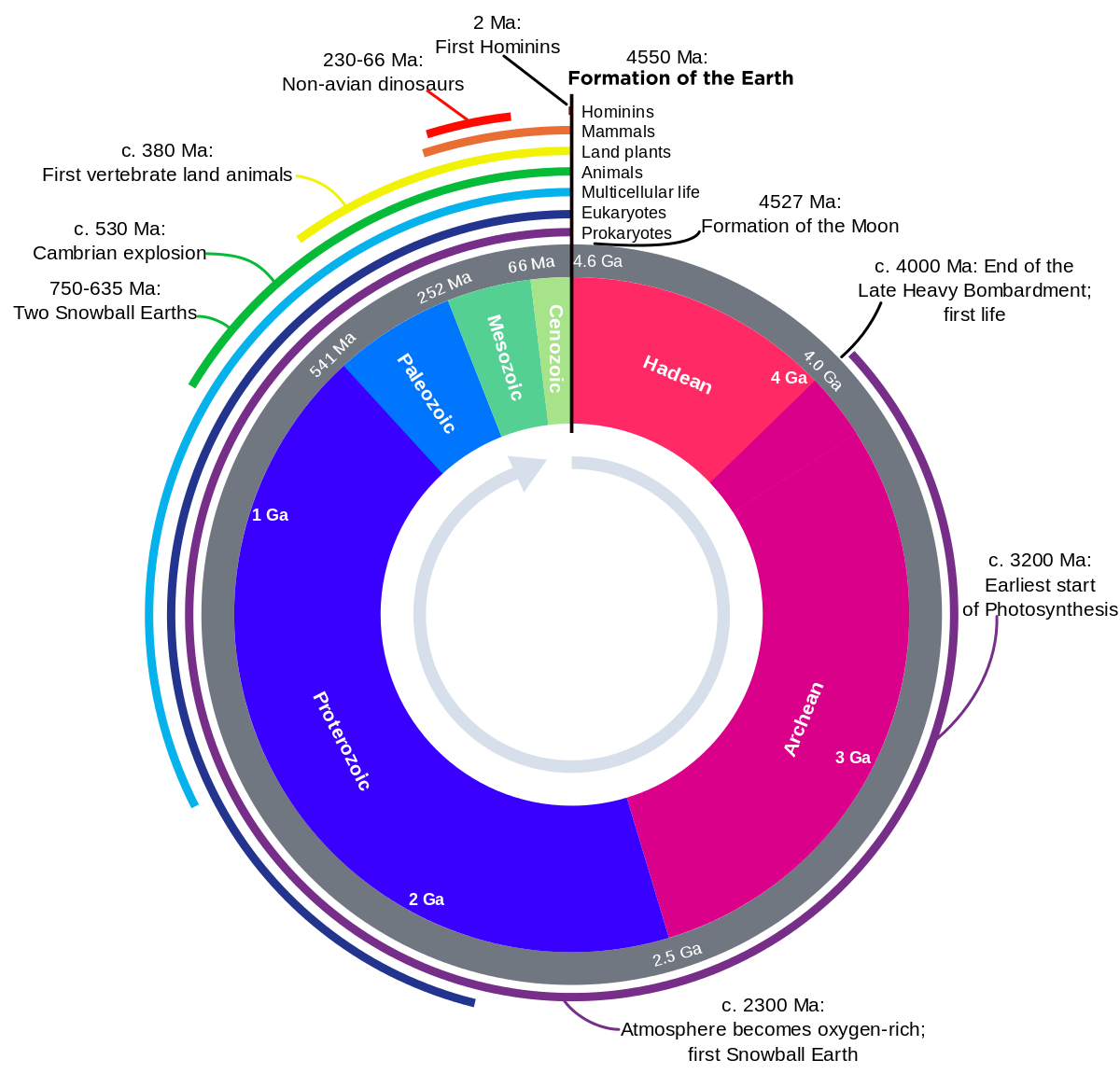
What about some of the more important educational and scientific controversies that still exist today? Evolution has been happening for several billion years, but many would like to believe that we’ve been around for only 6000 years.  Religious dogma aside, isn’t it possible that part of the reason that some people resist what science clearly demonstrates is because we are talking about a length of time that few can relate to?  The vastness of time threatens to humble us all as blips in a universe far older than we can fathom. And its size and origin similarly attacks our human conceit at being the grandest and cleverest design in a creator’s eye.

                                         The Geologic Time Scale

Vast amounts of people also create vast sums of money.  Billionaires have almost unimaginable wealth that people still commonly believe that can obtain too.  Politicians and media constantly throw large dollar values in our faces to intimidate us.  When one wants to high light wasteful spending we can put point to something costing 100’s of millions of dollars and we shudder at such an amount being wasted.  Forgetting that with 100 million taxpayers, something in the 100’s of millions is costing us a handful of dollars a year.  I have seen the tactic used frequently.  Once again we might on some level realizes that a 100 million, 10 billion, and a trillion dollars are different, but they are all unimaginably large sums of money that in the battle for what’s important and what’s not, they can all be seen as being on equal footing. The idea that public television and radio need to be cut for austerity is quite simply a joke when compared to a 10% increase in defense spending if anybody thinks that’s going to balance the budget.

One might argue that the microscopic matters very little (no pun intended), but I do think an appreciation for that scale is valuable, if for no other reason helping us appreciation the vast variation of scales that make up our known universe.  Scientists often take very small numbers that might exist for pollutants or toxicity in foods or water, and change the unites of those numbers so that they are bigger.  I understand why, because of course we don’t want to underwhelm in those situations, but maybe it’s also a problem that we continue to cater to this limited range of numbers that our minds most easily manage.   It’s probably best to start incrementally, and perhaps a good example of how we can begin is with time.  John Zande over at his blog, The Superstitious Naked Ape, offers up a good first step towards our lack of comfortability with numbers outside of our “sweet spot”.  The start of our counting of years begins with the birth of Christ, but this is a religious and faith based reason to start the counting of the years.  Why not use Thai’s bone which is our earliest evidence of careful astronomical observations of the sun and moon over a 3 ½ year period.   Instead of the year 2017, it would instead be 15,017.

                                                                          Thai’s bone

It might seem like an arbitrary difference, but I think it would give us a better feel for the vastness of time, and a better appreciation for the numbers that shape the universe we’ve come to know.  Since there seems to be little stopping the advance of science in technology, perhaps we better find more ways to help these brains, made for a different time, catch up.