The Moral of the Story

I was ‘talking’ with a fellow blogger who is a nurse, and as I am a meteorologist we were trying to figure out who had it worse.  Was it more annoying to deal with the “climate change deniers” or the “anti-vaxxers”.   I agreed his was more annoying, because while human induced climate changed is well-evidenced it is always going to receive a lot of political blowback in a fossil fuel dependent world and it is both a complex and new problem facing us.  Vaccinations on the other hand have worked so well and have eradicated disease so completely that people don’t remember why they even get them and instead have invented dangers to receiving them because they can no longer see the purpose.    It’s as routine as opening your mouth and saying “Ahhh”.  People don’t really question that, but it doesn’t inject anything into you and is sort of hard to get upset about, but I think when some medical advancement has been around so long and so successful we forget the reason and just see it as possibly something that isn’t necessary.

This led me to wonder if the same thing wasn’t true for how we understand morals.  One of the common things you hear from atheists is that many theists are under the impression that we do not have a moral and ethical code.  That such thing is not possible if we don’t have God and some supernatural system of punishment and reward.  I remember my mom, who is Christian, telling me at some point that our sense of right and wrong must come from God or else where would we get it from?  The general answer is easy of course, we are taught them by our parents and others.  We have authority figures that tell us what is right and what is wrong (even though you can convince a child that things that are wrong are actually write, like prejudice and intolerance).  The point is if as children we seem to get our morality from the authority figures in our life, perhaps it’s not surprising that many people, especially those who have no qualms about relying on the “rightness” of authority, that morality comes from what many consider the ultimate authority, God.  But it seems obvious to me that morality can easily be derived through scientific investigation.  Morality though has been around well before the scientific method, but humans have been around for a long enough time that we’ve been living a social experiment of morality and have simply been learning.  At one time the things we take as obvious might not have been overtly obvious, even though I think some of the big ones we could figure out rather quickly as they would not be a beneficial for survival.  Just like we stopped questioning why vaccines are important, perhaps we stopped questioning why certain immoral acts are wrong, such that people assume that it all must have come from some other plane of existence.

Some morals are certainly cross-cultural, like physical and sexual harm to other people’s children.  This one would be a pretty obvious natural (perhaps genetic) trait because our survival does depend on the survival of the next generation.  Anything that threatens that would be considered immoral.  Unfortunately in many places physically or psychologically hurting your own child is not seen as wrong.  It wasn’t so long ago here that, unless something got really severe, you were hardly considered in the wrong for disciplining your child with a belt or the back of your hand.  Some people still adopt that attitude unfortunately in North America, and it can be worse in other countries.  Regardless though we generally do go to ridiculous (and perhaps psychologically detrimental) lengths to protect children.  In general though killing is not quite viewed the same way.  Many think it’s okay to kill criminals (apparently it sometimes doesn’t even matter the crime…resisting arrest is enough), and killing in war is not only tolerated, but often cheered about.   For some time killing your wife in a crime of passion was often considered justifiable.  And many civilizations have committed genocide in our past and that has gone unpunished.   So even of the most basic commandments “thou shall not kill” isn’t clear cut, so this obvious sense of right and wrong we are supposed to get from God looks pretty muddy.  And if we are worried about some sort of eternal punishment system it’s amazing the ways we can justify killing when we need to dodge that one.

But let’s look at it from the perspective of “unlawful killing” which is why modern translations say “murder” instead of kill in the 10 commandments.  Thus we already have human law deciding what killing is lawful and unlawful.  This is not an overly divine commandment already.  We know that before civilization we roamed in smallish hunter gatherer bands.  Maybe a few hundred people at most.  This was a time before Christianity, before the 10 commandments, so let’s assume this group doesn’t know right from wrong.  Like a small town, in these small groups, you knew everyone.  Surviving in the wild is not easy and everybody had a role to play, and everybody shared and worked together.  Studies of hunter-gatherer tribes today show them to be rather egalitarian in compared with much of civilized society so let’s look at this as a group that gets along.  So we have a group of a few 100 people, and because they have no God to tell them between right and wrong they think murder might be just something that’s okay to do.  What would be the results of a few people that decided to commit a murder every once in awhile:

  1. Population decline and lack of genetic diversity – We could at the very least learn that there is a murder rate that is not healthy for the survival of the group. Through cooperation, life was made easier, but the group gets smaller, things get harder. Population can only increase so fast. So at the very least, if murder is okay, we can’t do it too often.
  2. Loss of those with specialized or exceptional skill. While daily tasks required teamwork there would have been certain people with more extraordinary skill. A tribe may also only have one person who does a particular job. Murder could reduce the chance for survival if such people are killed.
  3. Growing fear and distrust. If people are being murdered, people are less likely to cooperative. Some people will simply be scared they will be next and be more cautious and protective. Some people will be angry at the loss of their child, brother, sister, etc. This will cause others to fight back. There may be false accusations, which builds more anger and distrust.
  4. They are diminishing their own chance for survival. Once a murderer is discovered, those that committed the murders may find themselves a victim.

Now there are probably even more things that could be listed as to why murdering would not be a good idea, the least of which that we are by definition a social species for whom survival depends on our being in a group, and being able to work well in that group.  It simply isn’t in our nature to murder our own, and there is a lot of good reasons why murder would not be a good idea.  However when it comes to other groups, all bets are off.  We may be xenophobic due to bad experiences with other groups before, or simply be xenophobic because someone who we don’t know simply isn’t somebody we can implicitly trust, and thus we can justify killing others that are not part of our society.  This is why war is not against the law, but murder is.  We can do similar thought experiments with many other basic things that cause harm, like stealing, or any action that causes harm both physically and emotionally.   But even if it was not in our nature, this social experiment has been going on for some time and it seems quite reasonable to assume that even if there was not a morality inherent in us through birth, if at the very least we have a driving force to survive then many of the morals we have today would result through experience and observation and concluding how to survive better.

As a population we continue to adjust.  Different groups share moral truths just as they would share any other type of knowledge.  And so perhaps much of what we consider right and wrong is handed to us without that rediscovering process, but you can still see the impact of people doing the right thing and wrong thing today.  Because even though I think that on average humans are more moral in civilized society today than in the earlier days of civilization, we still have a ways to go.  People who are doing good and bad things are not of one particular faith or philosophy.  If you have compassion and care about how you make others feel, you will discover yourself how to behave in a way that’s more positive everyday as you grow and learn also.  It is the scientist in us that helps us become more moral.  If anything, the Bible demonstrates this more completely as the old testament has very much an eye-for-an-eye mentality, but the new testament is very much about forgiveness, redemption, and compassion.  Even God seemed to find a more moral way of dealing with enemies. Thus I don’t think it’s surprising that morality should progress in the same way that science does.


Tin Foil Hats

Hey, Travis, when everybody is out to get you, paranoid is just good thinking!

– Dr. Johnny Fever


If there is one group of people that I despise arguing with, it is conspiracy theorists.  I find it even more frustrating than debating someone with strong religious convictions.  Maybe it’s just because I can sympathize better with people with strong religious beliefs because I have been exposed to religion and have had family who have strong religious beliefs.  Now both types of people are belief driven and in many ways there is no difference at least in terms of how neural pathways are formed and how the impact of reinforcing those neural pathways impacts the brain, but there is something about conspiracy theorists that seems more concerning.  Maybe this is true only for religious fundamentalists in the west.  In other areas of the world I would fear religious fundamentalists much more, but maybe it’s because with religion the crux of the debate falls to the supernatural and with the supernatural there is no way to disprove it.  For those who have faith it’s tangible and real and this is what governs their thinking.  A lot of times if you bring into the realm of the real world you can often find common ground and agree on things, even if you disagree on the mechanism.  In fact I’m pretty sure I’d be less surprised if someone found actual evidence of the existence of God than some of the conspiracy theories that some people believe in as being real.

When it comes to conspiracy theorists, the troubling part to me is that all of what they believe is easily disprovable.  There are no supernatural forces at work; it’s a conspiracy that involves this plane of existence.  It’s physical and tangible in a very real sense.  We can actually settle the debate.  With God, you’re never going to settle it, because God cannot be disproven in a strictly logical sense (of course that’s because for something to exist the onus for proof is on those that would assert its existence).

I was talking to a colleague recently who is a geologist.  He had told me before that his father was very conservative and does not think evolution is real.  More than not accepting the scientific evidence he has invented a conspiracy theory in which all fossils are fabricated and made in a factory somewhere and then scientists plant them around the world so that they pretend they have evidence.  It just blew my mind when he told me.  The amount of fossils we have is enormous and the time and energy to make all of those, plant them all over the world, all so that we could tell a false narrative about the origins of life are astronomical for me to even wrap my head around it.  Of course I’ve heard the general theme before that evolution is just a conspiracy to try and disprove the Bible and I literally don’t understand.

As an atmospheric scientist of course the one I deal with the most is the conspiracy associated with global warming.   Thousands and thousands of scientists all banding together trying to get greedy off that alternative energy money and trying to destroy the poor fossil fuel companies who apparently are struggling to make ends meet.  Debates usually go something like this:

Me. “As somebody who studies this and understands how the atmosphere works…” I list a lot of hard evidence, and explain how the greenhouse effect works.

CT (Conspiracy Theorist)  Evidence ignored and the grand retort is “But other people are experts too and they disagree”.

Me. Thinking, ohh they want to try to take that right now  “Actually not really, few people who deny climate change are actually atmospheric scientists, and none of them have been able to publish any scientifically sound papers in peer-reviewed journals on the subject.  Such scientist’s research is always funded by oil companies.”

CT:  “That’s because the journals are controlled by the IPCC and they prevent any contrary evidence from getting published.”

Me: *bangs head*

The back and forths are usually longer, but this was just a glimpse. One thing I have noticed that is common with all these debates is that they never address any scientific evidence you present directly.  So in retrospect, debate is a bad word.  They have no defense on the workings of antigens, the physics behind the greenhouse effect, or the random mutations of genes.  There is always some larger organization involved pulling the strings, shadow networks, cover-ups, secret e-mails, vast sums of money involved.  They post links to sites that reference other articles written by someone with equally little knowledge of what they are talking about.  There are vague references to events that never happen, or if they did happen there is no way to prove that they happened.   And why do these conspiracy theories always involve the government or scientists?

Governments are for the most part, simply incompetent.  The level of organization they need to have to pull some of the shit off that people give them credit for is truly astounding.   The really corrupt ones are so obviously corrupt and drunk on power there is no need of secrecy they do it right in front of your face.  And of course I know many scientists.  They are some of the finest people I know: curious, intelligent, and for the most part noble and compassionate.   Corrupt scientists are few and far between and are easily exposed because scientists believe that what they are doing is valuable and important and have zero tolerance for those that would make a mockery of the scientific process and allow bad science to flourish.

Now certainly you might say at this point, while we have never proven the existence of a supernatural deity, there have been conspiracies.  To that, I say most definitely and in fact that’s what makes conspiracies relatively short-lived and small.  Because people are generally good and if there is some conspiracy that is causing harm to people, and lying to people it’s not long before somebody’s conscience gets the better of them and they get the message out.  In fact, this would seem to put a natural limit into how large a conspiracy can grow.  Once it gets too big or too harmful, whistleblowers will come out of the woodwork.  And there will be tangible evidence of this conspiracy and unsubstantiated hypotheses are no longer necessary.

I have decided that I need to stop engaging such people.  But it’s hard, because there some of the conspiracy theories, if allowed to spread, can cause real harm.  Like ones related to climate change or vaccinations and then I find it hard to keep quiet because lives are literally at stake.  Ultimately it feels like people who purport conspiracy theories enjoy the attention, the feeling of importance that they are part of the minority and they get it and everybody else has been duped.  Perhaps it’s just ego.  Perhaps it’s just pure and utter fear of a world they don’t understand. Perhaps it’s just people wanting to believe in something do badly that they will invent anything to rationalize that belief.  I don’t know.  I’d be curious to learn how some of my other readers deal with conspiracy theorists.


Note:  A study was conducted to determine whether Tin Foil Hats really protect your thoughts being read.  Turns out it makes it worse.  At least that’s what “physics” tells us. (That’s the punch line if you don’t want to read the article).

Ideally Though

I’ve been doing a lot of thinking about a particular issue in this world and I think made an important and worthwhile change of view.  It’s not really a complete 180˚ turn, but I am asking questions in a different way, and feel like I am becoming more grounded about the issue.  That issue is for a later post, because in trying to understand my change of heart, because I feel like my original stance is not wrong.  After some soul searching I’ve come to the conclusion that the problem was that I was being too idealistic and it has lead me to think about ideals, and how we can sometimes get caught up in them and that it’s not always that helpful.

So what is an ideal?  We all have them.  We’ve all known people that are overly idealistic and while those people can be enjoyable to be around and make for engaging conversation, sometimes such people can appear a little naïve.  I may be one of those kinds of people at times.  The dictionary defines “ideal” as person or thing regarded as perfect, or a standard of perfection, a principle to be aimed at.  I realized that the reason ideals can get us in trouble is because they do involve some personal vision of perfection.  I have written about perfection before and how it can be an unhealthy concept since a) we all have different ideas of perfection and b) to my knowledge perfection has never been reached, so do expectations of perfection do us a disservice?  I believe at times they can.

If by definition an ideal represents some state of perfection, one that either cannot be reached, or cannot be reached easily or quickly being dogmatic about your ideals can lead to rigidity in thinking, it can also put you in a “future mindset” too easily when problems exist in the here and now.  For example you may hold the ideal that war is pointless, unnecessary and we should all live in peace.  I love it, and I’m on board.  But unfortunately there is war.  And while I do believe that we may someday get to a place where we find better ways to resolve conflicts than through war, it’s not clear that will happen anytime soon, and there is always the possibility that war may always exist, despite how obvious alternate solutions might be.  So given that there is war, we can’t get caught up in an ideal of world peace that we forget to treat soldiers humanely who have been injured physically and emotionally and give them the medical and psychological treatment they need during, and after their service. Hell even the immutable physical law, the Ideal Gas Law which describes the relationship between pressure, temperature, and volume of a gas doesn’t really exist.  The law describes how a gas would behave under ideal conditions.  Ideal conditions that while we can get close to we have been unable to reach.  So it’s important to remember that ideals are just that, and not in anyway a truth we can find in the present.

From http://meetville.com

There are many fine and lofty ideals out there.  It’s easy to just start thinking, I wish the world could just see things my way and it would be a better place, but that isn’t likely to happen.  But I don’t think ideals are a waste of time.  The part of the definition of an ideal that I like the most is it being something to aim at.  Ideals are like far away targets and it’s easy to imagine yourself hitting the target, but instead we should simply see it as a direction to head and not worry so much about whether we get there.  Focus on the journey and pay attention to what is actually happening.  It could be that solutions in the present don’t necessarily conform to your ideals but they are the right thing to do for the time that you live in.

Climate Change for the Masses (Part II)

Well it would seem that a group blog idea with a weather and climate theme has fallen apart, and so I’ll have to do my blogging about it here instead.  Several months ago I began what I hoped would be a 3 part series, themed around the John Oliver’s  “Last Week Tonight” Episode on the climate change debate.  In my first blog post I wanted to try and investigate what type of people don’t accept the evidence on climate change, based on my own experience in getting into various discussions on the topic with people outside my discipline.  In this blog article I’d like to take a look at the actual media portrayal of the problem which was more the central theme of John Oliver’s segment.

If you haven’t watched the clip, John Oliver critiques the media for having one person who accepts the scientific evidence, with one person who denies it, saying that this gives an unfair representation of the scientific consensus on the issue.  Over 97% of the scientific literature from over 10,000 scientists across earth and biological sciences have concluded that human induced climate change is a fact, making it appear as though it is a split issue is quite simply dishonest.  And this absolutely true, but it is in fact even worse than that.

The 50-50 split looks even more in favor of the deniers when the media is always using the same person to represent the scientific side.  If you watch many interviews on the subject you might actually get the picture that it seems to be only one guy who thinks human-induced climate change is real while many other people don’t think it’s happening.  If you always saw the same guy “for” an issue and many other people on TV saying they are “against” it would be somewhat natural to think that the “against” side had a better argument.  Of course you’d be wrong in thinking that.  This is called the “Appeal to Popularity Fallacy” (or ad populum for you Latin Lovers).  An extremely common one used nowadays.  Of course as it turns out, it is the logic of the arguments and the strength of the evidence that makes for who has taken the correct issue on the stance.  Of course there are many biases and fallacies that we naturally gravitate towards because it is in our evolution.  Being the outcast in a group didn’t get you very far early in our evolution and the same is in a large part true today.  Although generally today, no matter how different you might be, with a large population you are likely to find a group to connect with.  But in terms of genetic history being an outcast in a group of social animals who may be relatively isolated from other populations doesn’t really give you anywhere to go, and since survival on your own is more difficult “following the herd” is part of who we are.  Of course, in this instance, there is no real punishment for accepting scientific evidence but sometimes I think our wiring doesn’t really care.

The 50-50 perception unbalances even further when you consider who Bill Nye.  Now don’t get me wrong.  As a scientist, I know he’s

From http://brandonhillphotos.com

a scientist, and that he has the ability to not only understand the issue, speak intelligently about it, and accept the hard work done by so many scientists to reach the conclusions they have about climate change.  But to the public there are a lot of negatives about Bill Nye that would make his credibility more suspect, especially to people who are on the fence or deniers themselves.   First of all Bill Nye is not a climate scientist.  He is not an expert in the field of climate science and as such this will weaken his credibility as an advocate.  In fact Bill Nye is most famous for his use of science concepts for educating children.  Climate change is a very adult issue that will require adults in government and voting adults to accept the scientific evidence and put forth appropriate policies to address the issue.  Bill Nye is also a celebrity and many people have negative attitudes towards celebrities who get involved in issues that are political.  In Canada, David Suzuki is a very famous scientist and naturalist, but is not very knowledgeable about the issue and so while he has tried to be advocate for climate change, he has not done very well when addressing even the most common fallacious criticisms put forth by deniers in a debate format.  He was hoping his popularity would help change the minds of people, but in fact it has likely hurt those who might be willing to listen to a well reasoned debate on the subject.  So I think Bill Nye may have similar impacts.

Now don’t get me wrong, because I am not convinced that the media is intentionally using Bill Nye for the purposes of misleading others.  For them, he is a celebrity and known and will add a few viewers whether people have grown to hate him or love him.  He is also an excellent public speaker, and he is also eager to break away from his previous persona as a scientist for children (honestly go back to getting children excited about science, I think it’s too late for congress now!).   So what is the solution to making the debate fairer?  John Oliver’s suggestion is not a bad one, but of course they are unlikely to get 100 people on the stage for a debate.   We nerdy introverted scientists simply need to become better communicators.  We need to get involved in educational outreach and scientific discourse at regional, state, and national levels.  Since there are literally 1000’s and 1000’s of people researching this field and concluding that man is impacting the climate just as we hone our research and analytical skills we must also hone our communication skills so that we aren’t just contributing through the publication of an article in a scientific journal.  And media, you could do a better job of finding actual experts to have on your programs.  You could do a better job also by being honest and saying we know this is not even close to a split issue in the scientific community and have more debates about what the best way about addressing the issue is, rather than trying to debate whether it is an issue at all.

If you are interested in learning more about climate science, learn about what the common myths are about climate change and why they are not well reasoned arguments, and be able to investigate climate change science at various levels of complexities I strongly recommend this site called Skeptical Science.

He Blinded Me With Science

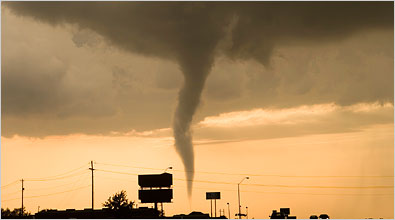
As a meteorologist and scientist I am very familiar with many pseudoscience arguments and websites like creation science, new age science, anti-climate change arguments, and all the conspiracy theories that go along with it.  My colleague recently turned me on to a little gem of a website.  Somebody has ‘solved’ tornadoes.  I hope you click on the site.  Not only will the guy who owns this WordPress website be excited that he has so many hits, but you will immediately be able to tell that this person isn’t playing with a full deck.  At first I laughed a lot as I read it, but the more I read it, the more I actually started to be impressed.  Now don’t get me wrong, it’s not that I’m impressed with the actual ideas here, they are completely wrong, but I was impressed with how much time and thought this person has gone into thinking about the problem.  I don’t want to post any individual blog posts linked here, because I really don’t care to have this person start harassing me, but if you go through a number of them you’ll see that he has talked to some real experts in the field (although it’s unclear about whether he has e-mailed them or actually talked to them personally), he has posts where he has retracted some of his statements and then explained why he retracted them.  He has designed experiments to test his hypothesis as well.  In fact I’m a bit jealous that this guy actually has more blog followers than me.  Did I say jealous?  I meant frightened.  Anyway, what I thought what was really interesting is that here is a very unique belief system which has blossomed into something rather complex.  One that to my knowledge nobody else really believes (at least not yet, or at least I hope not yet) and yet bears much similarity to existing belief systems.  So I thought it might be interesting to deconstruct it a little and see what we get.

At the heart of every belief system is at least one premise that is accepted as true, without being supported by any empirical observations.  Once this is accepted as

From http://www.nc-climate.ncsu.edu

true, much can be built from it.  For instance many religious belief systems accept as fact that there is a God and goes on from there.  Many times of course there are several faulty premises.  It could be that they stem from an original, but it’s hard to say.  Let’s take a look at the one’s that seem to this gentleman’s starting point

Premise 1:  The jet stream is a conscious entity that is thirsty for water and thus tornadoes are a result of the jet stream needing to suck up water.  I guess that makes a tornado a giant straw.

Premise 2:  Moisture is the most important factor in determining density differences in buoyant air. (Actually it’s temperature).

Premise 3:  Meteorology is a cult, and meteorologist simply believe in old and outdated arguments that have never been proved experimentally.

From this all sorts of things are possible.   If you were to accept the first two things as truth you would come up with a very different scenario for how and why thunderstorms and tornadoes form.  The 3rd premise is what then allows him to never have to rethink the first two.  People who could argue intelligently with him and are more knowledgeable are meteorologists and since they are part of a belief based cult they can’t possibly be correct or unbiased.

Another important part of a belief system is the inequality in standards the proponents of the belief system must live up to in comparison to non-believers.  For

From http://static01.nyt.com

instance, those against gay marriage will expect everyone to respect their right to be legally bound in holy matrimony, but do not have to respect the rights of homosexuals.  As is often the case pseudoscience literature like this, the expectation of other is to provide rigorous proof, yet no such proof is given by this gentleman as he espouses his hypothesis about how and why tornadoes form.   At its root I feel this comes from a lack of humility.  To be so sure you are right about something that you are beyond the need for evidence, and that you are beyond the ability of anybody (regarding their experience and expertise) to change your mind is to be so prideful that even Donald Trump would be impressed.  It is also a sad state to be in.  As I’ve argued before since reinforcing beliefs releases dopamine in the brain, over time as the neural pathways become so entrenched into a belief, this person literally will become ill to consider anything else.  The stronger the argument you make, the less likely you will get anywhere.

So what’s the harm in all of this?  Perhaps very little since there is a certain amount of crazy that even the most clueless about the subject won’t buy into.  Nevertheless there is at least enough science jargon on his website that people who are not educated about the issue may think there is controversy and conspiracy.  Just like many who are not educated about climate change think the same way.  There was at least one commenter who reblogged one of his articles saying it was an interesting “new theory”.  I wanted to also introduce this website and blog post as a lead in to a discussion of the age of information (or misinformation) that we live in.  This person has self-published a book for sale on amazon and has done a lot of writing on this subject.  If he had a little bit of money and/or web savvy he could make his site one of the top hits on google when people search for information about tornadoes.  Critical thinking skills are even more important today than they were before the internet to be able to navigate the flood of information that we are faced with on any one subject area.  Anyway, keep well everyone and stay away from thirsty jet streams!

How Our Will Is Not So Free – Part II

In Part I, I hoped to get you into a relaxed frame of mind as you consider the possibility about the existence of free will.  That perhaps our subscribing to free will is more trouble than it’s worth and that life can be no less wonderful without it.  So here is the way that I like to look at our ability to make choices.

In a previous blog post I talked about the fortunes of life perhaps depending on the choice between Pepsi and Coke, so let’s stick with soda (or pop if you

from http://createmeaning.com

prefer) to start our little thought experiment.  Let’s say you live in a world in which there is only one beverage you know about, and that beverage is Coke.  When you are thirsty and you need something to drink, there is no decision to make it is going to be Coke.  Free will does not enter into the decision.

Now this is not particularly realistic.  So let’s add a choice like Pepsi into the mix.  They taste different, but both can quench your thirst.  Which one do you choose?  Well let’s see what might go into making a decision.  You are at the store that sells the only two beverages that are available and which one do you choose?  Likely your choice will come down to statistical probability.  If you absolutely had no preference, your decision would simply be random.  Over the course of your life you would probably have picked Coke 50% of the time and Pepsi 50% of the time, provided you had a choice.  Nothing in your life that you have learned has caused you to lean one way or another, there are only two choices, and thus your choice is limited and can be simply equated to flipping a coin.

You might say at this point, wait, I can choose to pick Coke or Pepsi more often.  Okay then, but why would you?  What particular reason would you have for choosing one over the other?  This question is particularly devilish so I’ll get back to it later.  As for now, you have no reason to choose one more than another, and so quite simply you wouldn’t; it’s a flip of the coin, which isn’t free will.  Generally people don’t do anything without a reason.

Now let’s throw in a reason.  Your mother who you revere and think is wonderful always brought you a special souvenir coke when she’d go away somewhere, and so drinking Coke sometimes reminds of that warm feeling.  This is an influence that impacts your decision making. All of a sudden your preference for Coke perhaps goes to 60% (40% Pepsi) because when you’re thinking about your mom you’re in a mood for Coke, taking away from it always being a completely random decision.   Now since Coke is a little less sweet, perhaps your blood doesn’t react well to too much sugar, a genetic trait running in your family, and you can’t tolerate Pepsi as often and all of a sudden you’re at 75% Coke, 25% Pepsi.  Then you find that the makers of Coke are a little more efficient at running their business and are able to have more sales on their product.  As someone who is money conscious all of sudden you are buying Coke 85% of the time, Pepsi 15%. A really hot girl or guy is in the Coke commercial – 90%/10%.  Finally your Dad is a mean person who beat you as a child and he always drank Pepsi.  All of a sudden you are only drinking Coke again.  Your choices are a function of the things that influence you.

For every answer there is a question.  You’re money conscious, but where does that come from? Perhaps your father despite being abusive was very disciplined with money and so you gained that skill from him.   What if you decide that you aren’t going to let your father’s action impact your decisions and

From http://crenshawcomm.com

get a Pepsi out of spite.  Great, but what would cause you to be so defiant and rebellious.  Perhaps your mother showed that trait.  Perhaps you were inspired by Martin Luther King, Jr. that you learned about in school.  Perhaps you were inspired by the movie Braveheart.  There may be many possible influences, the point is that you believe that defiance is a positive way of dealing with such childhood trauma and that idea had to come from somewhere.  Many people do not have such boldness.  Perhaps that is not a weakness, perhaps they just feel the best way to cope is for them to completely dissociate themselves with their Pepsi drinking dad as way of staying stress free and peaceful.  They learned this from a self-help book that they read on letting go of the past.

Now going back to an earlier question, what prevents you from just preferring one drink over another for no reason?  People seem to do things for no reason all the time, and I would have to agree.  But doing something for the hell of it is also a trait.  There are people who will never be like that all their lives.  Some people say, I’m just going to be a Coke drinker even though I like both of them well enough, because hey why not, I’m a wild and crazy guy, and I just want to be on team Coke.  Where does this spontaneous side come from?  An aunt you love and revere whose always taking chances and is a thrill seeker?  A friend you went to college with who just loved to be spontaneous?  But if your spontaneous next year you might just be on Team Pepsi.

The reasons for our decisions are so varied and complex that such a breakdown for why we make the decision we do is not always clear, but it is clear that we are conditioned by multiple influences over different scales of time to reach those decisions.  Your choice of beverage might really be something like this:

Coke 70% – Tastes better, grew up with it, family drank Coke

Trying something new 10% – Your mom always encouraged you to try new things and that variety is important so you aren’t afraid to take a chance when something catches your eye

Dr. Pepper 10% – You also like the taste and it reminds you of your years in grad school when you and your friends used to always take a break from studies and get a Dr. Pepper

RC Cola 5% – They were out of Coke, you wanted a cola and you hate Pepsi

Tolerable Beverages 5% – when your favorite choices aren’t available you can tolerate maybe an Orange Crush, Fanta, or Root Beer because it’s better than any of the other choices you’ve been given.

And then finally you might have a special category of beverage you’d hate and never choose unless you had been in the desert a real long time and had no other choice.

In our minds we think about all the things we have drank and see them all as choices and feel like we are consciously making the choice with our free will, but the truth is that we are conditioned into those choices and if we really thought about it, we usually do get a Coke, and the other beverages are choices but low probability ones.

Can our lives really be predicted so easily?  Our decisions already pre-determined? The answer, of course, is “no”, because life is full of unexpected events.  Even if everything that occurs is deterministic you are an incredibly small part of everything and cannot follow the chain of events. And perhaps your penchant for trying new things leads you to a beverage you love more than Coke.  Perhaps you fall in love with a girl who loves Dr. Pepper and that becomes your preferred drink since you both like it and it’s something you can share.

From http://dilbert.com

Life is full of events that we don’t know are coming and it is those intersections that throw us out of our comfort zones and give us new experiences that shift the probabilities and possibilities of choices we can make in any given situation.  Whether you are open or closed to new situations also depends on the various things that can influence us as human beings.  We are animals born with a unique mixture of genes, in a part of the world we had no choice in, raised by people who we had no choice over, while our senses feed us information every day we exist to a brain that has been conditioned over millions of years to process all that information amazingly well and do its best to help us survive.  Yet most things we will never know or understand fully, closing off an entire range of possibilities that we might choose from.  And so what if we are not consciously making our choices?  We are a complex mixture of nature and nurture and in such a symphony who wants to pick out a single note from a single instrument.  Just sit back and enjoy the music.

How Our Will Is Not So Free – Part I

For any of you who are foolish enough to read my blog you are used to a lot of rambling.  I can’t promise this will be too different, but I would like to be a little formal and have an actual thesis for this post.  I have posted my thoughts about free will in respect to religion, but even if one is not religious the idea

From http://www.brandonragle.com

that we have free will is extremely pervasive and I think it is ultimately a not necessarily helpful concept to believe in.  The choices that we think people have are an illusion and we tend to instead judge others because people do not make choices that we would make.  It prevents us from really helping those who are violent, disturbed, hurting, depressed, etc.  It has us believe that there are people who are inherently evil allowing us to dehumanize them and cast them aside, when instead they might simply have brain abnormalities, be traumatized, influenced by people as messed up as they are, or simply lost and confused in a world that is beyond them and behave desperately.  I think it also acts to separate us from nature and is a great source of human conceit.  Free will is not something we ascribe to plants or animals and thus also gives us the illusion that we lie in a place above all else.  Whether you believe that the supernatural has imparted us this blessing of greatness or you think that evolution is a pyramid in which humans rest on top, both these notions are ultimately dangerous because they allow us to justify great atrocities against nature as we continue to satisfy our own self-importance.

In the first 8 months of watching my son grow it is clear that free will is not something he was born with.  He started out simply crying when he was hurting, uncomfortable or hungry, and sleeping when he was sleepy.  Not a lot of free will going on there.  As I watch him change, I see him simply become aware of more things.  When he first could see our cats, not surprisingly he was curious and wanted to touch them.  Now that he’s been outside he asks to go outside (well not in words).  Now that he realizes the comfort of being held he asks to be held.  He also mimics.  He sees us eating something and he wants to eat it.  He sees us using a remote, our phones, computers, and he desperately wants to use those too (or rather put them in his mouth).

Before I formally begin my argument for the absence of free will I want to put an excellent quote from an article I read some time ago from the New Yorker which has had a large influence on my thoughts in trying to understand why we are the way we are and where this sense of self comes from that I blogged about some time ago.

I believe we inherit a great river of knowledge, a flow of patterns coming from many sources. The information that comes from deep in the evolutionary past we call genetics. The information passed along from hundreds of years ago we call culture. The information passed along from decades ago we call family, and the information offered months ago we call education. But it is all information that flows through us. The brain is adapted to the river of knowledge and exists only as a creature in that river. Our thoughts are profoundly molded by this long historic flow, and none of us exists, self-made, in isolation from it.”

From http://www.eugenecascadescoast.org

The reason I want you to keep this in mind, because not only does it support the argument I am going to make (doesn’t of course make the statement true), but most importantly I want to reveal to you that just because I don’t think we have free will, doesn’t mean that I don’t find life absolutely amazing.  The idea expressed in this passage speaks to me in a way I cannot fully express, but I find this idea beautiful.  It tells me that we are product of processes that function over many different scales of time.  From what we learn each day, to what nature has molded us into over millions of years.  We can extend even further and look at the billions of years of evolution which has produced us , and we can go back further to old stars dying and being the seeds for our own sun and solar system which allowed one fortunate planet to even allow life to evolve.  So the fact I may not be quite as in control of the process is hardly depressing.  In fact it removes a lot of the pressure if anything.  I can simply marvel at all that has taken place for me to sit here and write these thoughts out today back to the beginning of time.  It is humbling, inspiring, and magnificent.

I shall now let you pause a bit before going on to the next blog post, because going back to the beginning of time is something that requires some deep reflection. 🙂

One Thing Leads to Another

Have you ever done the following?

“If in the 6th grade there was a section in our science class about clouds, and then a section on it in the 8th grade that taught me more about meteorology I might never have picked the field to study.  And then if they hadn’t shown that video about radar in my undergraduate from the University of Oklahoma I might never have decided that I want to specialize in that and go to the University of Oklahoma.  That interest in radar in clouds led me to the University of Wyoming.  And then if I hadn’t met that girl Diane studying in the geology department who shared a love of games with me, leading to us taking turns hosting games nights.  And then at one of those games nights if I hadn’t cooked chicken curry for some of her acquaintances from the geology department who were invited and who didn’t announce they were vegetarians beforehand and couldn’t eat what I cooked, causing my friend to be so insulted on my behalf that she refused to invite them again, thus causing her to invite two new people to replace them, one of them being my future wife.  I would never have the wonderful life I have now.”

I am quite sure you have done this before.  Maybe it’s about a special relationship, maybe it’s a great job, maybe it’s even a tragedy or negative situation.  You could even go back further to how your parents met, grandparents, etc.  But let’s take a closer look at this journey through our life.  We look back at this chain of events and we see all the amazing decisions along the way that brought us through a path in life and it is somewhat mind-blowing. What we’re really doing is amazing ourselves about how large events in our life might never have happened if not for an amazing set of circumstances.  And of course it is true that this chain of events lead you to where you are.   Is it fate? Should we be blown away by all these amazing set of circumstances?

To answer this question we must ask ourselves another one.  What is the alternative?  There is none.  Events happen in time in a chronological order in

From http://www.photo-dictionary.com

which one event always leads to another.  And every person has their own timeline.  Every bit of life has a time line.  And even some things that aren’t alive have a timeline like hurricanes, avalanches, earthquakes etc.  All these events are happening and as each of us follows our path in time and space it is natural that we will intersect with the paths of other things in their timeline.  There is no choice to this.  If you met your future spouse in a convenient store as you were both reaching for the same bottle of coke we say this is remarkable how you were both thirsty that day and arrived at the same convenience store that was out of your neighborhood and decided to get yourself a beverage.  One of you feeling like Pepsi that day would have changed the course of your entire life, but there would like be another major event as you met somebody else instead later, not knowing what you missed, with a different chain of events that you deem important.  In fact what’s really interesting here is that, in a way, the fact that you chose Pepsi and not Coke that day allowed you to have the path you enjoy now but you would never even know the significance of that choice.

It seems also that part of the reason we are blown away by such a recounting of events, is that ultimately we are the ones who choose whether an event is even significant at all.  Meeting a lover, a best friend, or getting that perfect job might be all things that we find extraordinary and thus the events that led up to them seem almost banal leading to such momentous events.  But what if we were just to look at everything that happens in our lives as events?  For that is what they are, with each one only have the significance that we ascribe to it.  This walking into the convenience store before you met the love of your life and reached for that bottle of coke, is the same chain of events minus one link.  The moment when you realized you were thirsty and wanted a coke two less links in the chain of events in your life.  I think you get the picture.

So what should really blow our minds is that every event in our lives is the result of a complex chain of events, and that the littlest decision such as whether

From http://www.the-exponent.com

you want a Pepsi or Coke can be equally as life changing.  In one hand you realize it (choosing Coke) on the other hand you don’t (choosing Pepsi).  Now if thinking that every one of the littlest decisions of your life might be the most important you ever made stresses you out, don’t let it.  You are bound to make decisions, and even deciding not to anything about a situation is a decision and those decisions will lead to outcomes.  It is unavoidable.   I just think it’s a nice thought to think that every event might be as important as the next, and that any event might be one that is extremely significant even if we don’t know it at the time.

I am going to publish this post now instead of 5 minutes ago because I decided to heat up my chai because it got cold.  And who knows, maybe that will be change the course of my life.

The Nature of Correlation – Part II

Since we now understand some basics about correlation I think it would be interesting to try and understand “How do we initially hypothesize a connection between variables?”  If we analyze something simple like Newton’s second law which says that the force exerted by an object is directly related to its mass and acceleration.  How might such a relationship have been devised initially?  Well this is something that can be easily observed.  You push an object like a

From http://weebly.com

cart and it accelerates.  If you push it harder, it accelerates faster.  If the cart is full of objects it becomes heavier and requires more force to get the same acceleration.  Such observations are the basis for an experiment which can show us the nature of the relationship.  Our experiment might end up only being mostly successful as we might be confused about why the force might change depending on the surface across which we move the object.  Until we understand friction we might not be fully aware of the other forces that are working against us when we make our measurements.  Newton was able to also explain the frictional force as well, but the fact that the Earth is turning on its axis revealed Newton’s second law to be incomplete for Earth and only true in a reference frame that is not in motion.   Newton’s description of force came first and it was only through further experimentation and testing that we came to understand the limitations associated with his relationship between force, mass and acceleration.  So the basis for a correlation comes through a lot of trial and error after some initial observations.  Proper application of the scientific method (adequate sampling in particular) along with result repeatability can demonstrate the correlation between two variables.

Finally it’s important to understand the complexity of relationships that exist.  Just like the force is dependent on the mass and acceleration, most things in this world are not as simple as one cause and one effect.  Most things are complex systems in that one variable may change as a result of several other variables.   The global average surface temperature is a function of the amount of solar radiation hitting the Earth, the concentration and location of greenhouse gases in the atmosphere, the amount of geothermal energy released at the surface, and the amount of energy released through radioactivity.  The last two tend to be fairly small.  Solar radiation is the most important factor then followed by the greenhouse effect.  So if we want to look at how CO2 varies with global temperature, we are never going to get a perfect correlation, but we are going to see a correlation.  And if we understand the role the sun plays in heating, we can easily delineate between which part of the heating is due to changes in solar radiation, and which part of the heating is due to changes in greenhouse gases.  Just like with our example of force, we can determine whether that force is because of a light object traveling at a fast speed or whether it is a heavy object traveling at a low speed.  Our knowledge of the relationship allows us to make that determination.

In social sciences the variables impacting a system can be numerous.  As I’ve argued before gun control is an extremely complex issue.  The number of gun deaths is dependent on the types of laws we have, the number of guns available, quality of mental health care, attitude towards mental health care, income inequality, education (both general education and education about use of guns), the role of the media and politicians fear mongering, culture attitude towards violence and death, and probably more than that.  With these types of issues it’s easy to point to all the other things that could be causes to try to show that changing one variable isn’t going to have an impact.  But neither side is completely valid here, because the argument should really be about the factors that are more important and which ones are less important.   Just because one variable is more important however doesn’t eliminate all other variables from having an influence.  Just like coalition governments where the dominant party can lose power if the other parties combined outweigh them in votes, a dominant variable in a complex system may be outweighed by the combined importance of the other variables.  For instance when it comes to the greenhouse effect, carbon dioxide is not the only important greenhouse gas.  Numerous greenhouse gasses like CFC’s, nitrous oxide, ozone, and methane are released as pollutants and if industrialization continues at the pace it is at, the combined impact of those other gasses may become similar to the impact of CO2, even though individually those gases have a very small effect.  It is important to understand all the variables that are involved and address them, especially when harm is being caused to people, because even a small variable that we can fix might reduce that harm.

As the complexity of a system increases the direct correlations between one variable and another generally decrease.  A correlation of 0.2 might be significant if there are many variables all impacting the state of a system, especially if all those variables might be of similar importance.  People like to keep relationships simple, but by doing so fail to solve problems that are usually far more complex.  This is also why complex systems are some of the easiest for those who don’t really understand it to mislead others.  Climate change is a great example.  A change to the climate system depends on many factors and thus makes it easy for someone to try and emphasize one part to make their argument.  Like the oft used “Carbon dioxide is necessary for plants to grow, how can more be a bad thing?” This ignores the role carbon dioxide plays in the greenhouse effect, ocean acidification, and what happens when plants decompose.

Happiness is often brought about by the simple things in life, but it is also important to remember that there are lots of things happening out there that aren’t so simple.  We are a part of a complex universe.  Part of why we continue to survive better is that we continue to breakdown the complexities of the university into things that we can understand.  Also remember that just because things are complex doesn’t mean that there aren’t those who truly understand the problem and that with patience and effort you can too if you choose.

The Nature of Correlations – Part I


The fact that the universe is complex shouldn’t surprise anyone yet one of the things I find surprising how vehemently people try to argue that it’s not. I have already written a blog post about correlation vs. causation, but I’d like to talk about something a little broader than that. Correlations try to demonstrate the relationship between one variable and another. It would be a sensible decision to try and correlate the amount of gun ownership with gun deaths. I don’t think anybody would argue that it might be a relationship. And even if we do find a correlation what does it mean? What is a good correlation, or a bad correlation?

So what can we expect out of a correlation? First we might ask, “Can any two things to ever be perfectly correlated, even if we have a mathematical relationship?” The answer is no. Quite simply for data to be perfectly correlated it would require perfect measurements. Since every measurement always has some error there will always be a less than perfect correlation. The more difficult the measurement the less likely we are to get a good correlation at all. In social sciences measurements may depend on a survey, qualitative and/or subjective observations, and complex sampling techniques. This will all impact the correlation we calculate. Correlations range from 0 (no correlation) to 1 (perfect correlation) and it depends on the quality of the data and the nature of the problem to really determine what correlation is high enough for us to be positive of a relationship, but generally anything about 0.5 is significant. Correlations can also be negative as well. A negative correlation actually implies that as one variable increases, the other decreases, and those are important relationships as well.

From http://www.venganza.org

Now, what happens when we try to correlate things that have no relationship to each other? It turns out we can get all sorts of results. The often cited graphic to the right is often used to show the difference between correlation and causation.  Two variables may appear to be correlated but have no relationship at all even if the results are repeatable.  Correlations turn out to be even a little trickier than that. Some types of data show natural variability that is higher and lower than the average. A couple of examples would be the amount of blood sugar or atmospheric pressure. Now let’s say we correlated those two things. Let’s say I have two years of daily air pressure values. And let’s say I have sampled the amount of blood sugar in my blood every for 30 straight days. The smart thing to do is select the atmospheric pressure values that correspond to the days that I took the sample and correlate them. But what might I find. Well it could be that in those 30 days, a slow moving high pressure system moved in as we approached the end of the period meaning that in general pressure increased. And then perhaps my diet was not so good, or I ate infrequently, irregularly, or had a few big meals one day and then light snacking the next, blood sugar will fluctuate. I might find that there is a negative correlation between pressure and blood sugar. But what would happen if I did the experiment for another 30 day period. Depending on the specific conditions I might find a positive correlation. But what I’d find, that over time, after doing many of these repeated tests is that I would have no correlation. The average of all the correlation calculations I perform will be essentially zero. This speaks to the importance of having a larger sample size and whether or not results are repeatable for the same experiment. Had I taken two years worth of pressure data and 2 years worth of blood sugar data, I would have found zero correlation. Furthermore even if I did find some correlation, my results would not be repeatable over many studies. The media often exaggerates findings from experiments that try to say link certain foods or cell phones to cancer. Variables that naturally fluctuate may randomly show a correlation, but further experiments reveal no correlation. But the media usually just picks up on the one study that found a correlation.

To further illustrate this point, take a look at the following two images.  The one on the left is a large sample of raw data trying to correlate to variables.  If these two variables were correlated we would see the data points approximate a line.  Maybe a straight one, maybe a curved one, but definitely some sort of trend would be apparent.  You are right if you think that whatever these two variables are they have no relationship two each other.  Next to it is the same data set except that some of the data points are missing.  Now it looks like there might be a correlation between these two variables.  Sure I have selectively chosen in this case which ones to eliminate, but it is possible that a random selection of some of the data points could be these same data points on the left.  Thus it is possible that we might think we’ve found a correlation when we didn’t.  Once again the more data we take and the more we try to repeat the experiment we would show no correlation.

LDrXq LDrXq2

In the next part we will investigate how we hypothesize about correlations, and how complex most relationships are.