

I don’t know. These 3 words are important.
 One thing that is fairly obvious among humans is that we don’t like uncertainty. To say that we don’t know something is to highlight ignorance. It’s the highest level of uncertainty we can reveal. Even us ego driven academics are often chided for weighing in on every issue, and it’s a stereotype that is not unfounded. But as every good teacher will tell you there is a lot of value of telling your students that you don’t know. Now maybe some students idolize your intellect and saying you don’t know might shatter the pedestal they put you on, but if they truly care about the pursuit of knowledge they should be lauding you for having the humility and honesty for saying “I don’t know”. No one can know everything, even in their own field. And it’s a moment to teach your students about how one goes about finding the answer to a particular question, and that you never really stop learning or being a student.
But how is it that we know things? We can know things through experience and through investigation. Some claim instinct or intuition is also a type of knowing. But is it, or just a reaction to a particular situation? Instincts can be certainly be wrong even if they are embedded into who we are as humans. But instinct or intuition can also be honed through experience. For instance, a doctor might have a hunch or intuition about what might be wrong with a patient. This isn’t some inborn knowledge. The doctor, as a 16-year-old, certainly wouldn’t be able to make the same guess than they might have after years of experience. Most things that we chalk up to instinct or intuition are based on experiences we have had, or perhaps read about. If, as a woman, you have intuition about a guy that he’s creepy or dangerous, it could be that you’re spot on. Given the litany of examples of violence and abuse of men towards women this wouldn’t be a surprising thing to fear. But whatever that feeling is, does it represent true facts about the universe? Not necessarily, because you could be wrong, but it’s part of our survival to play it safe, instead of taking chances, going against our intuition can be costly. Regardless of what you believe about instinct or intuition all ways of knowing are subject to our cognitive biases and thus investigative methods that attempt to remove biases have a higher probability of being right.
 The one thing that I think religion and science have in common is that they are both representative of our desire to know things and our uncomfortability with uncertainty. There are always things we don’t know. Sometimes big things like why is there a universe at all? Or, how did life begin? Many of the questions we’ve had over the years have been explained by the supernatural, only to have that debunked through scientific investigation. Refusing to leave things unexplained we have, in human history, always had those who claimed magic is real and that supernatural forces act with intent. But can we call supernatural explanations an explanations? It answers what, and sometimes who and when, but rarely how and why. It also seems to me that such explanations never really factor into things we are closer to understanding. For instance, we still have questions about lightning, but this is something that we also understand a lot about. We don’t say, “Alright we don’t know exactly how charge separation happens in a cloud, so therefore God.” We have enough of a physical understanding of the situation to know there are some details we haven’t worked out, but that it’s an explainable, natural phenomena. In ancient China, well before we understood anything about lightning, people believed that lightning was caused by supernatural forces and it would strike down people who were disrespectful to their parents. It’s as good an “explanation” as anything when you know nothing perhaps, but that’s a big problem. Such explanations are a dime a dozen, you could say “No! Lightning strikes people who are dishonest with their spouses”, “It’s pixies in the clouds, angry at humans for taking their home to make their village”, “It’s punishment for an entire civilization for their sinful nature”, “It’s an electric elk called Simon”. Things that promote magic as real render the investigation of scientific laws and principles useless. What value would understanding these things if such rules are ignored by the supernatural and the whim of a believer? People often want answers so badly they don’t care about the process.
 This is where science differs from religion. Science seeks to explain and is much more about the process of investigation than the answer. Obviously that is the endpoint of a particular question, but how you arrive at that destination is at least as important, if not more important than the destination itself. Science seeks to explain through premises that are verifiable and analyzing available data before arriving at a conclusion. This conclusion then must be reliable as a starting point for new questions to be answered successfully, and this conclusion must be reachable by others independently. And because we don’t always have or know what relevant data is to answer a particular question, we can’t guarantee that any conclusion is 100% right. We can only determine the most correct answer given a certain set of information.
 People say that history is also a way to know what’s true, but such people who say that don’t truly understand what good historical scholarship involves, or the reliability of such conclusions. Historians know that any one source of historical knowledge can be biased, so the more data (sources) about a historical event the more sure the conclusion. But even then there still may be cultural bias, or differences in the way historical events were recorded at different times in our history. The lexicon of a particular language was less complex than now and thus we can sometimes only guess at the true meaning of a particular text. We can also support historical claims with archaeological evidence. Apologists that I’ve debated with love to cite the truth of a historical event in the Bible, but saying a historical event happened doesn’t mean the rest of a particular text is reliable. We can’t say that because City A existed as described in the Bible, thus the resurrection happened. This would be like saying well Mel Gibson’s movie Apocalypto must be all factual history because there was a tribe called the Incas. The Bible is a mixture of ordinary and extraordinary claims, and given that it was written by people who were aware of history and the norms of their time it would foolish to expect all of it to be fiction. Unless we have some unaltered video footage we still can’t know anything for sure. Video footage of Kennedy’s assassination tells us that he was assassinated and where the assassination took place. It doesn’t tell us who did it, or why? That had to be investigated and evidence collected. And despite the many conspiracy theories out there, the one thing that nobody says is that God sent down a bullet to kill Kennedy. The laws of physics were obeyed. Somebody fired a gun and that bullet traveled as it should towards its target.
 The most important value perhaps of admitting “I don’t know” is that this means that it elicits curiosity and investigation. Having an answer, even if it cannot be tested, can often close off an avenue of investigation that might have otherwise been taken. If you ask me a question about the atmosphere and I give you an answer, you may simply believe me, based on my authority as an atmospheric science professor. If I’m right the fact that you don’t investigate for yourself costs you nothing. Yet if I think I know, or am afraid to look dumb and pretend to know my answer can prevent you from finding the actual answer, and now you may act on false information in the future. The reality is that there is too little time in our lives to investigate everything. Some things we do have to just believe. Having an answer is comforting. Believing in the supernatural can be comforting. That which is comforting doesn’t necessarily equate to truth, it is aesthetics. Aesthetics are important, but we shouldn’t expect everyone to share our aesthetic preferences.
 Finally it is often the case that apologists will also use uncertainty as a means of positing that all answers are thus equally valid in the absence of evidence. Sometimes this is true, but certainly there are some explanations that have a higher probability of being true than others. If a tornado doesn’t hit your house one answer to why, could be that God spared your house. But this is highly improbable given how much the dynamics and the thermodynamics of the atmosphere influence storm motion. Provided we could get sufficient measurements of the atmosphere, we would have a better explanation as to why the storm took one path and not the other.
In cases where all answers might be equally valid, for which we have no evidence to support a particular assertion, there is an extremely large number of possibilities. For those who purports the logically flawed prime mover argument, even if it was a sound argument it says nothing about what might be the prime mover. Is it:
- One God
- More than one
- Nice God
- Bad God
- Indifferent God
- Computer programmer of a simulation
- Flying Spaghetti Monster
- God who is just really smart, but not omniscient
- God who is powerful but not all powerful
- God who is not timeless. Created the universe but then expired about 2 billion years ago.
- A group of people from a parallel or previous universe who could do magic by writing things down. The act of writing on a page made it come true.
This list is possibly endless as we try to prescribe a nature to the supernatural. In fact the less evidence there is for an assertion the more possible answers we can provide. Not surprisingly we’ve had over 10,000 Gods in human history. My believing in one of these answers and writing it down in a book does not make an answer more true. Yet we are asked to simply accept specific extraordinary claims and reject others regularly by theist apologists.
The better, and more honest answer is, “I don’t know.” The more comfortable we can become with uncertainty, both individually and as a people, the more likely we are to grow. Not only is humility a virtue, but a methodological assessment of that which we have evidence for and what we don’t, can help us search for possible explanations that we might not have searched for because we believed we knew the answer.





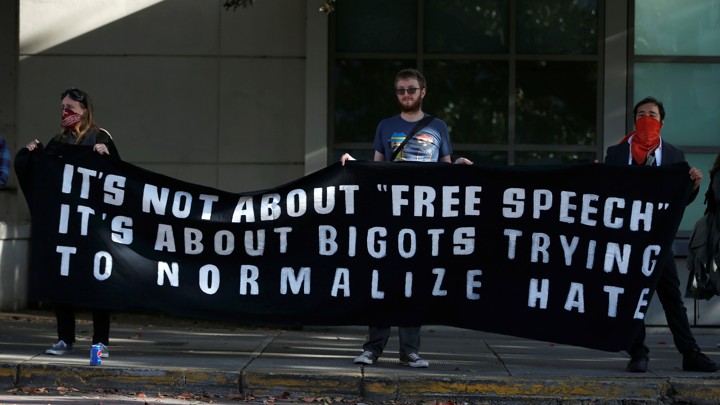 If we want to live in a society where the government isn’t going to interfere with what people say publicly, we are left with a sort of vigilante style justice system. When I was on social media there were quite a few people that felt Antifa’s actions were justified. Some of those people were quite well educated also. Their argument, which I tend to agree with, is that any group that advocates the superiority of their own group over others, purports a worldview that only their group has certain rights while others do not. And this tends to include a lack of protection from violence for those groups that they feel are unworthy due to their race, religion, sexual orientation, etc. Such a worldview is not compatible with a free society and thus if we must have free speech, then punching a Nazi is completely acceptable as a consequence to somebody expressing their racist worldview. Answering hate speech with violence is the part I struggle with. I tend to think that anybody who advocates a worldview does not support equal rights for all humans is simply sowing seeds of hate which will lead to violence and this is therefore harmful speech that should be punished. If we say the law should punish them, then this becomes a slippery slope. Once we start limiting free speech this also presents dangers to a free society.
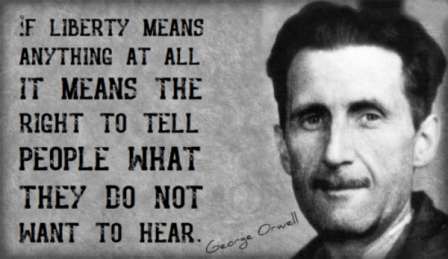 I am sure there many people who have thought more deeply about this societal right than I have, but I tried to think about what the purpose is for free speech. I think I would boil it down to two important aspects 1) The ability to have an unbridled free market of ideas that allow people to challenge ideas and choose the ones that have the most merit and 2) The freedom to voice dissent about existing paradigms, culture, governments, etc. Both these things are good for a society and not being punished by those in power for this speech is important. History is full of bad ideas that have taken hold of societies and without dissent, things would simply not have gotten better.
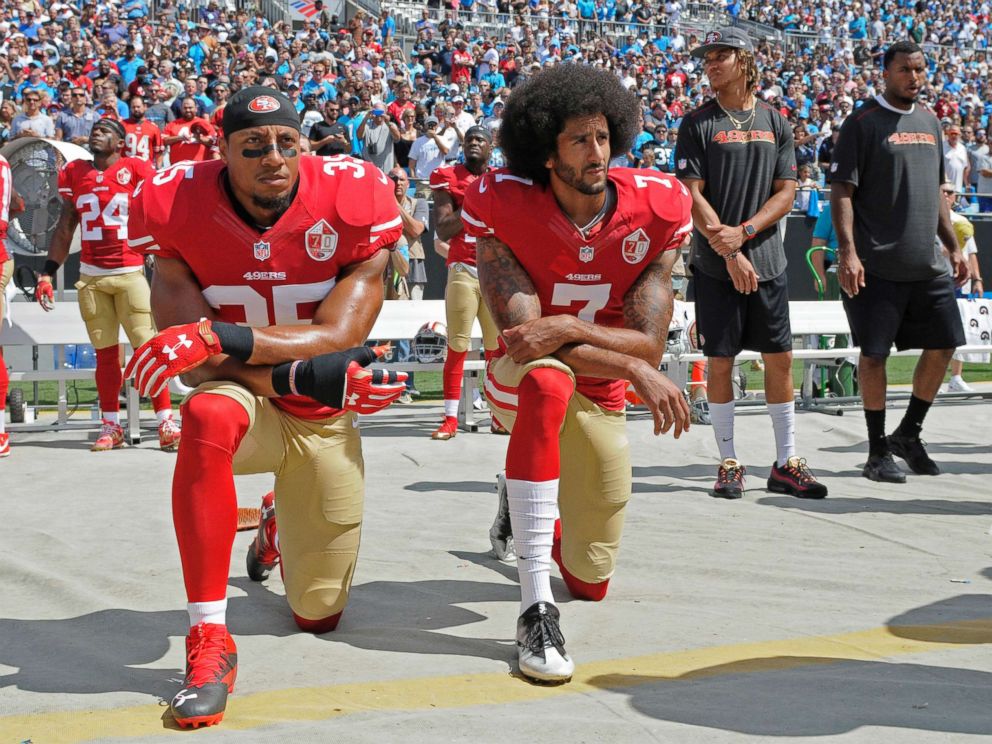 Of course the problem is that people are punished for dissenting ideas all the time. Certainly those who disagreed with slavery, segregation, and other oppressive policies and cultural attitudes towards African-Americans has paid prices in this country (and still are). The fact that those in power can advocate for policies that cause real harm to particular groups of people, makes the importance of being able to express dissent freely even more obvious, even if this hasn’t happened in practice. We know how hard it is to have progress in affording all people basic human rights when free speech is chilled. And even though I can bring many more examples of consequences that people face when exercising their first amendment rights (even if that punishment isn’t be federal law) we know that speech is rarely 100% free. And if this is the case, do want mob style justice for that speech or do we want thoughtfully put together laws, and judges and juries making decisions about whether possible violators are innocent or guilty?
 It’s not obvious to me that violence is the right action, nor is it obvious to me that such speech shouldn’t be met with sharp reprisal given the level of danger that such ideas represent. Maybe the question really boils down to “Is it okay to dehumanize people who dehumanize others?” There might be obvious actors that we would answer yes to this question.



 unconstitutional, the fact remains that this is a much higher brand of intolerance than that which is being shown towards Christianity. In such states, trying to fight those unconstitutional state constitutions will simply alienate yourself from voters even more. How many politicians can be openly gay? How many people of other religions can make it to office in the U.S.?


 Cloak Unfurled