The Ethics Of… The Men’s Rights Movement

I know many feminists and I am sure some may find points to disagree with, but as always I find this blogger does a well balanced look at the issues. He does, I think, an excellent job pointing out serious issues that men face today, while criticizing excellently the Men’s Right Movement, which really isn’t about fighting about male issues, but rather about tearing down feminism. The fight for equality is a common fight, not a tug of war.

The Ethics Of's avatarThe Ethics Of

As a feminist I do the usual little token effort on International Women’s Day and post something up on Facebook. And while most people either like it or ignore it, every single year I get at least one comment along the lines of “Why isn’t there an International Men’s Day?”.

It may sound like just a snarky throw-away line (and often is), but the idea behind that comment is the tip of a very large cultural iceberg that has been floating around for a while now: what about the men?

No seriously, before you sneer at that question and dismiss it as blind privilege, take a moment to consider how men might find the world today a bit frustrating. For the most part everyone agrees that women’s liberation was a great thing; the right to choose your own career, lifestyle and the right to vote are all fundamental human rights…

View original post 1,920 more words

Post-Election Soul Searching: What We’ve Forgotten

In talking with many of my friends who share similar political views it has been up and down this past week.  We search for silver linings, we express anger and sadness, we try to calm ourselves down, and we aren’t always synchronized with others and so everybody can end up arguing with each other at some point.  For me, when something unfathomable to me happens I try to understand as hard as I can.  In many ways this is what led me to understand more about beliefs and why we have them and headed me down the path of neuroscience and cognitive science.  This post will be a bit long, but please don’t be intimidated most of it is copy and pasted from an article that I thought was very well written.  I hope you read the full articles, but if you don’t have time for that, you’ll have to settle for what I think are the most salient aspects.

A few weeks ago I wrote a post, that was the beginning of my investigation into trying to understand the support for Trump and generating some empathy for people who voted for him. And it worked.  The eventual Trump win however caused me to go through some deeper introspection as to how I played a role in divisiveness and demonstrated a lack of empathy.  So I came across a couple of wonderful articles (here is one nice balanced perspective) that looks at this rule vs. urban phenomenon more deeply and I think they are excellent reads.  One of these articles I want to quote several passages.  It is an interview with a UW-Madison sociology professor (Kathy Kramer) who has done a lot of research with rural Wisconsinites.  Let’s take a look at some important passages from the article:

“Cramer argues that this “rural consciousness” is key to understanding which political arguments ring true to her subjects. For instance, she says, most rural Wisconsinites supported the tea party’s quest to shrink government not out of any belief in the virtues of small government but because they did not trust the government to help “people like them.”

“Support for less government among lower-income people is often derided as the opinions of people who have been duped,” she writes. However, she continues: “Listening in on these conversations, it is hard to conclude that the people I studied believe what they do because they have been hoodwinked. Their views are rooted in identities and values, as well as in economic perceptions; and these things are all intertwined.”

Here we can see an important problem.  And the problem perhaps goes for many liberals as well.  Our identities are tied up in our politics.  Perhaps this should not be so.  We know inside we will never get a candidate he really caters to everything we belief.  In fact, most politicians don’t end up doing most of the things they say they are going to do in an election.  It is because our identities are associated with politics that populists exploit them to gain support.  What if instead we expected politicians to give detailed plans on how they would address the issues of all Americans?  You might not be a person living in the rural counties of the rust belt,  but what are their problems?  And if you are a democratic party member should your candidate not be addressing those people?  Sitting down and talking to them.  The same goes for Republican candidates also.

“What I was hearing was this general sense of being on the short end of the stick. Rural people felt like they not getting their fair share.

That feeling is primarily composed of three things. First, people felt that they were not getting their fair share of decision-making power. For example, people would say: All the decisions are made in Madison and Milwaukee and nobody’s listening to us. Nobody’s paying attention, nobody’s coming out here and asking us what we think. Decisions are made in the cities, and we have to abide by them.

Second, people would complain that they weren’t getting their fair share of stuff, that they weren’t getting their fair share of public resources. That often came up in perceptions of taxation. People had this sense that all the money is sucked in by Madison, but never spent on places like theirs.

And third, people felt that they weren’t getting respect. They would say: The real kicker is that people in the city don’t understand us. They don’t understand what rural life is like, what’s important to us and what challenges that we’re facing. They think we’re a bunch of redneck racists.”

I thought this section of the article was very meaningful.  The first point is something very similar to what I’ve experienced in Canada.  People say things like “The feds aren’t listening to Francophones”, “the government is in the east, and nobody is listening to the west”, “government isn’t helping anyone in the rural areas”.  If you are a journalist doing an in depth story on the problems of the day, you probably live in a city, and there are so many people of different walks of life there, you probably would never step outside the city limits.  But the problems of the day are both urban and rural issues.  I can imagine it must be difficult for people in rural areas to pay taxes but not see benefits from that.  Now maybe they are and they don’t know it, but the fact that they have this perception is a valid thing that needs to be addressed.  I can imagine a majority of tax money being used for urban purposes.  Cities make the most noise usually, especially since that’s where the media focus is as well as where politicians spend most of their time.  And her third point speaks to our own contribution to divisiveness between rural and urban.  I’ll own up and say that I have over generalized in that manner and it was wrong.  And even if they are racist, they are still human.  Why do they have that attitude?  Is it just ignorance?  Is it that they have been fed false information?  Is it anecdotal experience that was taken as truth instead of an exception?  We all know we can easily succumb to such things and develop incorrect or harmful opinions and attitudes, despite the fact that we have the best of intentions.

In looking at attitudes of resentment Cramer has this to say:
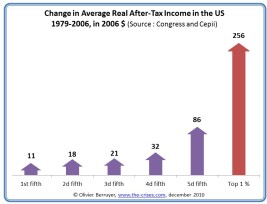
income-inequality-usa-15“Look at all the graphs showing how economic inequality has been increasing for decades. Many of the stories that people would tell about the trajectories of their own lives map onto those graphs, which show that since the mid-’70s, something has increasingly been going wrong.

It’s just been harder and harder for the vast majority of people to make ends meet. So I think that’s part of this story. It’s been this slow burn.

Resentment is like that. It builds and builds and builds until something happens. Some confluence of things makes people notice: I am so pissed off. I am really the victim of injustice here.

Not much to say here other than problems don’t just go away, they keep getting worse when left unaddressed.  I suspect democrats aren’t entirely to blame either.  It’s been going on for years under various administrations.  Maybe we can even see this as a source of a lot of racial issues that are cropping up now as well.  Problems that have been happening for years and now resentment is just so high people are angry and upset.

On the issue of race there were several good points raised:

We know that when people think about their support for policies, a lot of the time what they’re doing is thinking about whether the recipients of these policies are deserving. Those calculations are often intertwined with notions of hard work, because in the American political culture, we tend to equate hard work with deservingness.

And a lot of racial stereotypes carry this notion of laziness, so when people are making these judgments about who’s working hard, oftentimes people of color don’t fare well in those judgments. But it’s not just people of color. People are like: Are you sitting behind a desk all day? Well that’s not hard work. Hard work is someone like me — I’m a logger, I get up at 4:30 and break my back. For my entire life that’s what I’m doing. I’m wearing my body out in the process of earning a living.

In my mind, through resentment and these notions of deservingness, that’s where you can see how economic anxiety and racial anxiety are intertwined.”

While race certainly plays a role there is again this blue collar vs white collar, rural vs. urban issue popping up again.  My father was a machinist and so really appreciate the value of his work and others like him.  I have often worried about how my son will perceive those people in society given that he won’t have personal experience the way that I have.  But we do live very much in a society where blue collar jobs, low wage workers in retail or the restaurant industry are looked down upon.  I had read an article a few years ago from the perspective of a poor single mother who worked every day, lived paycheck to paycheck, and was on welfare.  She said that she didn’t mind being poor or being somebody who had to work a lot harder than everybody else and not really get ahead, but what mattered most was that people actually felt that she had value.  We shame and dehumanize a lot in this society.  Some people are not good people.  Some are lazy, racist, misogynistic, xenophobes, apathetic, selfish, but they are still human and we have to ask always, how did they get that way?  And if they are treated with kindness and humanity, is there a way in which we can make them a better person?  Cramer continues with:

It’s absolutely racist to think that black people don’t work as hard as white people. So what? We write off a huge chunk of the population as racist and therefore their concerns aren’t worth attending to?

How do we ever address racial injustice with that limited understanding?

Of course [some of this resentment] is about race, but it’s also very much about the actual lived conditions that people are experiencing. We do need to pay attention to both.

Great words.  The interviewer then asks about the idea of people not feeling like they are getting what they deserve:

“Part of where that comes from is just the overarching story that we tell ourselves in the U.S. One of the key stories in our political culture has been the American Dream — the sense that if you work hard, you will get ahead.

Well, holy cow, the people I encountered seem to me to be working extremely hard. I’m with them when they’re getting their coffee before they start their workday at 5:30 a.m. I can see the fatigue in their eyes. And I think the notion that they are not getting what they deserve, it comes from them feeling like they’re struggling. They feel like they’re doing what they were told they needed to do to get ahead. And somehow it’s not enough.

Oftentimes in some of these smaller communities, people are in the occupations their parents were in, they’re farmers and loggers. They sayit used to be the case that my dad could do this job and retire at a relatively decent age, and make a decent wage. We had a pretty good quality of life, the community was thriving. Now I’m doing what he did, but my life is really much more difficult.”

When I read this passage it really made me think that this is what a lot of Americans are facing, not just ones in rural areas.  I’ve seen many articles about how the millennial generation struggle compared to their parents simply with costs being much higher in comparison to wages.  Even with a professor wage I know I have less buying power per dollar than my parents did.  There are so many Americans facing the same struggle financially.  The theme continues and Bernie Sanders gets a mention:

         “It’s not inevitable that people should assume that the decline in their quality           of life is the fault of other population groups. In my book I talk about rural              folks resenting people in the city. In the presidential campaign, Trump is very          clear about saying: You’re right, you’re not getting your fair share, and look            at these other groups of people who are getting more than their fair share.                Immigrants. Muslims. Uppity women.

But here’s where having Bernie Sanders and Donald Trump running alongside one another for a while was so interesting. I think the support for Sanders represented a different interpretation of the problem. For Sanders supporters, the problem is not that other population groups are getting more than their fair share, but that the government isn’t doing enough to intervene here and right a ship that’s headed in the wrong direction.”

leaderI thought this was an interesting observation.  I too saw the excitement Bernie had been getting among more rural and working class voters.  Whether you agreed with his solutions are not, he was also resonating with those that were angry at the government, those that felt the government wasn’t serving their best interests.  Maybe he still wouldn’t have won the presidency, but I do think he at least took the right approach into reaching people and finding common ground among both urban and rural working class citizens.

So what is the way out of this all? Cramer had this to say:

“People for months now have been told they’re absolutely right to be angry at the federal government, and they should absolutely not trust this woman, she’s a liar and a cheat, and heaven forbid if she becomes president of the United States. Our political leaders have to model for us what it’s like to disagree, but also to not lose basic faith in the system. Unless our national leaders do that, I don’t think we should expect people to.”

As much as I’d like to believe that everybody can just pick themselves up by their bootstraps I know that it is really not possible.  I’ve felt for some time that it is our leadership who actually have to convince us that they serve us and not special interest groups.  They need be more vocal about us coming together.  Sadly I think many of them know that keeping us divided is a more effective way to keep power than to get us to unite.

In the end Cramer reminds us that empathy, that talking to each other face-to-face and listening are the most valuable tools we have as individuals:

“One of the very sad aspects of resentment is that it breeds more of itself. Now you have liberals saying, “There is no justification for these points of view, and why would I ever show respect for these points of view by spending time and listening to them?”

Thank God I was as naive as I was when I started. If I knew then what I know now about the level of resentment people have toward urban, professional elite women, would I walk into a gas station at 5:30 in the morning and say, “Hi! I’m Kathy from the University of Madison”?

I’d be scared to death after this presidential campaign! But thankfully I wasn’t aware of these views. So what happened to me is that, within three minutes, people knew I was a professor at UW-Madison, and they gave me an earful about the many ways in which that riled them up — and then we kept talking.

And then I would go back for a second visit, a third visit, a fourth, fifth and sixth. And we liked each other. Even at the end of my first visit, they would say, “You know, you’re the first professor from Madison I’ve ever met, and you’re actually kind of normal.” And we’d laugh. We got to know each other as human beings.

That’s partly about listening, and that’s partly about spending time with people from a different walk of life, from a different perspective. There’s nothing like it. You can’t achieve it through online communication. You can’t achieve it through having good intentions. It’s the act of being with other people that establishes the sense we actually are all in this together.

I’ve always grown in my life when I’ve gotten to know people from different walks of life and I need to continue.  Make an effort to do so.  It was easier growing up because I met so many people from other countries, with various levels of education and careers.  When one has a career themselves it gets a little harder.  I know pretty much other professors and students.  Maybe I need to help Kathy Cramer with her research. 🙂

rural__disenfranchised_voters_push_trump_0_6563315_ver1-0_640_360When it comes to terrorism and the issue of Syrian refugees I’ve spent a lot of time showing research and trying to explain to people the importance of compassion and how disenfranchising people who need our help is likely to increase the level of extremism and not reduce it.  It plays into ISIS’ hands.  And this is all true.  But what if, and I know it’s not all people who voted for Trump, but what is there are lot of disenfranchised white rural voters living in poverty?  Is it likely that they might start adopt more extreme views as well?  It’s an interesting pause for thought.

So in this post I maybe haven’t give a lot of love to all of us who are hurting right now, but I felt this part of the discussion is important.  In my next post, I will talk more about why I think many of us have cause for concern at the new government we face, and how the empathy that I have tried to build here for the Trump voter is not just a one way street.

Reason

I know that darkness won’t endure,
But sometimes it’s hard to see in the dark,
But I will not lose my reason,
My desire to understand the seasons,
Turning leaves reveal the truth,
Known to every pimpled youth,
There is no escaping that things change,
And so you can hold on
And squeeze the moment,
But it will eventually slip like sand,
And with time abrading your open fingers,
To make sure you learn lessons well,
To remind you, you’re avoiding the inevitable.

You can wallow in the quagmire of your beliefs,
You can even inspire with a clever tongue,
You can wipe clean all that science has found,
And it will come back and haunt you,
But humanity is no ghost,
It is curious and is happiest when it discovers,
Even though it risks its happiness,
Because somewhere in the maze of consciousness,
We know that without the risk there is no joy,
No success, no growth
We are not content to look through a pinhole,
While one eye looks at the dark, and the rest
Of our senses atrophy into putrid decay.

Each time that you hate and dehumanize,
You become less than you think you are,
Your victims more than you think they are.
And I will oppose you with heart, with teeth,
And you will fight on the battleground of reason,
Or risk endless cycles violence,
Ripping parents from children,
Casting yourself into an oblivion,
That you believe to be paradise,
All because you never knew,
How great a human you could become,
How so many pieces of existence,
Were waiting for you to know them.

And you will pay dearly for unwise choices,
And you will be forgiven,
Because the world has loss and pain,
But nobody really wants to destroy you but time,
And none of us have any say over that,
Make your meaning out of the indifferent universe,
And treat existence like a gift.
Because it is.

The Grand Illusion

It’s difficult to organize thoughts this morning after the election, but I have been getting some thoughtful words on Facebook and from friends that I think are important to express right now.   In discussion with a friend I was saying how Trump was never really successful at anything in life and his success is built solely on the illusion of his brand.  My friend responded “well isn’t that a sign of success?”  As much as it hurt to admit I think he’s right.   He has sold America an illusion, and America bought it.  He isn’t going to build a wall, he can’t bring coal jobs back, he isn’t going to magically fix inner cities, he isn’t going to make America great again.  Especially consider nobody really knows what that means, and how we define greatness is highly subjective.  We went on to discuss this illusion and how Trump’s illusion is really America’s.  Once again I couldn’t help but agree.  I’ve been mulling this thought over for a few hours and really makes sense.

America has branded itself over the years.  The country that can’t fail.  The country that does it right, and that other countries should look to as a model of freedom and democracy.  We sell the American Dream, and people believe in it, even though we have been struggling to deliver that for some time.  And when I say we’ve bought into it, I am talking about all of us to varying degrees.  We’ve even convinced many people outside the U.S. that this is the case. But it is an illusion as grand as the Trump brand.  We aren’t perfect and we’ve got a lot of problems.  There are other countries out there who are doing things better than we are.  We spend more time convincing other countries that we are the strongest and the best, and less time giving our own people something substantive to believe this is the case.  Obama called us the greatest nation on Earth.  Where is the humility?  Hillary referred to half of the voting population as deplorables.  How extreme is that righteousness?  Those of us who see behind the veil of Trump’s brand to what he really is, convinced ourselves that there would be no way Trump could be elected.  I included.  As a nation we have made some great progress at social justice and equality, but we’ve also let far too many people fall into poverty, we had some poorly executed and designed policy, even if well-intentioned.  We’ve made some terrible foreign policy decisions that has cost us money and lives.  And all these things are excusable, but we also refuse to admit it.  Why?  Because we are the greatest nation on Earth.

I believe that to earn that title, we need to have empathy, we need to have courage, and we need to have humility.  We also need to have honest introspection.  We have to create our sense of self-worth over substantive matters.  We have to demonstrate that we are as capable of celebrating our successes as well as admitting and learning from our failures.  These are the values that make for great people, and great nations.  I’m not sure any nation can be said to be there, but some are closer than others.  We have further to go than we’d like to believe, and I hope that in these next 4 years we can break through this illusion and find a way to heal a divided nation.   Democrats are just as guilty as Republicans for not reaching across the aisle.  That’s the beginning of the humility we all need to have.  All of us regardless of race, religion, sexual orientation are human.  That’s the love we need to have.  And then we have to ask “How can I live my life so that it helps raise all humans up?”  That’s the courage we need to have.  And we need to keep at these qualities, everyday of our life, because hate, self-righteousness, and fear are always with us, waiting to shake us fragile humans to our core.

Sentience

Greeting, meeting

How do I absorb you
A precipice below me
A chasm before me
And there you are unreachable
But I hear your words
They drive like daggers
They drench like warm rain
They taste sweet like sugar
They embrace like satin
Each molecule gains purpose
And finds the next one

Compression, procession

They echo into silence broken,
I hang on every word that’s spoken,
Dashing through my circuitry,
Electrically charged syllables,
Dripping with potential,
And new life, blurred at the edges
Unfurls amid quantum fluctuations
Speak faster to build me a bridge
Suspension…of disbelief
It’s precisely what I need
Take me, entice me

Ambition, attrition

Fragile like porcelain
I pray to angels on high
That they save you from breaking
Breathtaking, panting
The lines are slanting
Are you leaning toward me
I lean too, and we learn
Unfolding while we yearn
Blossoming in each other’s garden
Plucked into pretty bouquet
Add water and trim stem
Fragrance for another day
And we waft towards each other
Circling floral perfume
I shall not presume
But I thank you for sharing

Merging, diverging

Double Binds

As always the NPR podcast The Hidden Brain had my mind churning today (Episode 48*).  This one was talking about the double bind women find themselves in when they strive for leadership positions.  I am sure any woman reading this doesn’t need much explaining.  The basic idea is that if you’re nice (as you are stereotypically supposed to be) you’re weak, and if you’re a competent strong leader you’re unlikable. The lack of representation of women in government and as CEO’s of fortune 500 companies is pretty good evidence of this.  And I know professional women experience shades of this regardless of whether or not they are vying for top leadership positions.  Just asserting yourself can have you seen as bossy, bitchy, abrasive.  Attributes that rarely get prescribed to men when they are assertive.  And there are other double binds beyond the scope of the podcast such as additional judgments that go along with their appearance that men often don’t have to face.  The expectation to maintain the home, and take a lead role in parenting in addition to their own personal ambitions.  For many women it seems like there are consequences no matter what they choose.

What my mind started to think about, in addition to the challenges women face, is why would we consider a “nice” woman a “weak” woman?  In terms of leadership attributes studies are showing the importance of empathy in a leader.  Another episode from the same podcast (Episode 43) reported that people who were empathetic inspired more people to follow them than those that were authoritarian.

research-women-frenemies-friends-390x285One thing that has always bothered me about the oppression of women and I feel doesn’t get talked about as much is the devaluing of those qualities that we typically associate with women.  Why is kind, nurturing, or emotional a bad thing?  In a fascinating story (also in podcast form, but written about here) a new method for improving safety on oil rigs was employed where employees (all male) were trained to become more openly emotional.  To be vulnerable.  The results were astounding with an 84% drop in the accident rate.  Many of the workers also forged more meaningful relationships with their spouses and children as a result of being more emotionally open.  Today we see how many of the stereotypes that men face, as a consequence of those feminine characteristics that we devalue, are equally harmful and dehumanizing to them as well.  The key difference between these gender stereotypes is that one is valued and one is not.   Maleness is the standard.  I wrote about this in one of my earliest blog posts concerning a biologist who talked about how the male of every species is the one usually depicted in textbooks and used as the star in major animated features.  Feminism is a fight for gender equality and important one.  But I worry sometimes that too often the fight is women trying to achieve that standard of maleness, as opposed to celebrating those feminine qualities and seeing them as having value, seeing those a strengths, and not weaknesses.  I’ve always gotten along with women better than men, because I have always been drawn to that dialogue that is open emotionally.  It has helped me grow, become wiser, become stronger, and in my opinion is a superior way to be human.

And that’s what it really boils down to:  defining what qualities make for a healthy human.  I don’t mean to be binary here in my discussion because there are so many qualities that are beneficial to us as human beings. Distributing those qualities among men and women and automatically assigning value to one because it belongs to a certain gender isn’t really what we should be after.  To put it another way, is gender equality about having more female Donald Trumps, or is it about having more female Bernie Sanders?  Maybe it’s both, but I’d certainly like a world with less Donald Trumps.

I don’t mean to criticize feminism here, because in the end I believe in the value of a woman’s right for self-determination.  If she wants to be a power-hungry authoritarian leader then so be it.  I simply have never found much to like in such an individual.  Man or woman.  My friend Victoria over at Victoria Neuronotes has told me that I am a man who is in touch with my feminine side.  I take that as a compliment, but I’d rather think that I have gained a better understanding of how to be human.  Women, at least the ones I have known, have always represented the best in humanity to me.  As a man I have often felt that I would be better off to try and reach their standard as opposed to what the patriarchy has decided as the standard.

Women have and still do bear so much in this world at the hands of men.  Maybe it’s because they’ve been given the freedom to be more human that has helped them survive through so much unspeakable dehumanization by men.  Those emotional, empathetic creatures who are great at listening and nurturing.  Maybe true gender equality is only reached when we recognize what qualities put humanity at their best and that these qualities are ones we all should strive for.  This is why feminism, to me, is not just a plight for women, but something that we all should see as important.

*Note:  The Hidden Brain Podcast on Women and Leadership challenged each listener to share it with one man and one woman.  I thought it was worth it for more to hear it.  I’d love to hear what you have to say about it.

Solidarity

Well the strike of faculty in the Pennsylvania State System of higher education ended after 3 days of class.  Given that I had a couple of blog posts leading up to the post I thought it might be useful to sum up.  Before I get into the details of the agreement I thought I would start with some more personal observations.  I have never been on strike before and I found the experience interesting.

I think it was initially just odd because I think we all expected a last minute agreement.  It was also an odd feeling that I then became a truant, somebody who wasn’t fulfilling his contractual duty and for all intents and purposes didn’t have a job.  On the picket line we stand outside the university grounds and it was weird to get locked out of any access to campus systems as if we were just another person who didn’t work or attend the university.  I understand how it goes, but it feels a bit cold for a place that you’ve invested the last 14 years of your life in.

stike_millersvilleOn the picket line the feeling was definitely more positive.  There were so many students who supported us.  They honked their horns, came and stood with us on the picket line, and delivered snacks and water.  I really can’t express how much strength it gave all of us to see the student support.  We also had some support from grade school teachers who had recently gone through strikes of their own who lent support.  I really thought you would just be standing their on the picket line and then would have to walk to the closest fast food place in order to get lunch.  I’m pretty sure I gained weight on the picket line with all the food that was brought to us..

strike_calustudentsThere was also an intense camaraderie among faculty.  I saw many faculty I hadn’t seen in a long time as our separate “lives” in separate buildings often keeps us from interacting frequently.  I met faculty I had never met before and we had great conversations in getting to know each other better.  Despite the individual or department oriented battles we normally face every day, on the picket line there was a common sense of purpose that was a wonderful feeling.  And even though the strike is over, there is a part of me that misses that feeling.  I am sure I would feel differently if it was a cause I didn’t believe in, but when you mix in that feeling that you are fighting for something you think is important, with a group of people all feeling the same way, it’s powerful.  More powerful than I imagined it would be.  As a consequence there was also a darker side to this.  I am not sure what it all means yet but I found myself having an equally intense set of negative feelings to those who crossed the picket line.  There were a few.  While I know, intellectually that different people might have legitimate reasons, it was a sacrifice and a risk for all of us.  I even know someone who had very intense health problems and still went on strike.  I’m struggling with the empathy and already lost somebody who I considered a friend who crossed.  And I have another one that also crossed and am not sure how to deal with it right now.  Well so there’s that. “Group think” is a powerful force.  Although I’m happy to say that it still wasn’t cause enough for me to want to chant.  I’m not chanter.  🙂

strike_studentSo how did it all end?  Well I am happy to say we won.  Well sort of.  For those who believe that it was about the money for faculty I think we more than effectively proved them wrong.  After going an entire year without a new contract and losing the normal small increase in salary we usually get to keep pace with inflation, our final deal revealed very little salary increase and most of it was negated by health care cost increases.  We did reduce some of the deductibles slightly as the increased health care costs really impacted those faculty who themselves or their family have health problems.  I am happy to say that we did effectively eliminate all items from the table that reduced academic quality that I talked about in my previous post.  We also made sure adjuncts were treated fairly.  The biggest downside to it all is that the contract was short term.  It was only a 3 year contract, retroactive to when the last one expired.  So this contract will expire in May of 2018 and we’ll have to go through negotiations again.  Ultimately it’s disheartening how much the state wanted to degrade quality education for the purpose of money.  It seems apparent that they know the truth: that faculty really care about their students and educational quality and they can keep trying to degrade that and force us to take it on the chin in terms of salary.  Our increase in salary was half of what other state unions were able to get.  For most other unions it is just about salary and benefits, but our contract contains a lot of things that impact educational quality which can be used as leverage to keep salary increases low.  In a normal world, one might expect new contracts to contain things that enhance educational quality not weaken it.

With the way education is being attacked in this country I am thankful that I am in a union and that other educators have unions as well.  I naively thought it was kind of a silly thing when I started out.  It didn’t occur to me that such a large portion of society wouldn’t see it as important to always invest in and make better, as opposed to running it like a for profit business.   Currently the state schools in PA get appropriations that cover only about 25-30% of their costs.  To me this isn’t public higher education, this is a private school system with some state subsidies.  No wonder tuition costs continue to rise.  I suspect this strike is just one of many future battles we’ll be facing, and I’m ready to keep fighting.

———————————————————————————————–

Here is my theme for the strike as I was the PR person and was hounded by reporters at times and “could not be everywhere at once”.

Paying Lip Service to the Forgotten

For many people that I know and that I see around this country, the idea that a person like Donald Trump could be this close to the presidency is simply baffling.  A place we find it hard to empathize.  I am a person who always tries to remain optimistic.  The more pessimistic about things, the more I try to find that silver lining, that thread of understanding, and try to open the door to a more enlightened and positive mindset.  It is very difficult to do this about Trump and those who support him.  However in that journey I came across a couple of media pieces that have help.  One is this video piece done by The Guardian in the UK.  It is very well done and closely examines McDowell county in West Virginia and speaks to the desperation that many people are facing and why they would hang their hopes on someone like Trump.

The main thing that I want to discuss is this article from Cracked.Com.  Every once and awhile I’ll across a thought provoking article from this satirical site and this is one of them.  There are many points that I agree with, and few points that are hard to swallow, and I had to remind myself that I did have to open my heart a little bit more than I had.  There are also some important points that I disagree with, or rather omitted points that I think provide for a more fair approach to the subject.

Rural vs Urban voting
                        Rural vs Urban voting

The main thrust of the piece is that when you look at a map of blue vs. red, the state map that we often look at during elections gives us a false idea for how that break down happen.  The map in the article clearly shows that blue vs red is really urban vs. rural.  The fact that blue has been taking precedence nationally I think is fairly indicative of that demographic shift to an urban dominated country.  My state of Pennsylvania is a good example of how the urban centers of Pittsburgh, Harrisburg, and Philadelphia dominate the voting population even though most counties tend to be very conservative.  There are very many counties like the one investigated in WV in The Guardian video, and poverty and drug use is high.  As the Cracked article points out, rural America is a forgotten group of people and grows smaller and thus is paid less attention to over time.  Our country was once much more agrarian, many rural counties had factories or mines and all these things allowed small town and rural America to thrive.  This however is not the world we live in anymore.  As the article points out, even for the most part pop culture has left rural societies out of the conversation.  We forget where food comes from.  We are concerned about the mistreatment of urban minorities, but show little concern for the extreme poverty that many who live in rural areas or small towns live in.  The deterioration of their livelihood with no plan put into place for how to give these people a chance to better their situation.

Republican politicians often talk about two Americas, and in some way they are right.  They often talk about the good hard working folks in “any town” USA, and they are right.  How many times do democratic politicians even really actively campaigned in rural areas and made their concerns part of their platform?  I will concede that to many liberals, the needs and lives of rural America are forgotten or ignored.  I included.  We may find their attitudes deplorable, but let us also, at the very least consider how deplorable their lives have become over the past 40 years as jobs have moved overseas and that most of our food is produced by big companies and industrial farming.  And here comes Trump, who addresses the “common man” who says he’s going to bring coal jobs back (even though they aren’t coming back), who says he’s going to lower everybody’s taxes, who says that he’s going to bring companies from overseas back (he’s not), and make America great again.

My criticism with the article I linked is that (and maybe this is a problem with the media) we aren’t getting people who come to the fore, supporting Trump, and really making nuanced arguments about the difficulties in rural America.  What we have is a slick NYC businessman as far from rural as you can get being supported by people who rail against immigrants (even though they themselves were immigrants), who want religious law to influence government law (no abortion, end marriage equality), who shout patriotism without substance, who want to build gigantic walls that would only further their economic challenges, and who literally find their candidate’s offensive views on women to literally be no problem at all.

I think the article makes some great points and I think that in the end if we are going to survive as a nation than “WE the people” has to mean something.  We all have to do a better job at reaching across the aisle.  And this is one of my posts that is much as a call to action to me as anyone else.  I struggle sometimes when I see someone come on TV speaking hate and intolerance, but I don’t want to become a person who writes that person off as a loss cause.  So if there is this other America that is disenfranchised and needs are help than I am happy to do so, but that doesn’t mean I am going to turn my back on women, on racial minorities, religious minorities, on LGBQT people to do so.  Both sides have to want to heal the divide and that means that we have to start seeing everybody as important whether it is racial vs urban, all races, creeds, sexual orientation.  There are a lot of problems that we all have in common.  Let’s start there, and I think you’ll find that if we worked out those things first, a lot of the other things wouldn’t matter so much.

Vicious Truths and Sweet Nothings

Fell into a perfect ending,
But the last page was missing,
I looked for right angles and straight lines,
And all I found was mostly irrational.

I’ve prepared a speech for just such an occasion,
You’d swoon and be moved to tears,
But when it came time to speak,
My throat closed and I choked on every word,
I let it drop to the floor and fall to pieces,
A dissection of imperfection,
A bloody vulnerable mess to be sure,
But I wanted there to be no doubt,
You’d capitulate and even smile,
I’ve got questions that wait for answers,
But as long as your voice answers,
It doesn’t matter what you say with it,
Or if you just sit in silence,
Thinking mirrored thoughts,
Moving in mirrored movements,
Taking a little walk around the room,
Staring at doors down the hall of the mind,
As beautiful as the memories behind them,
The knob is right in front of me somehow
Is it locked or was I afraid to open it?

Leaning back, I slump on the floor,
The wood is warm, just close your eyes.

It’s life and there’s nothing tidy about it,
Your heart stops without warning and starts again,
And you go on like nothing ever happened,
It’s a cold glass of lemonade on a hot day,
It’s a long heavy sigh that aches but doesn’t hurt,
And I can’t stop myself from another deep breath.

Don’t Bring Me Down

There have been numerous articles now posted in local papers about the upcoming possibility of a state system of higher education strike in Pennsylvania.  And with that comes comments.  It has been unsettling to see the amount of ire towards educators.  I know there are a lot of conservative people in PA.  In a way PA is probably a good microcosm for the general breakdown of the country in Republican vs. Democrat.  There is a thread in attitude by the critics of the strike and I just wanted to briefly talk about it.  I don’t know what to do about it, but it does make me sad.

  1. There is of course general ignorance towards the problem.  Nobody really understands what educators go through on a daily basis, but apparently we can all easily be replaced with more qualified people at a lower cost.  For most people it’s all about the bottom line.   Dollars and cents.  Critics don’t think of whether or not changes to our contract might not cause the quality of education to suffer, we are simply greedy people who want more money and don’t care about our students.
  2. There is an overwhelming sense in these hard times that if other people are suffering we should suffer too.  One person commented “Let them not work for a year and see them struggle to pay their bills just like us.”  When did we become a country who simply wanted to tear each other down.  Shouldn’t we be trying to raise people up?  I want other people to have good health care…if mine became bad I wouldn’t be asking for others to have their health care reversed.  As we tear each other down, it seems like the only people going up are the very wealth in our society.  I saw a meme recently that was based on a Harvard Business study on perception vs reality.  Most people think CEOs make 30 times what the average American worker makes, when in fact it’s 350 times more.  Here is a video that illustration financial perception vs. reality.  It seems to me that the wealthy have done an excellent job at pitting us against each other.  In the south poor white people blame poor black people or poor Latinos for their problems.  Average workers are pitted against educators.  Teacher salaries are actually quite low compared to other countries and yet we are painted as people who are draining the system.  Poor people are pitting against law enforcement.  Yet law enforcement doesn’t pay very well, and pensions are being cut.  Law enforcement is an important job that requires intelligent and highly skilled people.  Somewhere in lost in the sea of finger pointing are wealthy people laughing at us all and distracting us from who is really
    taking away all of our money.
  3. Anti-union sentiments are strong.  I never really thought much about unions and their value.  I know unions can become corrupt.  Anything can become corrupt. Churches, government, business.  But overall I’ve noticed that when there are no unions, workers are taken advantage of more strongly.  This country has a history of workers not being treated fairly and humanely.  Unions have helped us rise out of that situation.  They have brought us child labor laws and helped workers make living wages.  And while there are plenty of examples where workers are treated well without a union, by and large this isn’t always the case.  Some companies have no need to form unions, others I think it is very important.  Our union is unique because our contract also contains important elements to educational quality.  Investing in education pays off, but when we treat it like a business and we don’t invest in that business, the quality suffers.

Education itself may need reform, but the answer isn’t to reduce quality.  Let’s look at what research demonstrates as effective pedagogy and make that happen in our schools.  Let’s make education truly affordable again.  Let’s not bring each other down, and focus on the true cause of our suffering.  People on welfare aren’t my enemy.  People who have lost their jobs, their benefits, who have had to take pay cuts aren’t my enemy.  I would support you every step of the way for you to improve your quality of life, and be treated fairly by your employer.  I’m not your enemy either.  I’m in the middle income tier in PA, as are many other professors.  Your teachers on average are in an even worse place financially.  The middle class continues to get thinner and it’s not good for our country.  There should be common ground between democrats and republicans to work together to build the middle class.  Weakening education and tearing middle class people down, doesn’t seem to be the answer.