Hero Worship

I know this post will be very unpopular with some people I know, but I write it not as someone who means to offend, but simply as someone who wrestles with ethical principles all the time and this is a subject I’ve though a lot about.  I guess I was inspired to share my feelings about this after reading an article that talked about the dangers of automatically associating heroism with anybody who is in the military.  I’ve written about heroes before and how there are a lot of people in this world worthy of being called a hero, but most people don’t know about.  In this country it seems that if you’ve joined the military and are deployed you are a hero; plain and simple.  In fact usually when someone joins the service they are automatically seen as honorable and brave.  Adopting any attitude that is in opposition to glorifying the soldier is seen as treasonous by many.   The only narrative we are allowed to accept is one that paints the recruit as someone who nobly has joined to serve their country and defend American freedom (this turns out to not be the reason, most people join the military).  To think otherwise, it means you don’t appreciate the fact that soldiers died for your freedom.  You are ungrateful and you don’t understand the cost of being free.  I’ve always taken offense to this generalization, and it seems to me that many people who say things like this experience nationalism in the same way that the devout experience religion.

It’s not that I don’t think it takes a lot of guts to join the military, knowing that one day you may be placed in a situation in which people are trying to kill you.  In the middle of combat it is either kill or be killed and to come out of such a situation alive requires

From http://www.motherjones.com

some pretty good team skills and awareness in an extremely stressful situation.  There is certainly something to applaud and be amazed by such people.  Many of us perhaps would not be able to face such an extreme situation.  The question is, does that quality mean that this is their only defining quality of character?  And do we not have the right to complain about the context in which these soldiers are placed to take part in this very dangerous combat?  People often criticize us peace-lovers if we don’t support the war, and say we are not supporting the troops.  But I can think of no better way of supporting the troops than wanting them home and safe and not fighting in a conflict for which we have no business being part of.  If your child wants to do something that could get them killed, for which you don’t think there is any valid reason for them to be doing, if you don’t want them to do that are you being unsupportive?  Perhaps you just value their life more.  And when you don’t support a war, many consider you unpatriotic.  Most of those people have no problem criticizing Obama and his policies, so why is it unpatriotic to criticize a decision to go to war?

Often, of course, these things come down to your point of view.  If the act of joining the military and the willingness to put yourself in harm’s way automatically makes you a hero, and a brave and honorable person, then every member of the military anywhere must also have such qualities.  It may even include rebel forces, or terrorists.  Such people believe in their cause just as much as anybody in the military.  In some way this would make war even more horrible if the most brave and honorable of men and women are always being killed, it seems to me a terrible way to solve a problem.  The

From http://www.theatlantic.com

problem is that we tend not to see just any soldier is honorable, but only the ones that fight for us, our allies, or causes that we agree with.  To say that a Nazi soldier was as honorable as any allied soldier would not go over well.  And of course in order to justify killing the “enemy” we must dehumanize and make them less than they are.  When they kill civilians they are the scum of the earth, and when we do it, it’s an accident in the course of an honorable fight.  Was every Nazi a Jew-hating genocidal maniac?  That seems unlikely.  Many were perhaps simply fighting because they had been recruited, because they wanted to provide for their family, because the country was destitute at the time and thought the fight was a cause that could improve the German standard of living.  There are likely many other reasons, but how easy would it be to kill someone if he was no different than you, but just happened to live in a different country?

In Henry V, one of the well-known scenes from the play involves King Henry disguising himself as a common soldier and walking through his troops on the eve of a big battle.  His troops are tired, sick and will be outnumbered the following day.  At one point the King questions one of his men about whether or not they should trust the king, that

From http://www.empireonline.com

what if his reasons for this fight are unjust and is just leading them all to slaughter.  A soldier gets angry at this and says that he fights for King and country and that if the King’s reasons be unjust that that is a crime he will have to answer for when he dies and that it is something for the King’s conscious to deal with, and not the soldiers.  This seems to be the ultra-nationalistic mentality that many in this country subscribe to.  If there is an afterlife then perhaps this is true, but even if there is some supernatural judge up their making us answer for our crimes, does that morally justify leading men to their slaughter even if their loyalty leads them to be willing to do so (although at least in King Henry’s time the King fought along side his men instead of sitting thousands of miles away)?  Just because someone is willing to die for you, should they?  Is it not even more morally wrong to take advantage of that loyalty for an unjust cause?  It seems that context is important.  When it comes to killing shouldn’t we need more than simply, “this is just what our government wants, so we have to do it”?  Shouldn’t we make absolutely sure that our cause is just?  Shouldn’t we also really make sure that other means of solving conflict aren’t a better option?

For the most part, honor and courage being automatically associated with the military mystifies me for a couple of reasons.  First I find it very uncomfortable to surrender my choice about what causes I fight for.  Would I have enlisted to fight Nazi’s in WWII.  I think that’s likely especially given what they were doing in concentration camps.  But would I have happily then gone to Korea 5 years later?  Absolutely not.  And while I realize on some level a military probably wouldn’t work if we got to pick and choose which conflicts we wanted to fight in, when it comes to pointing a gun and killing somebody else I think I should believe in that cause, not do it because someone else believes in the cause.  I want to live a moral life.  The Nuremberg trials even set the international legal precedent that “just following orders” cannot be used as a defense for committing atrocities and absolving guilt, but only lessening the sentence.  I simply don’t want to be put in a position where I am asked to fight and kill others unless I think it is the best and only course of action.  I don’t find any honor in simply killing or dying for someone else’s cause.

WilliamPurves
My grandfather

Secondly, many people will question your lack of courage when you say you don’t want to be a soldier, or say at least that a soldier has more courage.  I’d like to say that I am not afraid of dying for a cause I believe in.  Dying is a pretty easy thing to do after all.  Many people have done it, and you only have to do it once.  What I am afraid of is killing.  My grandfather fought in WWII.  He didn’t talk about it much and I admired the courage it takes to get through such a terrible conflict in which so many, including his brother, were killed.  I never asked him how many people he killed though. He was a good man.  It was hard to imagine him killing, and if I were to guess, I think he is the type like many who would have carried the weight of those he killed.  Even in a cause he believed in.  He would have wondered, “what kind of man was it that I killed?  In different circumstances could we not have been friends, shared a shot of scotch whiskey and kept each other laughing all night?”  I know such questions would plague me.  I know the average person loves his/her family, is kind to his/her neighbors and would help those in need.  And perhaps it is come to the mind of many in the military, “Perhaps that soldier’s leaders have taught him/her dehumanize me in the same way I had been taught to dehumanize them.”  Maybe they have doubts.  I certainly would.  Like, what if my bullet misses and hits some civilian or my own comrade?  What if we were told to attack the wrong target and it was a school instead of a military hideout?  If I choose an action that could end my own life, that is my choice, but ending someone else’s life is another matter altogether.  From a psychological point of view, one could easily argue that putting yourself into a situation in which you give up your right to choose the causes you fight for, and are willing to kill people you really don’t have a problem with, can be seen as mentally unsound as opposed to a decision filled with honor and courage.

In the end, I can’t subscribe to the idea that those who join the military are the best example of bravery and honor.  There are people in the military who have done terrible things.  Rape in the military is a huge issue right now.  Where is the honor there?  Of course we want our military to be honorable, and there are many who are.  But there are also many honorable people in different facets of society.  If we are going to celebrate heroism let us not only do it for the glorification of war.  There are many people who have courage and face difficulties and adversity everyday.  Sometimes it takes more courage to live than to die.  Let us at least bestow the label of honor, courage and heroism to wherever it applies and not apply it blindly.  Such things prevent us from having honest conversations about important issues concerning conflict, war and violence.  I bear no ill will towards soldier, and appreciate the sacrifices that they go through.  Particularly because I know many of them did not join the military because they wanted to fight in a war.  And maybe I don’t understand or am a coward, but personally I’m glad that we have found better ways to deal with conflicts and that there are a smaller percentage of people dying in wars today than in our past.  It gives me hope for the future.

He Blinded Me With Science

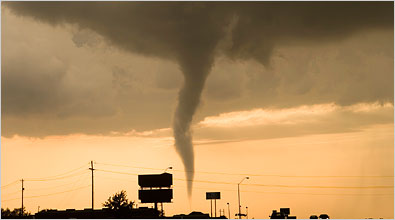
As a meteorologist and scientist I am very familiar with many pseudoscience arguments and websites like creation science, new age science, anti-climate change arguments, and all the conspiracy theories that go along with it.  My colleague recently turned me on to a little gem of a website.  Somebody has ‘solved’ tornadoes.  I hope you click on the site.  Not only will the guy who owns this WordPress website be excited that he has so many hits, but you will immediately be able to tell that this person isn’t playing with a full deck.  At first I laughed a lot as I read it, but the more I read it, the more I actually started to be impressed.  Now don’t get me wrong, it’s not that I’m impressed with the actual ideas here, they are completely wrong, but I was impressed with how much time and thought this person has gone into thinking about the problem.  I don’t want to post any individual blog posts linked here, because I really don’t care to have this person start harassing me, but if you go through a number of them you’ll see that he has talked to some real experts in the field (although it’s unclear about whether he has e-mailed them or actually talked to them personally), he has posts where he has retracted some of his statements and then explained why he retracted them.  He has designed experiments to test his hypothesis as well.  In fact I’m a bit jealous that this guy actually has more blog followers than me.  Did I say jealous?  I meant frightened.  Anyway, what I thought what was really interesting is that here is a very unique belief system which has blossomed into something rather complex.  One that to my knowledge nobody else really believes (at least not yet, or at least I hope not yet) and yet bears much similarity to existing belief systems.  So I thought it might be interesting to deconstruct it a little and see what we get.

At the heart of every belief system is at least one premise that is accepted as true, without being supported by any empirical observations.  Once this is accepted as

From http://www.nc-climate.ncsu.edu

true, much can be built from it.  For instance many religious belief systems accept as fact that there is a God and goes on from there.  Many times of course there are several faulty premises.  It could be that they stem from an original, but it’s hard to say.  Let’s take a look at the one’s that seem to this gentleman’s starting point

Premise 1:  The jet stream is a conscious entity that is thirsty for water and thus tornadoes are a result of the jet stream needing to suck up water.  I guess that makes a tornado a giant straw.

Premise 2:  Moisture is the most important factor in determining density differences in buoyant air. (Actually it’s temperature).

Premise 3:  Meteorology is a cult, and meteorologist simply believe in old and outdated arguments that have never been proved experimentally.

From this all sorts of things are possible.   If you were to accept the first two things as truth you would come up with a very different scenario for how and why thunderstorms and tornadoes form.  The 3rd premise is what then allows him to never have to rethink the first two.  People who could argue intelligently with him and are more knowledgeable are meteorologists and since they are part of a belief based cult they can’t possibly be correct or unbiased.

Another important part of a belief system is the inequality in standards the proponents of the belief system must live up to in comparison to non-believers.  For

From http://static01.nyt.com

instance, those against gay marriage will expect everyone to respect their right to be legally bound in holy matrimony, but do not have to respect the rights of homosexuals.  As is often the case pseudoscience literature like this, the expectation of other is to provide rigorous proof, yet no such proof is given by this gentleman as he espouses his hypothesis about how and why tornadoes form.   At its root I feel this comes from a lack of humility.  To be so sure you are right about something that you are beyond the need for evidence, and that you are beyond the ability of anybody (regarding their experience and expertise) to change your mind is to be so prideful that even Donald Trump would be impressed.  It is also a sad state to be in.  As I’ve argued before since reinforcing beliefs releases dopamine in the brain, over time as the neural pathways become so entrenched into a belief, this person literally will become ill to consider anything else.  The stronger the argument you make, the less likely you will get anywhere.

So what’s the harm in all of this?  Perhaps very little since there is a certain amount of crazy that even the most clueless about the subject won’t buy into.  Nevertheless there is at least enough science jargon on his website that people who are not educated about the issue may think there is controversy and conspiracy.  Just like many who are not educated about climate change think the same way.  There was at least one commenter who reblogged one of his articles saying it was an interesting “new theory”.  I wanted to also introduce this website and blog post as a lead in to a discussion of the age of information (or misinformation) that we live in.  This person has self-published a book for sale on amazon and has done a lot of writing on this subject.  If he had a little bit of money and/or web savvy he could make his site one of the top hits on google when people search for information about tornadoes.  Critical thinking skills are even more important today than they were before the internet to be able to navigate the flood of information that we are faced with on any one subject area.  Anyway, keep well everyone and stay away from thirsty jet streams!

Returning Your ticket

Let’s say you are on a big cruise ship. Over 6,000 men, women, and children are on board.  This cruise ship promises to take you to paradise and it’s not a lie either. A place where everybody is happy, nothing bad ever happens, and everybody gets along in love and friendship.  Children are laughing and smiling and running around.  Nobody

From http://www.freefitnesstips.co.uk

is hungry or hurting.  Everybody lives in harmony.  There was no charge to even be one of the passengers.  You’re on for free and who wouldn’t pass up such an opportunity.

As you are making your way to paradise, the captain announces that due to some unknown structural defects that they need to get rid of about 100 passengers or the boat will sink.  Fortunately there are an equal amount of bad criminals who have done some bad things and don’t really deserve paradise on board and the captain knows who they are and asks everybody else to throw those people overboard.  Would you still want to be on that boat?  Keep in mind that by even looking the other way, you are an accessory.  But many people, I think, given the promise of such a wonderful destination they could make it work for their conscience.

Now rewind the scenario and the same announcement comes on and says we need to unload 100 passengers or we all sink, and paradise will never be reached.  It’s only 100 people and still some 6,000 people will get to go to paradise.  But everybody wants to go so nobody volunteers.  People get tense and some people start deciding for themselves who might be bad or good, who might be too old to survive the journey and thus can justify getting rid of them.   Would you still want to be on the boat?  Again doing nothing to help still makes you an accessory.  In this scenario, not that the group who stays must develop some sort of justification for why those people will have to die.  Judging them without evidence, making assumptions, perhaps developing a philosophy that gets people to volunteer, convincing the more gullible of passengers that they will get to paradise anyway by making the sacrifice (even though they don’t know that to be the case, no matter how strongly they believe it to be so).

Let’s rewind again except this time the captain announces that his good friend the Grim Reaper will be coming around and taking the lives of 100 people at random.  It

From http://wiki.urbandead.com

could be your child, your friend, your wife.  Slowly everybody watches 100 people keel over without knowing why they had to die.  Would you still want to be on that boat?  If you stayed, what justification would you come up with to be okay with those deaths?

Let’s rewind one more time.  Instead of the Grim Reaper, the captain announces that everybody will be restrained while a psychopathic killer, wrought by the same person who made the paradise, will be coming around to kill 100 random people.  Having little control over his actions and lack of moral center, he will beat, rape, and torture these people before he kills them.  Many or all of these people are innocent.  Most importantly some are children. Young children, perhaps even babies.  Children in their innocence and purity must be physically and sexually abused in order to reach this paradise.  Would you still want to be on the boat?  What justification would you invent to be okay with this if you stayed?

In one the most influential books to me was The Brothers Karamazov by Fyodor Dostoevsky.  In that book one of the Brothers Ivan is having a conversation with his younger brother Alyosha in a chapter I believe called “Revolution”.  Ivan is an atheist and a collector of news stories around Russia of atrocities committed against children.  He questions the religious harmony that Christianity offers (I do not single out Christianity here, only relaying the religion that was used in the book).  We are all supposed to follow The Bible and follow its moral teachings.  The goal being that we will all come to know God on Earth and secure our place in Heaven afterwards.  But we are also supposedly given free will and thus some do not follow.  This allows for the possibility of great harm to innocent children: abuse, rape, torture, death (not even counting all the natural/accidental causes that take the lives of children).  Ivan claims that if this is the price of harmony then he would like to “respectfully return his ticket” to the Creator.

In reading that passage, I could not help but agree with Ivan.  Being a father now only reinforces that idea more.    If there is a Creator who is omnipotent and decides what happens to all His creation and that there is a reward of Heaven for those who are good, then I submit that this existence is simply not worth the price given all the suffering that does and has taken place already to get there.   There are of course many other atrocities that happen to adults, that make it not worth the price either, but it is especially hard when I think of the harm that comes to children.  The logic of a Creator who commands us to act according to His moral guidelines in order to achieve some post material existence paradise at the expense of harm to innocent people, simply does not add up.  It’s not enough for me to say that “God works in mysterious ways” or that “no one can know the mind of God”.  It’s not enough for me to know that God has taken the innocent up to Heaven either.  Because what is the point of this existence if they had to suffer here?  And for the life of me I really don’t understand why that can be enough of an explanation for anyone else.  I’m open to any and all explanations as to why the tears of a suffering child are worth this paradise?

Evidently it’s Evidence Part II

Part I, probably doesn’t provide too much pause for thought, but hopefully this one will.  I’ve been told my posts are long, so I’m trying to shorten things up. 🙂

Perhaps I should also preface before I begin that almost anything can count as evidence.  However it seems that people with little understanding of scientific investigation often make the mistake of delineating good evidence from bad.  Or being able to determine why one source of evidence is weaker than another.  Because after all I could argue that it is faith that I believe the sun will come up tomorrow, when the truth is I don’t really know for sure.  The fact that it has come up all the days of my life, is some pretty good evidence.  It’s even better evidence that it has come up for others.  And it seems as I look through historical evidence from before I was born it has been coming up pretty regularly.  And then there is the evidence that the Earth is rotating and that we are revolving around the sun.  It may be that all that changes tomorrow, but it seems unlikely. So at the very least, I can say that my faith has some pretty solid substance to it. (Also please be aware that I do know that the sun actually doesn’t come up, it is the Earth’s rotation that gives it the appearance of rising. lol)

Here are some of the things that many people seem to think of as evidence:

  • anecdotal evidence
  • a contrary opinion
  • a book
  • a “gut feeling”
  • a low probability event (a coincidence)
  • celebrities or other famous people
  • a documentary
  • a movie
  • media
  • even worse  – social media
  • the number of hits you search for something on the internet

There are probably more things that could be added but these are some of my favorite.  Part of the problem is that any one of these could be right.  I am not going to address each one, but there are times when your “gut” tells you, you are in danger and you are right.

From hm.dinofly.com

Anecdotal evidence can also be correct.  I could say “In my experience the sun comes up every morning” and I would be right.  Sometimes celebrities are correct, and documentaries are accurate.  Someone who is disagreeing with you may actually be doing so for good reason.  Because he/she knows more than you do. And occasionally a news story might even report actual information. 🙂

I am a fairly big food snob.  I’ll admit it.  I’m probably even more proud of that fact than I should, but tasty food is an important pleasure in life to me.  Not to mention sitting down to a good meal, can be romantic, social, and/or cultural.  One of my favorite things is to

Pad thai from myrecipes.com

introduce people to new food and new culinary experiences.  It has often been the case that someone will say they really don’t like a certain food.  Upon further investigation you find that the one time they tried it, the person didn’t know how to cook it properly so they had a bad experience, and then never tried it again.  Often if I get them to give what I have prepared a try, they find that they actually like it.  The point is that our own experiences are often flawed.  I am sure the person when they first tried badly cooked spinach they had no intentions on hating spinach, they simply didn’t like what they had, and assumed it was the fault of the spinach and not the cook.

While it is not surprising from an evolutionary standpoint why we would take our own experiences as truth, it is clear that as individuals we are prone to many biases.  If you know nothing about snakes, it is ALWAYS safer to stay away from snakes since a few can be deadly.  Surviving and being safe represents 99% of our evolution as a species, but if civilization has any true advantages, it is the ability to break free from the fearful uncertainty of the wild and to give us time for reflection and thought.  The lack of detailed knowledge about something is the birthplace of beliefs that are based on little or poor evidence.  This is why education is so important.  This is why understanding of science is important.  This is why critical thinking is important.

More importantly this is why humility is important.  One lifetime, at the very least in the length it is now, is never enough time to know all there is to know (if that is even possible).  But when you have true humility, not just humility before God, but humility before all existence, you accept that you don’t have all the answers.  You accept that there is still more for you to know, and to learn.  You can accept that you can be mistaken.  When you accept this, then you can delve into the next set of questions.  How is it that we can come to know things?  What are different ways of knowing?  How do they work?  What is their reliability?

from http://www.jasonwhowe.com

How boring would life be if you just decided on how everything works at the age of 30 and then just criticized everyone else the rest of your days? Keep asking yourself questions, and enjoy the experience of enlightenment that comes from a lifetime of learning.  The feeling of enlightenment is euphoric and is an edge that never dulls, no matter the age.

Game, Set, and Match

“Nothing in the world is harder than convincing someone of an unfamiliar truth”  – said by Kvothe in A Wise Man’s Fear by Patrick Rothfuss

Every person on the planet can agree on one thing.  The world could be a better place.  For those of us who strive towards equality, wish to reduce human suffering, and care about the planet as a whole the world looks fairly messed up.  Some people  ignore the problems.  That’s a bit selfish perhaps, but the weight can be a lot to bear and we all have our limits, so who am I to judge?  Some people are definitely selfish because instead of trying to fight it they simply become part of the problem.  Trying to get a share of what they think is theirs.  If the world is going to be unfair then why not do whatever it takes to be a winner and not a loser?  In recognizing that we are a cooperative species, to me the fight to making the world more fair is always worth it even if the goal is never achieved and feels like a continual uphill battle that sometimes gets steeper and not gentler.  As a whole, we are simply better when we are working together to solve problems.  Problems do arise, even ones not of our own making.  Even ones that do arise because of our own making we can’t always blame ourselves, because hey nobody’s perfect and hindsight is 20/20 (at least we hope).

In this age of information and social media the amount of people that can be in contact with each other has expanded exponentially.  As a result we see the vast array of opinions out there.  Some people are clearly uneducated about the subject but seem very excited that they can say something and somebody will see it.  Some people make comments simply to anger people and cause an outrage or what is known as being a troll and this has been a topic of much discussion lately.  How we deal with people who make inflammatory comments or are very hostile towards the author of an article or another person commenting on a thread.  Interestingly inflammatory comments that support the view of a particular piece is not seen as negative, only the person who disagrees.  I would argue that if you read an article that say expresses a Democratic point of view and in the comments you say something like “Just another example that Republicans are pieces of shit” then you are just as bad as anybody you consider a troll in the ensuing comments.

Spurned by a few incidents in the recent past and also by this excellently written article about making better arguments in politics I wanted to express my thoughts about how we might be able to engage people we disagree with in a more meaningful way.  The quote that starts this article is something that just struck me as the wisest words ever written when I read them and speaks to why if you like to debate and engage people with different points of view, why you are rarely successful.

Picture from Amazon.com

The article that I linked in the previous paragraph talks about biases we have.  For a very comprehensive look at our biases and beliefs I also strongly recommend reading the The Believing Brain by Michael Shermer.  It’s a brilliantly constructed book and very educational.  His argument is that we believe first and rationalize later.  I think your immediate intuition sees the truth in that.  Right now you might think well that’s what the other guy does, but if you are really honest with yourself you’d realize you do it too.  It takes a lot of discipline to let your reasoning side take over, and suppress that “gut feeling” to believe what you think is right.  As a result of this tendency to believe first and then rationalize those beliefs, when absorbing a new piece of information we tend to see it in a light that supports our beliefs rather than negate them.

Another bias we have that is the main part of the article is the self-serving bias.  The idea that in order to protect our self-esteem or sense of self-worth we must reject ideas that make us feel like we are wrong about something.  As the article says is we are wrong about one thing, then what else might we be wrong about, and then how do we deal with the idea of not being as smart as we think we are?  This is why I think one of the most important human virtues we can have is humility as I wrote about in a previous blog post.  Being wrong about something is a tough thing to deal with.  What is strange to me is that I think we can all agree that we’ve experienced being wrong before.  If you reflect on your life you’ll realize you actually got through it and you are actually okay.  Nevertheless we still tend to not deal to well with it in the moment.  Just like dealing with addiction, admitting you have a problem is the first step. 🙂  In this case, don’t worry because everybody has these biases and so everybody has this problem.  So I would like to provide what I think is a helpful guide to getting people to see things from your point of view.  And if right now you are asking, “Why should I listen to this guy?”  Well because quit frankly I’m right dammit! 😉

Be the person you would like others to be

Painting by Miles Halpern

Don’t you hate it when someone is not sympathetic to you and the oppression or struggles you face?  It makes you angry, it makes you not really like that person, and it makes you frustrated.  So what should your response be?  Most people seem to respond by being equally dismissive to others and their problems.  What if, however, you tried to remain that sympathetic and compassionate person you hoped the other person would be?  What if you said “I’m sorry you can’t understand how the incident made me feel, and even though I don’t know why you can’t be sympathetic to my struggles I sincerely hope that you never have to feel the way that I do right now.”  If someone cannot demonstrate compassion for your genuine reason for being angry about something or being hurt about something, being afraid of something, or whatever is causing a negative emotion that is all the more reason to give sympathy towards them in return.  Give them an example of what sympathy and empathy is all about.  Maybe nobody has ever showed them any and so they literally don’t know it’s value or what it’s about.  Maybe they had an ultra-chauvinistic father who never allowed them to show their feelings and were always told “Buck up and be a man you pussy!”  Imagine growing up with that all your life.  How much compassion would you have as an adult?  Gandhi said “Be the change you’d like to see in the world” and so if you feel your worldview is superior in making this world a better place, make sure that you are genuinely being the type of person you would like to see in others.

Also haven’t you ever had someone in your life who you really respected because they seemed like a good person.  You admired them.  You wanted to be like them.  You are more likely to cause a change in someone’s behavior by being a positive role model rather than someone who berates them for their ideas.  Why would anyone want to be like someone who just belittles people for their beliefs even when those beliefs are misguided.  Because to the person with those beliefs…well they believe it and thus think they are not misguided.

Make sure you have a good sense of self-worth

What’s this you say?  I thought this was the problem.  The article I linked actually talks about using daily affirmations to enhance your self-worth as being important in being able to face things that you might be wrong about so that there is no net loss in self-worth.  I think the author glosses over this to almost make it seem like a trick you are using rather than genuinely building your self-worth.  If you have low self-esteem it can be hard to debate or argue with someone in a constructive manner.  Obviously if you barely value yourself, the few things that you do value about yourself, you will be even more afraid of losing.  Building a true sense of self-worth takes time and experience.  It takes an admission of your faults and the continual persistence to improve.  It takes trying not make the same mistake twice, even if it sometimes happen.  Practice humility, forgiveness, and spend time just observing and reflecting on those experiences before forming an opinion.  Then learn about how other people experience the world and try to pick out the commonalities in your experience rather than focusing on the differences.  Your self-worth will grow actually when you recognize that the world doesn’t revolve around you.  Self-worth and self-centered are completely different but often get tangled.

Make sure you respect the self-worth of others

From hellobeautiful.com

I’m not asking you to admit you’re wrong or say somebody else is right, but when you are humble and are willing to at least to consider the possibility that you might be at least partially wrong about your point of view, you will find that you move to a place of being inquisitive about where someone else’s point of view comes from.  This will lead you to ask more questions to see where that person is coming from.  It will help you get to know the person and that person now knows that you are interested in who they are, and are simply not just interested in making them feel like they are wrong.  After all who wants to listen and take seriously someone who is only interested in pointing out how right they are, and how wrong you are?  It doesn’t matter if you are actually right and that the other person is actually wrong.  People have a lot of wrong ideas not because they choose to be wrong but because they have been conditioned in their environment to see the world differently.

Recently there has been a lot of arguments in social media about racism and reverse racism.  What if someone is trying to advance the position that reverse-racism of blacks against whites is just as big of a problem as racism against black people?  You can respond angrily, dismissively, you can throw out all sorts of data and you’ll probably notice this makes no difference whatsoever.  What if instead you said “Hmmm…you know that hasn’t been my experience.  Can you tell me what makes you think that way?  Have you experienced racism as a white person?  If you have I am really sorry about that because I have personally experienced racism as well.  Maybe we could share our experiences.  Because I know how much it hurts when someone assumes something about you based on the color of your skin.”  In reality of that interaction with someone it doesn’t matter that as a whole blacks are not treated as equals and that white people do enjoy a position of privilege in society, because that person has simply been shaped by their experiences and their interpretation of those experience.  Sometimes being able to see the big picture is also a position of privilege.  It probably means you have had greater opportunities for education and slightly better income so that you have leisure time to explore a topic in more detail.  Perhaps parents who were interested in different points of view, valued diversity, etc.  Not everyone is lucky enough to have that.  Showing respect for a person and their experiences that led them to what they think is true today, is a better way to be heard by that person.  You might just tear down a few walls and find that you might not be that different at all.

Be willing to walk away

This seems pretty obvious.  A common piece of advice told by parents who want their child to not get into a physical fight.  It is true for fighting with words as well.  If you are hitting a wall with someone and trying harder each time, you will probably find that the wall is only getting thicker and harder.  You probably don’t even notice the tone of your dialogue change, but in my observation not just in other arguments I have watched, but when I’ve had a chance to look back at my own words I realized that the angrier I get, my logic gets worse and my tone becomes more inflammatory.  Being a more experienced teacher I now have more experience in just watching people who have trouble learning.  Being a good teacher is to find alternative ways in which someone can learn what you are saying and all those ways require patience and understanding.  So I think I am better at it that I was, but one can always improve.

More importantly of course getting angry, frustrated, and stressed because someone simply doesn’t “get it” is no way to live life.  It could be your inability to argue effectively, it could be your tone, and of course it could be completely and absolutely all their fault.  So what?  Maybe it is possible that they will simply never, ever agree with you so why waste your time and energy?  If you really feel convinced that you could make your argument better, then don’t keep arguing maniacally, but step away and reflect.  Pay less attention to the content of what you have said, but how you have said it.  Look less at the content of what they have said but try to pay attention to the experiences that may have led them to that line of thinking and try starting again.  The point is, if you feel yourself starting to get angry or frustrated, you should probably just stop.  Because I guarantee that you will not only not win, but you will have to deal with an emotion that can quite honestly ruin your day.

True change takes time

Photo by Alan Cleaver via flickr

Plenty of times in my life I have thought I have made no impact and sometimes weeks, months, or years later I see someone who has changed their position on something that they seemed so sure of in the past.  Most teachers will have stories of students who they couldn’t  motivate, were often at odds with, and felt sadness that they weren’t able to “reach” that student.  Only to get an e-mail a year later with an apology, or a revelation from that student, saying that they realize now how their behavior was wrong and that they appreciate you for trying to motivate them and believing in them.  Many times in the moment I have felt frustrated at being told I’m wrong about something.  I might even argue my case further even if I am out of additional legs to stand on.  Then I sit and think.  I read some more.  Realize that maybe something I read, or something somebody told me was wrong.  Or perhaps I realized that I hadn’t looked at a previous experience in the right way, and that I hadn’t perhaps learned all the lessons from it I should have.  Nowadays I try to let that person know that they were right about something and I was wrong.  In the past when my own self-esteem wasn’t strong I was often too embarrassed to admit it to that person.  That doesn’t mean that person didn’t have an effect on me.  So it may seem like wishful thinking, but don’t ever think your exchange didn’t have any value at all.  Because you never know.  It may happen years down the road, or the change may be ever so slight but because it caused someone to look in a different direction, it sets them down a path of learning they never would have gone down before without you.

——–

As a final thought I want to make it clear that I don’t pretend any of this is easy, or that I am the awesome person that I describe here.  I HATE being wrong and in my experience most other people do too.   Perhaps its because I have gotten older that the accumulation of things I have been wrong about has added up to such a proportion that it has humbled me.  I don’t know.  What we consider right and wrong however is a product of many things.  A function of space and time. Perhaps instead of thinking of yourself as being wrong about something, think of it as “Maybe I don’t know everything there is to know about something.  So maybe I’m not wrong, just not as right as I could be.” 🙂  Play nice and remember it’s a big sandbox.  There is room for a lot more people in it than you think. 🙂