The War on the Poor

We have a lot of people living in poverty in this country and through various conversations on Facebook and on blogs you see a lot of arguments against providing a social safety net, raising the minimum wage, and helping them in general that I thought I would compile a list of my least favorite and most fallacious arguments I hear.

  1. I know some people that actually think the government owes them, doesn’t look for a job, and these people are just lazy freeloaders.  Throwing money at them just supports a dependency culture.

Some variant of this argument is often used so let’s dissect it.  Whenever you hear someone say “I know some people…” or “I know this person who…” this argument can already be dismissed based on being anecdotal and not necessarily a representation of how things are.  We all have our own experiences that shape our views, nobody is saying your own experience didn’t happen, only that you may not be understand your experience properly in the context of the bigger picture.  There is no question that some people cheat the system.  But this happens across the board at every level of society, and I would argue that the rich cheat the system by a far higher percentage rate than the poor, the only difference is that the rich can change the laws so what they are doing is legal.  They can afford better lawyers.  More importantly is that we do tend to focus on the negative, and this is what we tend to see.  There are so many poor in our country that even if 2% of the 50 million living in poverty in the U.S. were cheating the welfare system that still 1 million people and FOX news could run 100 stories a day focusing on a different cheater of the system and still not be done in a year, but that doesn’t really give you the reality of the situation.  What if there are a lot of people on welfare who are trying to get a job, or who actually work a job but it doesn’t pay well enough to make ends meet?  What if most people are actually embarrassed that they are on welfare and are trying to get out of it and don’t get very vocal about it.  Do the rest of our time really take the time to talk to all the poor and find out which ones are on welfare and are honestly trying to get out of their situation?  Nope.  And especially if the freeloaders anger us, not surprisingly we are going to take You-Pay-Taxes-So-the-Rich-Dont-Have-tospecial notes on those people and they are going to stick in our memory and support our views about wasted taxpayer money.  I have also yet to find anybody post some actual data on how many of these welfare freeloaders are.  They are always anecdotal.

I would agree that throwing money at the poor is not always the solution that we also need to do better to help people out of it so that they can support themselves, but the conversation always seems to be welfare, or not welfare.  There is a 3rd option and that is to improve welfare.  To say it doesn’t have value is an insult to many people who have depended on it when times were lean.  Not all people on welfare are on welfare for the rest of their lives.

And concerning the subject of wasting taxpayer money if we want to play the “I’m not supporting things I don’t like game” with my taxes, then I would also not like any of my taxpayers to go to foreign wars that I disagree with.  You pull your money out of the freeloader driven welfare system, and I will pull my money out of military spending, and I guarantee I will be much richer at the end of the day.

  1. I have never had to work a minimum wage job in my life. If you can’t live on minimum wage, go find a better job.  Ask for a raise.

Once again we have a point that rests on anecdotal experience.  I find these statements also come from white people.  I’m not saying their racist, but perhaps the people who hired you are, and preferential chose you.  That’s a light argument though, so let’s get a little deeper.

Let’s just look at it by the numbers.  In a capitalist society I think conservative and liberal alike we can say that businesses want to make money.  They will definitely maximize their profits by selling some product for the highest possible price that gives them a large base of customers, and they will try to cut costs on expenses.  People that work for them are part of those expenses.  So we would expect that just like there are always a very small amount of really rich people in the country, there are also going to be a lot of low paying jobs and then less and less jobs that are higher paying.  The more special skills you have, and this could simply being really strong and doing hard manual labor, trade skills, or this could be, being highly educated, you are of course are going to garner a higher wage.  The types of jobs available to the high school graduate are small.  You have a job at $7.25/hr and you want a better one, and of course a lot of people do.  You have to compete, and if that higher paying one doesn’t require a specific skill set then you have even more competition, quite simply not everyone can get it.  So just to say “Find another job” isn’t realistic.  Finally, how easy is it to find that new job when you are working 5 days a week and actually can’t search for jobs which are quite often only open during the times that you work?  How do you take time off from your job, unpaid, to go look for jobs?  How do you think your boss will react when you need to take an afternoon off to go to a job interview?  And if they don’t get the job, they’ve lost money just by taking those hours off.  Money they desperately need.

The immobility of the poor demonstrated by disasters like Katrina

More importantly many poor people have other issues to deal with than just finding that better job.  What if that job is another city?  Can they afford to move if they already have no money?  What if by moving they lose the support of family who can help reduce their costs by taking care of their kid(s) while at work?  Even a job in another part of the city may involve a long commute on public transportation which increases the time that they have to leave kids at daycare or a babysitter that increasing their expenses.  Finally, should we really expect other people to move away from friends and family for a better job, a decision many of us are not willing to make either?  Why is it so unreasonable for them to expect the minimum wage to be increased and keep pace with inflation, since it has not?

Well wanting the minimum wage raised, is actually asking for a raise.  Going back to the start of this argument, in a capitalist society why would a company raise the wage of a minimum wage worker if they didn’t have to, if they job had such a low skill they could just replace them with the next applicant?  What if by asking for a raise, the boss actually decided to terminate them or give them worse hours?  When you are barely surviving rocking the boat isn’t always the safest play either.

And raising the minimum wage will help greatly with reducing suffering.  While it’s probably best to raise the minimum wage incrementally, in general the idea that prices on everything would double is wholly untrue, since wages are only a portion of expenses for a business.  While $15/hour might be excessive, no study finds that when the minimum wage is raised to keep pace with inflation that this harms the economy. This article by the Department of Labor does a great job of discussing it and remember that when people actually have money to spend, this is good in a consumer driven economy.  All those people in poverty aren’t buying as much stuff as you think.

  1. People on welfare are buying steak, have smart phones, getting manicures, smoking, buying drugs, etc.

Nothing cheers me up more than a person of privilege who has been fortunate to have the luxuries of this world, whether through marrying someone with a great job, or being born into a middle-class or higher family, complaining about other people wanting those things too.

Let’s ignore the fact that people need a phone, and that smart phones are practically free, and that maybe spending more money on quality nutritious food is maybe a better idea than crappy food which is cheaper and leads to all sorts of health problems.  But let’s look at the psychology of poverty .  When you live paycheck to paycheck barely making ends meet, and have grown up in poverty, your ability to long term plan fades, and yes you tend to not save money depriving yourself of creature comforts, because your life is one in which appears to have no long terms solutions.  So why live for tomorrow, when you can live for today?

Income-InequalityIn my training for my volunteer work we had to try and make a budget based on what a family makes on two minimum wage jobs and it is a daunting task.  And of course there are many families that do try to save, but saving is hard to do when you’re poor.  If you don’t have access to public transport, you have to depend on  car.  And people live in poverty have to buy old cars that nobody else really wants, but they can get a good deal on them.  However, such cars need repairs frequently, and repairs cost.  Now you could say why don’t they get a better car that is more reliable.  Quite simply it costs more and they wouldn’t qualify for the loan.  This leads to, what I call, the “stay-in-poverty-feedback loop”.  What little money poor people often save goes to these types of expenses because they literal can’t afford better quality stuff.  Car repairs are just one example, but people in poverty often have to get home repairs more often, replace things like water heaters, furnaces, or air-conditioners more often, because poorer housing means people are getting used, cheaper, and/or older stuff in their home.  So even if they are able to put away a little money each month it often gets eaten in one fell swoop by these unexpected repairs.  And there are plenty of other big costs, like health care, which they often put off, even if they have insurance to save money on co-pays, but then this compound into a worse cost later, but remember how poverty doesn’t lend itself to long-term planning.  And if you have kids, there are even more emergencies that can come up.

On the topic of buying drugs, well I don’t see a lot of people asking that all employees receiving public money take such drug tests, only poor people.  Some how if poor people are doing drugs, that is more egregious than any other income bracket.  As it turns out though, the amount of drug abuse among those on welfare is staggering low. So low that the cost of testing everybody costs more taxpayer money than letting that small percentage of people have their drugs.  Not to mention that just cutting off their life support doesn’t actually work as a deterrent to doing drugs, just makes them resort to more desperate measures to obtain drugs likely causes more problems.  And throwing these horrible drug users in jail, just gives them a criminal record, making it harder for them to get a good job and get out of poverty.

 4. Why are they having babies if they can’t afford to raise them?

Well there are all sorts of reasons that people have children, and if we ignore the fact that there are many areas of the country that don’t have adequate sex education, women don’t have easy access to birth control, or that a woman might simply get pregnant because a man lied to her, or the birth control failed.  But let’s say that there are these terrible women out there who are having children as some sort of scam to get more free money.  I am sure such women exist.  Nevermind the fact that such women were likely raised by a similar mother, probably has little education and special skills and is certainly not mentally well to be making that decision, should we cut her off from that money?  Is this the way she will become a wonderful mother? Or will she literally be unable to cope, unable to keep up with all her new responsibilities?  More importantly it’s of little good to question whether she should have had children, she does have children.  These children are innocent, they’ve done nothing wrong, and so cutting off the mother also harms the children.  Where is the humanity in this?  If you’re pro-life then this must also be part of your consideration if you care about children.

  5.  Poor people need to be more personally responsible.

I’ve blogged about personal responsibility before, I don’t want to repeat all I’ve said there, but I think we can agree that one’s responsibility for themselves depends on the environment in which they were raised, such as level of education, family, friends, culture, etc.  And as I also stated in that post, when we look around we don’t see a lot of people being personally responsible.  Politicians rarely are.  Rich kids like Ethan Couch certainly don’t show a lot of personal responsibility and so even if you believe that personal responsibility comes down to the absolute free will to choose to be that way, it’s clear that a lack of personal responsibility is not a trait that only applies to the poor.  Should we say that rich people are allowed to lack personal responsibility, but poor people or not?  More importantly why aren’t we asking the question of personal responsibility to those that are extremely wealthy?  Is it personally responsible to have more wealth than you can spend in your lifetime.  Is it personally responsible to have more wealth than is required to meet your basic needs have plenty of luxuries and send your kids off to the best of colleges?  Is it personally responsible for corporations to ship jobs overseas just to make more money, while their fellow citizens now struggle to make ends meet?  Is it personally responsible to make that 5 billion in a year than the 2 billion you might make if you paid your employees a fair wage?  Is it personally responsible to not pay your fair share in taxes by hiding your wealth in off-shore accounts and other tax shelters?  For those who hold personal responsibility as the most important of virtues, can we not apply this attitude consistently across all economic classes?  Why are only the poor held to these standards of personal responsibility?

———————-

I know this is already a little TLDR, so I’ll be brief here.  In a line from the movie the Usual Suspects Kevin Spacey’s character says “The greatest trick the devil ever pulled is that he convinced the world he doesn’t exist.”  Well maybe there is an even greater trick.  Is it possible that those who are driven by greed in the acquisition of wealth and power have instead convinced you that the poor are the demons in our society?  That even though a majority of them work longer hours, take less vacation, receive poorer education, less nutritional options, worse health care, and less social mobility, somehow a good proportion of the wealthy have led you to believe they are the bane of your quality of life?  And so effective is this message that many of the poor are complicit in that oppression and vote into office the same people who have demonized them in society.  If trends continue as they do, with the exception of a small percentage of the population we all sink together so let’s stop making the poor our enemy.

Who’s Better, Who’s Best

And so it begins. The dark side of parenting comes out and I was taken aback at my reaction.  A friend of mine shared with me a beautiful audio recording of her daughter reciting the alphabet.  It was the cutest thing ever and I enjoyed.  Her daughter is 3 months older and then I started to think to myself, my son is hardly saying any words.  I mean kids change fast, but he only has 3 months before he should be saying his ABC’s as well.  What if he doesn’t?  Am I bad parent? Is my kid not going to be very smart?

And it’s happened other times as well. When he shows interest in a particular thing, my mind starts to race.  He likes playing drums, he’s not even 2, what if he’s going to be this amazing drummer?  How awesome would that be?  Hey there is this kid on YouTube the same age as my son playing the drums and he is much better than my son.  Crap my son isn’t special!

Dhyan_hatSo I confess my mind has gone to such places, but before you start to lecture me I just want you to know that my anxiety passed as quickly as it came, but it makes you think why one would have such a reaction? Of course it’s a common stereotype, that parent living out their dreams through their child.  Or perhaps just as common, are the parents using their kid as a pawn to compete with other parents to show each other up to determine who is the better parent, because they have the better kid?  So I had to seriously contemplate whether I was this type of parent.  Where were these feelings of anxiety and competitiveness coming from?  Why is it important to me that my son be extraordinary in some way?

So dismissing the idea that I might be a crazy person I thought about this sort of biological reaction I had when my son was born,  for him to grow and get stronger. While it is important to enjoy the moment, I think it’s natural for a parent to want to see this growth in their child.  Self-reliance is ultimately our goal, even if at the same time it sucks so bad when they don’t need us anymore.  There are a lot of people in this world and so it seems also reasonable that we would have this drive for our children to be extraordinary at some particular thing or to have a natural talent that drives them in a particular direction.   It can be the easy ticket to self-reliance.  Rich or poor when they have some inherent gift to fall back on, it’s a feeling of security as a parent.  You may have heard the stereotype before that all Indian parents want their kids to become doctors.  A well deserved stereotype actually.  My uncle was one of those parents who wanted their children to become doctors.  The reason he gave for this was that doctors are never unemployed, they are always needed and thus his children are always assured in an income.  Being originally from India where there was no social safety net, where poverty was and still is fairly high, I can understand such a philosophy.  They were however well off and my cousins very well educated, they would be successful in anything they chose.  But as I see the places my own mind goes I understand the obsessive Indian parent constantly pushing their children towards medical school.  I of course never would force my own child into anything in particular, because in the end I can’t ignore the fact that my child is an autonomous being who needs to be free to make decisions for his self.

In the end, the right answer just seems to be to just remember to love, to encourage, and to teach them to learn well, wherever their interests lie. Teach them the value of determination, teach them the value of caring about what you are doing and taking pride in your own work.  Whether my son is extraordinary or not, he will always be extraordinary to me and that’s a gift in of itself.  I think it’s the hardest thing to know as a parent.  How do you make your child self-reliant?  There are so many avenues to that destination it’s easy to get lost.  Perhaps the best I can do is to trust in myself and my own self-reliance to do well in the moment and stop trying to worry and predict the future.

Imitation and Approval

When I was 12 years old I went to Bible Camp.  It was my first time going to camp, going away for a week without having any parents, grandparents, aunts or uncles.  Luckily my second cousin went so I would know someone and that was probably the only reason I wasn’t too scared to go.  I am not sure why my mom chose to send me to a bible camp, but as a Christian I am sure she hoped that I was receive some good education about religion, the bible, etc.  When I was there I was eager to impress the counselors and leaders.  They had a bible verse a day and a contest at the end to give a free camp hat to anyone who could memorize all the verses.  I was the only who could do it.  I used to have a good memory.  Maybe I still do, I just can’t remember.  At camp they also talked a lot about prayer and how praying could help you get the things you wanted in life, as long as you were good and you really believed.  For me the idea of prayer was exciting because I thought maybe it could work to stop my dad’s drinking.  So I opened my heart and let Jesus Christ in.  The counselors were so happy.  All of them congratulated me.  They were so kind and so pleased with my decision.  After camp was over, I was so excited I had made the decision because I knew it was going to make others in my life so happy.  My mother, my grandmother, aunts and uncles.  And on top of that I was told that if I was good and really believed that my prayers would be answered.  I had many tangible reasons to be very happy about it all.  It had very little to do with heaven or hell, or some events on alternate planes of existence, but the way it made others in my life happy, and the way it might help my dad to stop drinking was very exciting.  Of course none of my praying made any difference to my dad drinking and in the end the excitement of my decision to let Jesus into my heart faded and it became clear how the entire belief system had any relevance to life if one of the things they touted the most didn’t work.  I believed as much as a 12 year old could.  But the fact that prayer doesn’t work is not really the subject on my mind, but rather that as I reflect I see how much of a child I really was.  I completely didn’t understand the complexities of the religion or the Bible.  I was clearly caught up more in the joy that the adults in my life felt by my decision rather than really grasping the importance of what a religion means to someone’s life.

Dhyan_forkandknife

It takes very little time with an infant/toddler to see how much they want to imitate others.  And while I am sure there is an evolutionary aspect to this, because obviously if we have survived as long as we have, it makes sense to copy our parents, but what is also clear is our reaction to that imitation.  Because when he successfully uses a fork, or successfully gets up on a chair by himself, climbs the stairs etc, there is much applause.  There is much excitement and happiness.  All in the house are happy and pleased at this ability to accomplish these tasks that move them closer and closer to adulthood.  Every child can’t wait to do things older people can do. They can’t wait to grow up.  As children we are always looking for the approval of our adults.  We may rebel when we don’t get it, but initially, we want to be noticed by those we look up to.  As children we are somewhat helpless and getting adults to like you and notice you, is a way to make sure that they take care of you, teach you, spend time with you.  If you can impress an adult then this is a bonding experience.  Something we all seek.

dhyan_laptopFor all my dad’s faults he was fairly adamant about choosing a religion as being a choice to make as an adult.  That children didn’t have the capacity to understand the decision and thus did not want my mother to influence as children.  This was not something my mother or Mennonite grandmother could really help doing, but it was certainly tempered compared to many other children and I am quite thankful for my dad in that, because it’s clear to me that he was right.  Even at the age of 12 I could not understand a religious belief system.  From my mother I may not have adopted her belief system, but I learned about her charity, her kindness, her compassion, her perseverance, and the fact that she is someone who likes to ask questions and research the answers.  As I watch my child grow I can see that it’s less important what I believe, but rather how I act.  These are the things that will shape him.  Brainwashing him into a certain set of beliefs seems pointless over my actions being moral.  My child was born an atheist and if he decides that he wants to pursue a belief system as a guide to live his life then it will be his own choice, not because I’ve prescribed a doctrine for him to follow.

With the idea of God being “our Father”, I sometimes wonder if God isn’t the ultimate helicopter parent.  A way for people to still constantly seek approval from a parent-like figure.  It seems somewhat unnatural to me now to maintain such an attitude into adulthood.  As children it makes sense to have this attitude, but as adults we are supposed to no longer be seeking approval and be the role models for our young.  I guess as social animals it’s easy for such hierarchies to remain.  The only problem is, if there is no God then all we’re really doing is trying to make a non-existent entity happy and a lot of difficult to interpret texts written by men on what God actually wants to be made happy.  That seems like a wholly unhealthy way to live life.

The Long Silencing of Women

Sometimes I think about this world, and all the problems we have and begin to wonder what kind of world it would be if women were considered truly equal to men.  Imagine all those gifted females throughout history who would have made amazing leaders, who would have made amazing scientists, scholars, inventors, who would have made amazing artists, performers, musicians and who were instead suppressed, killed, treated as property, relegated to one role only.  A society thrives on its intellectual capital.  How much have we lost?  We will never know.

And how much are we still losing?  Here are some important things to note about the state of women around the world:

Women are still very much treated like property.  It has only been in recent history that the dowry system has gone away in many parts of Europe and North America, but it is still quite prevalent in many countries.  The idea that a daughter’s family should have to pay, just to have their daughter become the property of a man, and that failure to give an adequate dowry ends in violence against the woman is deplorable.

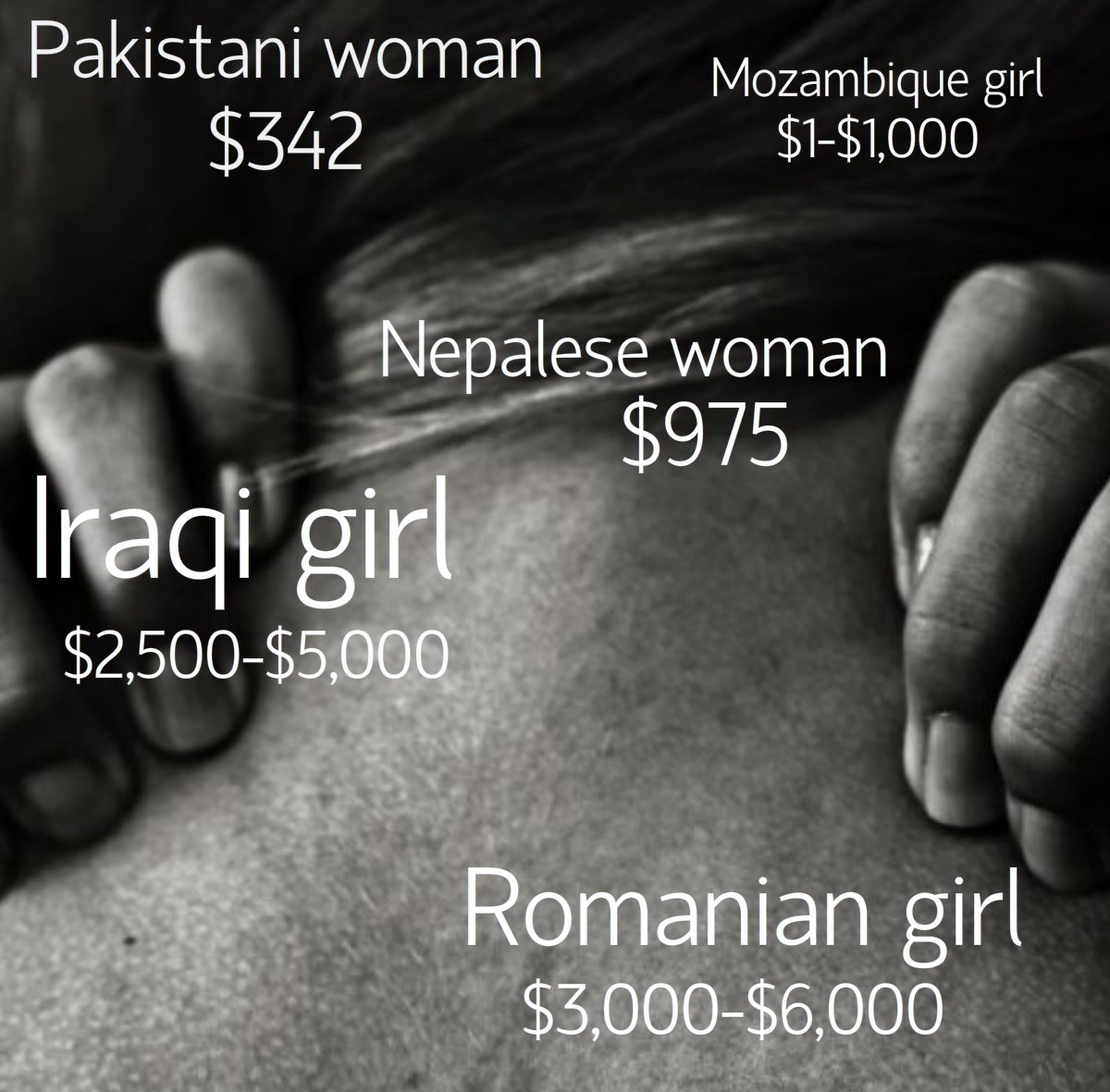
If this was not dark enough, when it comes to women being treated as property one only has to look to human traffickingWomen make up 98% of all humans sold for bonded sex or labor.

When women are seen as objects or property rape is even more common place.  These rape statistics are truly horrible to read.  And if you want to get all picky on how hard it is to collect rape statistics and you don’t trust these numbers you can factor in a liberal margin of error and still be see some devastating numbers.  And the difficulty in ascertaining how common rape is, should give you more cause for alarm than less.  Darkness is much more successful remaining hidden than exposed.  Some highlights from the linked article (which is well referenced) is that somewhere between 60-99% of all rapes are committed by men, and 91% of rape victims are female.  Also 97% of rapists will never spend a day in jail, and to those who think there is a large amount of false rapes reported, this number ranges only between 0.7% and 8%.  So even by your most liberal margin of error the raping of women is far too common.  Especially given that it is estimated that only 40% of rapes are reported to authorities.  These statistics are largely just from North America where rape statistics are easier to gather. A U.N. study found that “worldwide, a whopping 25% of men (1 in 4) had raped someone in their lives. 1 in 10 (10%) had raped someone who wasn’t their partner.”

Not unrelated to the points above is the greater crime of outright killing of our daughters, both in the womb and without.  In countries where women have limited opportunities for employment, where women will cost their family great financial burden from having to pay dowries, females are aborted or killed as babies disproportionately.  While this number favors countries of India and China, it estimated that about 200 million females are aborted or killed as infants every year.  That is 1/35th of the world population.  In other words 3 out of every 100 pregnancies end in death for that fetus or child solely on the basis of gender.  As I’ve argue before there is a strong correlation between abortion and infanticide and what the cost of that child is to the family.  A woman is a cost and a burden to many families.  There is logic or rationale for why this must be so.

On how much money can a daughter bring to a family if she is uneducated? In a not too terrible statistic 53% of the world’s out-of-school children are girls, however, 2/3 of the illiterate people in the world are women.  Indicating a different quality of education for women, or different amount of time girls are allowed to stay in school.  Educated women make better choices about their health and pregnancy.  For example in Mali, women with a secondary education or higher has an average of 3 children, whereas those with no education have 7.  Women without education tend to not use birth control or even know about it, thus uneducated people, who can provide less successfully for their children have more of them.  In Pakistan the difference between gender in education is an astounding nearly 700,000 less girls being educated instead of boys (although to be fair an even more astounding statistic is that over 5.5 million children are without education in Pakistan).

What do the statistics say about women and politics?  Here is a list of major countries that have only within the last 125 years or so have even given women the power to vote.  For much of “civilized” history women have had little or no say in choosing who governs them.  And how do we stand right now on the role of women in actually governing?  This link shows the incredible disparity in representation in government around the world between men and women.  Perhaps the most telling statistics from this article is that what is considered a successful benchmark for women in government is 30%.  Women make up 50% of the population and yet a goal of 30% is considered admirable. Few countries have reached that benchmark.  Currently only 22% of all national parliamentarians were women.

In science trends are more promising.  Women still only make up 42% of all science careers in the U.S.  A great international study that looks at the role of women when it comes to published scientific papers, finds that males outnumber females as lead authors in every country.  The authors admit that this may be due to the predominance of senior scientists that are men and this may hopefully change in the future, but currently women are still under-represented in science.  The study also notes “despite more than a decade of policies aimed at levelling the playing field. UNESCO data show that in 17% of countries an equal number of men and women are scientists. Yet we found a grimmer picture: fewer than 6% of countries represented in the Web of Science come close to achieving gender parity in terms of papers published.”

I won’t even pretend to have even listed all issues women face.  There are of course many others, a lot of them ripples of the deep impact from the even greater patriarchy of the past.  Even those ripples will take time to calm, and return us to equilibrium.

I am not insensitive also to issues that men face, some are very harmful and perpetuate the very serious realities that women face also.  Men have their burdens, but it is clear than women have the heavier load.  A burden they never chose to carry, a burden that men have given them.  This is not the oppression of a minority; this is the oppression of half of the human population.  Oppression so deep and ingrained that many women are even complicit to their own oppression, thinking that the extra burden they carry is normal and deserved.  I don’t care to point out how religion plays a role in all of this, although gender bias is deeply ingrained in many religious doctrines, and denying many women a place in the religious hierarchy.  The point is, there is zero moral justification for the way so many women are treated in this world.

To all the women who weren’t able or aren’t able to be all they could, I just want you to know that as someone who continues to strive towards being a better feminist, I hear your voices.  It may do no good to wonder what could have been, but we all should be in the business of wondering what could be.


*I dedicate this post by my friend Victoria over at Victoria Neuronotes.  A more intelligent and compassionate woman you will not meet.

A Little Red Wagon

Dhyan_wagonI’m trying hard to have the occasional short post for people who are tired of my long posts, so this seemed like a good one. 🙂  A friend of ours had no use anymore for a Roadmaster red wagon that their grandchildren had outgrown and gave it to us.  My son took right away to sitting in the wagon and has opted to be pulled around in the wagon instead of being pushed in the stroller.  I have taken him a few times now on a two mile route around my neighborhood in which one leg of the journey goes down one of the main roads in town and I have to say it’s a special experience.

It’s interesting how the red wagon seems to evoke emotion in the faces of others.  For most it brings smiles and a sense of nostalgia.  Today one gentleman was outside his home and on his phone and he called out to me and told me to stop and wanted to take a picture and he exclaimed to the person he was talking to “You’ll never believe it, but there is a guy pulling his kid around on a red flyer!”.  And he did take a picture of me and my son.  🙂  The reaction is much stronger than pushing him around on the stroller.  A lot of people point, or wave to him (he sort of just stares blankly unsure of why he has become so popular).  Maybe it’s because it is a classic wagon that the nostalgia is stronger.  Maybe the reaction would not be the same if it was some other color or some other brand.  Some people seem to feel a little sad though.  Nostalgia tends to do that as sometimes I see faces with a little bit of longing, perhaps for the past long since gone.  And sometimes I swear I see a deeper sadness, perhaps wishing that their mother or father would have taken them on wagon rides, or the remembrance of a parent that has passed on.

It’s nevertheless comforting to me that such simple things can evoke such emotion.  That small things can feel so grand.  I enjoy the feeling of taking him for a walk on a warm autumn day.  And for a short time that little wagon becomes a grand chariot to my son and to all around him, and even though I’m the one pulling it, I feel as rich as any king.

Let’s Pause Here

Dhyan_pandaI would describe myself as someone who embraces change, even when it sometimes isn’t easy. To me, change is the one true constant in the universe. My son is 20 months old and there are times, where I would swear that I could live at this time forever, because he is so sweet, and so pure. I think in an instant it makes us remember a time when things were simple, and completely joyful in their simplicity. So when I look at my son, I know that is what he is thinking and feeling right now.  Sticking a straw out of my mouth is amazing, that picture of an elephant is amazing, this rice is amazing.  Life is amazing. They don’t even know enough to appreciate it and the best part is that you get to appreciate it for them. And that is a beautiful feeling. The idea that such innocence and purity could last forever is a fantasy, but an extremely good one to hold on to. Because if you can just add just a little bit of that into the world, happiness can only grow.

The choice of having children: Not having children

In this series I have tried to take a look at the process of having children from the standpoint of essentially energy. In that what we have is a finite amount of it, and having children requires quite a lot. I have also tried to show that having children is a decision that is related to both the individual and the community. Population control is something practiced by man since we first became a species both through planned pregnancies and the unfortunate act of infanticide in extreme cases where the individual or group was threatened by a severe lack of resources. As we make our way into the modern era we find more and more couples in western countries with strong economies to be choosing to have fewer or no children. Should we be concerned by this?

Dhya_iowaAs someone who has entered the community of being a parent, I can honestly say there is a great joy to being a parent that no amount of rational thought beforehand could have prepared me for. No matter how many other parents I talked to and even if they could tell me their joy I would not know what it is like to have one of my own. Part of me wants to shout out to the world that this is an experience that is worth doing and yell at people to have some babies! But what do I know? We all know people who are extremely stressed, who are burning candles at both ends. Some are in imperfect marriages and feel unsupported by their spouse, or don’t get any joy about the combined effort of working with their spouse to raise children. Some people may have had horrible parents themselves, thus feeling ill-equipped to do the same. Some feel driven by their careers, feeling fulfilled in their everyday life, liking what they do and may actually prefer to give to the world in this way. Some, simply through deep introspection feel that they don’t have what it takes to be a parent, whether it’s a lack of energy or patience, too much anxiety or stress, depression, or other reasons. I came across this article, and I really loved it. There is lots of good stuff in it, but the important point that I got from it is, “Is it anymore selfish to have children than to not?”

If having kids is as wonderful as I’m feeling about it, and I’m doing this act that gives me an intense amount of joy, what difference is there between me and the woman who wants to focus on her career, wants to travel, wants to have smashing social gatherings with her friends? Should we force anybody to give up the things they want to do so that they can instead save money for her child’s tuition, travel less because every trip requires more money than it did before, seeing their friends less socially because babysitters are expensive, or trading a night out for dinner for a play date with a fellow parent? In todays world, having children may actual decrease happiness for many people, and is this the environment we want kids raised in?  If I’m honest there is a part of me who misses my life before children, but not so much that I regret it in any way. None of it feels like a sacrifice and I had a lot of freedom for a lot of years, and then I chose, with my wife, to have children.  We did, and are happy with our choice in every possible way. Why should it feel like sacrifice if it is what I wanted?  And if you’re a parent and it does feel like a sacrifice you probably should have thought about it more before having children. There are some hard days, but it’s just part of being a parent and I really don’t mind.

In my last post I looked at the issue of abortion, because here is a situation in which we judge women for terminating a pregnancy and killing an unborn fetus, and yet we also find we are treating many women who choose not to have children with nearly the same level of incredulity.  I am not saying the anti-abortion crowd is the same as those that are critical of women who don’t have children, but it’s sad that women really can’t win it seems unless they are popping out babies and loving every minute of it. Regardless of whether it was planned, or unplanned if you don’t want kids women are made to feel that there is something wrong with them. Like they are “going against the natural order of things”, to quote the article above.  And this is not a fair judgment.

But this is why I wrote this series is because human life is not simply about reproduction. Certainly a species needs to reproduce, but remember what I said in the first post? Our evolutionary advantage is intelligence. So here we have this social species, living in a now global community, who is intelligent. We are the most intelligent species on the planet (at least in theory) and our survival is not just about a numbers game. There is a reason other species have big litters, lay a 1000 eggs, or reproduce more frequently.  It is simply because if they didn’t, they would not survive. They are preyed upon, they have more accidents, they cannot cure themselves of disease, they cannot heal their injuries. Living in the wild is a hard life. In fact given that we evolved in the wild, and were limited in our rate of reproduction given our non-sedentary lifestyle, it reveals how important our intelligence was to our survival. But even if you wanted to argue that it was a numbers game for humans too, well you might have something…we’ve quite successfully made it to 7 billion people, I would say that we aren’t in any danger of dying off too quickly unless some gigantic asteroid hits the planet without warning.

As we move into the modern world, the newly acquired sedentary lifestyle which has led to a massive population has also led to a wide variety of roles that people can play in society and specialize in. Instead of everyone being a jack of all trades, we have people who are just really good at a few things and really just do one job. Whether that is a better way to live, I can’t say, but that’s sort of how society is right now, and we all work together with our different skill sets to make society function. Some people really want to be parents, some people really don’t. And we really need to be okay with that, because we are just fine. I can guarantee you that should something happen that would leave only a few thousand of us standing, everybody would pull together and start breeding like bunnies again to the best of our ability. Even homosexuals would probably kick in a few sperm here and a few eggs there to help humanity out. And if you want to be a lover of the natural order of things, I ask you to think about what is natural about dumping massive amounts of carbon and other pollutants into the air, hunting species to extinction, dumping plastic and toxic waste into the oceans, collective radioactive material and bringing it to the surface, and then expecting everybody to create even more people to do even more of all this stuff we are doing to the planet, all so they can experience the joy of having children. Now who is selfish?

But listen, I’m not knocking parents either, I’m only saying that we need to all relax and recognize that we all might feel passionate about different things and this is okay, because it is that diversity that enriches humanity.   What is best is that we all fulfill our roles well, not all fulfill the same role. If civilization is to have any advantage to our hunter-gatherer days it is that we can use the extra time that farming has given the rest of us to make the world a better place, and this doesn’t need to be done by everybody having children. For many there are some pretty good reasons not to have children, and we should respect the intelligence that was shown to make that decision, and the same intelligence should be put into those who want to have children as well. Raise your children well. Raise them to decrease the suffering of others. Raise them to make the world a better place.   Spend less time worrying about whether or not other people are having children, because there are many ways to make the world better. Future generations will be fine as long as, whatever we do, we use that intelligence that has helped make it this far.

The choice of having children: Why abortions happen

In having a discussion with someone a while back who is anti-abortion she said, “Isn’t it interesting how when they don’t want it, it’s a fetus, but when they do want it, it’s a child”.  The implication being that the argument on when personhood occurs is arbitrary.  Aside from the fact that she’s wrong, because a lot of people, even when they want a child and get pregnant, they still don’t think of the fetus at 14 weeks as a person, she made an important point without realizing it.  There is a big difference in our attitude when want to have children (even if it isn’t exactly planned) and when we don’t.  Meaning that the important question to ask is, if we don’t want the child, why would someone get an abortion?  Given that it has happened since we existed as a species, either there are a significant proportion of psychopathic humans who love murdering babies, or there is a natural and logical explanation for it.

In my last post, I talked a little bit about the fact that we are wired not only to procreate, but also to sustain ourselves and our community.  Community is much different than it was in hunter-gatherer days and in some ways it is much worse.  Western society especially can be very individualistic and so support may come from nowhere else but yourself, and you’re often lucky if you have a partner who is willing to support you if you become unexpectedly pregnant.  To our Paleolithic brains the worry about the scarcity of resources to care for our child is going to make us look for options other than not having the child.  If you feel like you have inadequate resources to care for the child, you will likely not want to carry it to full term.  I read a blog just recently about how great Christian communities can be when someone loses a job in helping them through that, but it’s a very different story when a teenage girl has a pregnancy out of wedlock.  She risks being shunned by family and friends. And I don’t mean to just single out Christians, because there are great many other cultures that stigmatize girls for getting pregnant outside of marriage.  So no matter how supportive a community might be in other aspects, when an unwed girl gets pregnant she is often treated much differently.

When you look at countries that have the lowest rate of abortions you find that these are societies that give adequate health care to pre-natal mothers, give financial support to mothers once their babies arrive such as 1-2 years of maternity leave for the mother, and even a good deal for the fathers.  Women have free access to birth control, and there is a lot of emphasis placed on sex education and proper child care.  Is it any wonder that such countries have low abortion rates?  The country I’m in right now is Poland.  Poland has banned abortion for social reasons and only allows for abortions in the case of 1) Risk to the health of the mother 2) serious birth defects 3) Cases of rapes and incest.  I can say that there is at least some compassion here as many in the U.S. do not even want to give women these options.  That being said, as this article indicates, the policy was put into effect (in 1993 before which abortions were allowed for social reasons) with little forethought in supporting mothers and thus abortions have not stopped and have simply had to go underground and try to terminate pregnancies less safely.  And this is the important point.  Making abortions illegal does not stop abortions.  This article is a bit old, but looks at abortion rates worldwide.  In countries where abortions are illegal they have a hard time getting data on the number of illegal abortions, but use techniques based on estimates of how many women have to be hospitalized after getting an illegal abortion.  There are about 5 times more women getting illegal abortions than those hospitalized after the illegal abortion.  And despite a country like Brazil having several hundred thousand women hospitalized it does not deter women from having abortions.  When abortions are banned they still happen and are unregulated.  They happen more expensively if you want it done right, but for most people, they will simply not be able to afford it or the more qualified person will simply be too far away or too booked up, and women will use a cheaper, less qualified, and less sanitary, less safe method for the abortion.  Perhaps heard of “coat hanger abortion”, this was a reality when abortions were banned in this country when some women would try to terminate their own pregnancy.  A follower on the last blog post said she knew someone that used abortion as a form of birth control and had multiple abortions.  I agree wholeheartedly that this is a terrible situation, and one does have to wonder what would be wrong with someone who thinks that it is a valid form of birth control.  It seems fairly clear that such a person is not mentally sound, but one therefore must also ask the question, if abortions were illegal, would such a person be deterred from having multiple abortions?  Once again we must go back to the question, why would a woman want to terminate her pregnancy if the drive to reproduce is so strong in life, and if we can answer that, what are the necessary conditions to deter women from having abortions?

If you were paying attention to the last post and this one you will realize that one factor is of primary importance to the brain in determining whether to keep one’s baby.  The first is to feel supported.  This means feeling supported by your family and community and feeling that you have the material resources available to care for your child.  Now it’s probably true to say that there or many women who may have the resources or have the support, but simply perceive that they don’t but perception is also relevant.  Just because you may see someone as having more options than they have, we build our own realities. Furthermore, no matter how much we may love and be willing to sacrifice for our child a perceived strain on being able to proffer our own survival or drain the resources of our supporting community will impact our decision.  For instance a woman might think that they could have the baby, but they would need financial help, and while she might know her parents would help, she also knows they would have to blow through their retirement nest egg to do so.  And it’s important to remember that there are other factors that come into play.  Perhaps the father of the child is abusive.  Perhaps the parents will simply kick the mother out of the house for shaming the family.  A woman using abortion as a form of birth control might be doing so to continue her heavy drinking, drug use, and wild unprotected sex lifestyle.  Is this the type of person we want to raise a child?  Becoming pregnant can be a transformative experience for some, but for others simply makes matters worse and now there is a child in the world with a parent or parents ill-equipped to care for it.

Personally I feel there is a lot of vitriol aimed at the pro-choice crowd, but I don’t think any of us are opening up a bottle of champagne every time there is an abortion.  We have common ground, and we’d all like to see a respect for life that is equal to the respect for women who have unplanned pregnancies.  Shaming, blaming, and scorn only exacerbates the feelings of isolation and a lack of support and simply doesn’t help.  So if you love babies and you want every child to have a chance at life here are some things you can do to help:

  1. Fight for all women to get a minimum of 1 month maternity leave.  In that first year, she shouldn’t have to worry about money while doing the very difficult job of trying to adjust to having a new person in her life.  And if you can give the father 6 months paternity leave, that would be awesome too.
  2. Fight for universal health care. Don’t like the APA then improve it.  This helps all women have easy access to birth control.
  3. Make sure the education system treats sex openly and responsibly. Enough with this abstinence only stuff.  It doesn’t work.  Make sure your kids can get actual information about sex.  Instead of pretending it’s not going to happen to your kid because you taught them it is a sin to not have sex until marriage, accept that they might have sex and make sure that if they do they don’t get pregnant.  Fight to make sure your kids are informed.
  4. My cousin had 3 children by the time she was 19, and my aunt, like a champ stepped up and supported her daughter. I am sure she sacrificed a lot for her child, but knew that if she wanted those girls to have a chance, and her daughter to have a chance to improve her station in life she was going to need help.  Let’s stop shaming our daughters, our sisters, and friends for getting pregnant accidentally and make sure they know you are there for them no matter what.
  5. As a community of people against abortion, use your combined resources to not lobby the government but start funds to help young mothers, adopt babies yourself, and spread the word about adoption as a viable options and convince people that their child will not end up in the foster care system because it spends the first part of its life without being adopted. There are a lot of myths about adoption out there, and for some people it is very costly compared to having your own and having it covered by health care.  Help parents who might want to adopt with the cost, so that pregnant women know that the option is there for them.  I think there is a lot of positive and negative information about adoption out there, and we can do better to make the system more efficient and make women who have unplanned pregnancies more confident about giving their child up for adoption.   I do think things are getting better.
  6. Fight to improve the foster care system, so that children who end up being born to unfit parents have a chance at something better.

When we treat women as only having value for the ability to procreate we also commit a heinous crime to the living.  When we create laws that takes away a women’s right to decide what happens to her body this, to me, is also immoral and is harmful to women.  Especially given that it does not deter abortions from happening.  Can we really force someone to raise a child?  Especially when we make no provisions for how they do so? And speaking of the how, what about the fact that we hold no parents responsible for what crimes their child commits?  Parents are free to teach their children to hate, lust for power, oppress, be greedy, etc.  What of the parents of Dylann Roof, Timothy McVeigh, or an Adam Lanza?  You might argue that these are unique cases, but I bring them up to show the possibilities of what can happen when parents are ill-equipped to raise a child.  What harm to the world have such parents caused, and none are accountable for how they have raised their child.  Are these not crimes as well?  What are the results of having parents who raise a child who genuinely feel like they should not?  The foster system is full of children removed from parents who neglect and harm their children, and the system tries hard, but ultimately many who go through that system end up committing crimes and not having productive lives.  It is this multitude of people who increases the financial burden on others as well, increasing the need for taxation.  Something the conservative crowd that is often anti-abortion is also against.  If we are also against paying for all these unwanted children brought into the world, what is the option?  Letting them starve?  Letting them live in the streets? Is this demonstrative of this love of children that would have scorn those who have an abortion?


Perhaps these crimes are no worse than aborting a fetus, but coming together on this divisive issue requires that we find a solution that tries to minimize all these crimes.  It requires us to minimize the overall harm.  It is completely simplistic to simply tell someone they shouldn’t have sex, or they should have used protection.  It’s quite possible that the reason you have been able to make good decisions in your life, and others have not is because of completely different set of variables in their environment.  There could be a multitude of reasons why that person feels like they have inadequate resources and insufficient energy to raise a child.  But all of us who are pro-choice and pro-life must come together to deal with this issue.  The things I outlined above are a good start and reflect the values that are held in countries that have low rates of abortions.  Of course most of the people I know are pro-choice and you need only to talk to them for a short time to know that there desire to preserve life is as great as anyone.  In some ways moreso as they are anti-war and anti-death penalty and often fight for the preservation of life in many important issues we face today.  As a result I refuse to refer to those who are anti-abortion as those who are pro-life.   We all value life in our own way, so let’s work on solutions that meet that common goal.   As someone who has a child now, that I love an immeasurable amount it is hard for me to imagine life without him now.  Abortion seems all the more tragic, but I also know there are many couples who regret having children when they did, or at all, and it makes me wonder if they would have been better served waiting until a later time, or not having children at all.  Hindsight is always 20/20 and of course I know if I didn’t have my son, I would never know what I was missing.  Most women, not surprisingly don’t regret having an abortion.  Somewhere in the Bible I believe God says to “Be fruitful and multiply”.  We have certainly multiplied, but we have yet to ensure that all people on this planet can be fruitful.  It is the being fruitful that gives people the freedom to multiply.  To feel fruitful, mothers-to-be need to feel supported by their spouses, but their family, by their community, and by their government.  It may never be possible to stop abortion completely, something that has always been part of our nature, but we have the ability to reduce it greatly if we work together and create the environment that mothers need to keep and support their child.

Blogging about abortion is the one way ticket to getting people to hate your gets, but it is important to talk about, even very divisive issues, and hopefully I have made a case for how we can all work together on this issue.  I will finish off this series by talking about the choice to not have children at all, which seems to be increasingly common these days and why having a family with children is not the ultimate life goal in today’s age.

The choice of having children: The Nuts and Bolts

One of the things that has been on my mind a lot lately was inspired by article that talked about why women aren’t choosing to have children in our society.  I was originally going to write about that first, but in my mind I ended up always going into the topic of abortion, and given how much the defunding of Planned Parenthood is being talked about today, I thought I would talk about this controversial subject first, and then follow up with a piece about wanting or not wanting to raise children, because ultimately much of what I will talk about here feeds into that.

Recently my wife and I had our first night away, together, from our child who is now 19 months old.  It was a weird place in both our minds because it felt like we were fighting some primal urge, vs some rational thinking machine.  One was very emotional and was worried about the stress on my wife’s parents who were watching him, worried about whether he would wonder if we just left him, worried that he was crying helpless wondering where mommy and daddy was.  The other part of us was thinking how good this was for him and us.  He was with people who loved him and quite capable of taking care of him.  And it was healthy for us to have some time away together, because it certainly is a good thing for a baby who have parents who have a strong friendship and love and some time away certainly helped that.  Also in the long run this was beneficial for healthy sleep patterns, gaining independence and trust.

The trap in the thinking here, is that we often believe that these are almost two separate parts of us.  One might criticize us for being too emotional, and another would criticize us for being too rational about it.  Of course both are evolved and necessary parts of what makes us who we are.  Those strong emotions we feel are extremely important for protecting and bonding with the child.  That rational part of us is there to make sure we do it in the best way possible.  It can be a see saw at times and we all vary in how much we let one side take a hold over the other.  The point is that regardless of the emotions you feel, it is also sensible.  It is sensible to be emotional, and it is sensible to be rational.

This leads us to a very uncomfortable thing that few of us want to admit about child rearing.  It really boils down to a lot of math.  We need both the emotional and the rational, but the one that win depends a lot on circumstances.  It could be circumstances of the environment, culture, family values, etc, but there is natural state of a human that favors one side or the other.  My mom told me once that she couldn’t accept that I was just a biological thing that happened, and that part of her belief in religion is founded on the fact that she sees things as much more than the sum of their parts.  The thing is, I feel the same way, but I also know that it is part of our biology to do so.  And all of that to me is amazing even if it is explainable.  But our brains are constantly working to make decisions that ensure both our survival and our genes survival, and the emotions we feel, and the rational decisions we make support that drive in us.  It gets even more confusing given that the rational part of us tends to actually make us feel like our emotions are rational.  “I really want that piece of cheesecake, but am trying to lose weight.”  Suddenly you start to rationalize…well I’ll just have a small piece, or so-and-so makes such good cheesecake it would be rude not to have some…I’ll spend an extra half hour at the gym tomorrow.  We’ve all been in this situation before, even if not about cheesecake. 🙂

So let’s take a look at some of the math of having children.  But before we start let’s remind ourselves that while we may live in a modern world where we have smartphones, cable TV, and airplanes, but from an evolutionary standpoint our brains haven’t progressed much from the stone age.  A couple hundred thousand years ago, when man was relatively what is today in terms of brain size and structure, is really a blink of an eye on the time scale of evolution.  Now we know that we are a social creature, but we didn’t live in populations like we do today.  As hunter gatherers we searched every day for food and lived in groups of around 200 people.  If you or someone you know has been pregnant and you’ve seen them go through it, you know a lot changes in them.  They tend to have less energy on average, and they tend to require more resources.  More water and more food.  In a group of 200 people where everybody has to pull their own weight, having less to give to the tribe in terms of energy, and you are taking more energy away from them as you require more resources.  You are a drain to your group.  Now certainly a necessary one, and I’m sure no one minds since in egalitarian groups such as hunter gatherers the ability to help as a community was strong, and of course later you’d be expected to do extra duty to help out other women who were pregnant.  But that doesn’t change the math one bit.  So one woman getting pregnant wasn’t too bad, but if all the women got pregnant at the same time, that would probably be bad.  Once the child is born of course resources get even more drained, because that new member will need calories as well.  Hunter gatherers needed to practice population control making sure the group didn’t get too big and also not too small.  Furthermore, small children were a strain on mobility.  My son at his age, still requires being carried a lot, and even though he sometimes likes to walk it’s not overly fast and, more importantly, not the direction you want him to move in.  His cousin however who is 4 and half and can keep up quite well, and will respond to voice commands even if somewhat reluctantly. 🙂  Anthropological evidence shows that women spaced their children apart about 4 years apart at minimum so make sure that their child was old enough to keep up with a tribe.  Most hunter gatherer tribes were not sedentary for very long.  After using the resources in one area that had to move until that previous areas recovered.  And depending on the environment, they may have had to make very long treks.  The luxury of having children at will, would not come until the age of agriculture.  An important theme that I will by discussing throughout this series, is to remember that our evolutionary advantage is our intelligence.  Everything reproduces, but we found a way to make having one children at a time work and make smart decisions about how many children to have and when to have them.

Abortion is by far not a new thing, but it is at the very least a more advanced process considering what life was like pre-civilization.  Despite the cool rational population control practiced by hunter gatherers, mistakes were going to happen.  Sex after all is pretty fun, as it needs to be, in order for us to want to reproduce, but the best laid plans go awry.  They do today and they did back then.  For them it could have been not as many people got eaten by lions that year, or not as many of the older people in the tribe died and populations were approaching critical.  Likely they would still try to survive, but the wild card that likely created the most population pressure was the environment (A great book on the impact of the medieval warming period on aboriginal tribes throughout north america and Europe can be found on Amazon here).  Perhaps it was a long term climate trend, drought, or some geological catastrophe blocked a passage they normally took to areas where they knew food was, or some other resource was scarce.  Whatever the case, evidence also indicates that infanticide was common.  It’s likely the rates were around 15-20% (I’m sorry the source is wikipedia here under the paleolithic and neolithic sections, but references are given on the page), which is extremely high given that even the worse abortion rates now are at around 5%.  Despite the emotional trauma the parents must have went through, with abortions not possible, this was the only way to make sure that a larger portions of the group didn’t starve to death.  And in an extremely cold and rational way, the truth is, the mother can always have another baby when situations allow, but an extra member of the tribe, until early adulthood, was a drain on resources.  We are made of finite energy, and we have to unfortunately look at ourselves as an energy budget, a tribe or group as the combined energy budget, which while more efficient is still finite.  So if anything, human history has helped us not only have more children, but see less overall (as a percentage) die.

I am going to end this here with the thought of our finite nature, and continue in my next post to talk about some of the more modern day points about abortion, and why people who are anti-abortion aren’t helping (and in fact making things worse), and give them some realistic suggestions about how they can actually help reach their goal of an abortion free world.

What Makes A Good Human?: Love

My second quality for what makes a good human comes as no surprise to anyone.  Who doesn’t like love?  Who doesn’t want love?  Is this a quality I really have to try at? Is this something that I have to be vigilant about?  The word love tends to conjure up images romance and being in love.  But anybody who has thought about love for any length of time knows that romantic love is really just one aspect of love.  In fact I would argue that your ability to romantically love someone has little to do (at least in a direct sense) with your ability to be a good human.  We all have the capacity for love and this wonderful human trait gives rise to many of other ideals and qualities that make the world a better place.

If you’ve tried to define love before, most likely you’ve had difficulty.  Music, poetry, art have all had their attempts, and one could argue that through the medium of the arts one might be more successful. Love, like art, is often open to some degree of interpretation and means different things to different people.  While neuroscience has made a lot of headway in look at love and attachment as a biological drive, I want to go back to older Socratic definition of love that separates love into four categories.

  1. Eros – Romantic love
  2. Storge – Familial love
  3. Philia – “Brotherly love”, or the love between friends
  4. Agape – Love of humanity

So in terms of having the quality of love, I assert that every one of these is important to both ourselves and others on a variety of scales.  Think how much happiness all these types of love can bring, both in loving others and feeling that love towards you.  Now from a biological level storge, and philia are shown to both to be important drives in our brain, with eros still up for debate, but at the very least eros is a secondary drive that helps give us the attachment and friendship to a possible mate.  And it is our capacity to love that I believe gives us agape as an emergent property that can extend to all humanity.  It should also be noted that most of us learn first about love from the familial love.  How our parents love each other and love us.  This, perhaps, makes storge the most important in giving us a healthy sense of what loving each other is really about.  And since loving is learned, it should also be noted that there are those who adopt and raise children that are not their own that do wonderful jobs, so the biological connection of family need not be there for familial love to be shown to children.  In fact one of the strongest cross-cultural morals we have is protecting children from harm, so it’s not surprising that love and bonding can occur between adults and children who are not their own.

Love, at least to me, is the best cure we have for suffering, whether it is suffering from sickness, poverty, fear, depression or any other situation that causes harm and pain.  When you love you have a desire to stop another’s suffering.  Thus love leads us to both compassion and empathy.  Ultimately I find that our capacity to love motivates us to do so in the best way we know how.  I would also argue that love without feelings of compassion and empathy is pointless.  It’s insincere and unhealthy and can sometimes be destructive, because then you are just loving for your own sake and not because you truly care about the other person.  Perhaps that really isn’t love at all.

Now love as a verb can be tricky.  Above I said “the best way we know how” and this can often lead to honest attempts at love that are ineffective.  Sometimes loving someone is staying close, sometimes loving someone means to let them go, sometimes loving someone is being tough and unyielding.  At this point I’d rather not get into a discussion about how best to love, because when we talk about all the other qualities that will be discussed in this series, I believe the answers about how best to love someone reveal themselves. So knowing how best to love someone is another part of what makes love so difficult to define. However, I believe that love is love, it’s just that the ways in which we can experience love, show love and give love are far too numerous to list.

Biologically we are a social species that operates on reciprocal altruism.  Love is therefore the primary way in which we build attachments to each other for our long term survival, both for reproduction and bonding.  Thus the idea that there is no unselfish act is somewhat true as a whole.  However, we are not always so shallow that we expect kindness to be repaid right away, In general if we love, and show kindness and caring to others they will hopefully love us and thus want to do the same for us when we are in need.  In a broader sense, our ability to love tells us that we survive better when we cooperate, and your motivation for cooperation is increased by the love you feel for those in your group.

The downside of reciprocal altruism is that it makes love mostly beneficial for those in your immediate circle.  Loving humanity as a whole becomes a somewhat abstract extension of our ability to love those closest to us.  Showing love to humanity may involve acts of charity, but how do we know that we are helping?  We are used to having love returned when we show it, so how does humanity give back to us?  Trying to better humanity as a whole is also an extremely slow process. The impact you may have may not be felt until beyond your lifetime. The problems of humanity are large and it takes great momentum to affect change that no individual person can do on their own.  Even great people like Gandhi And Martin Luther King, Jr. needed the support of the people.  In this way acts of kindness and charity for the greater good may be the most unselfish acts other than it give you a sense of well-being and happiness.  But just because loving humanity as a whole is more abstract, and can feel like we are just adding a drop to the ocean, it does not excuse us from the fact that it is more moral for us to love humanity.  To move from the abstract to the tangible one has to remember that empathy and compassion also have an intellectual side that must be fed.  I will address this more in another part of the series, but for now remember the following:

  • All humans are of the same species.
  • The biggest factor in why you are what you are has much more to do with where you were born and the circumstances you were born in than any inherent ability you have (or think you have).
  • Any race or gender put into the same set of circumstances will produce similar outcomes.

Therefore when we feel empathy for those suffering that we can see, feel, hear, etc it takes little imagination to determine that even those beyond our senses suffer in the same way and that doing something to alleviate the suffering of others is the moral thing to do.  One of the chief ways to morally justify inflicting pain and suffering on others is to dehumanize them.  Getting people to believe that another group of people are not of the same species lessens our empathy, therefore, logically, dehumanizing is immoral.

If love has a darker side it is only perhaps to let it envelop you to the point of not paying attention to anything else.  The oft portrayed young couple in TV shows or movies who give no thought to other things claiming they can “live off love” are ridiculed for a reason.  We’d like to believe that John Lennon was right and that “love is all you need”, but anybody past about 30 years of age knows that’s a crock.  The world can be a shitty place, and love can be hard to muster at times, and so life has to be full of other things as well that are fulfilling and happy.  Love can also be unhealthy when we direct it towards inanimate objects.  We’ve all met people who love money too much, their car, sports teams, drugs, other material goods, etc.  While love shouldn’t be predicated on whether it can be returned, it should at least have the potential to be returned.  Pouring love into things that cannot feel your love, or return your love might be okay for a light hobby, but should never take a backseat to the suffering of the living. Perhaps the common theme to the darker side of love is obsession.  Obsessions usually don’t serve one well in the long run.

It could easily be argued that love is the most important of any virtue, and given how much of our lives are spent looking for it, maintaining it, and grieving over it, it’s probably true.  Nevertheless I hope to convince you with this series that there is more to life than love and there are many things we can do to be better at love.  I encourage you all to celebrate love and show love as often as you can, and keep striving to diversify the ways in which you add love to the world.